Family-Friendly Content That Converts: Activity Guide + Lead Capture Ideas for Real Estate Agents
Family-Friendly Content That Converts
Activity Guide + Lead Capture Ideas
A real estate agent playbook for turning local activity guides, school-resource pages, and relocation planning content into measurable lead capture and follow-up.

How family-friendly content converts for real estate agents
The best family-friendly content for real estate agents is a practical local activity guide with maps, seasonal deadlines, school-resource links, and a short download form. It converts when the guide has a PDF preview, tracked links, an email follow-up sequence, and one objective bridge back to relevant property search.
- Families often research routines, schools, activities, and weekend life before they begin serious property searches.
- A local activity guide becomes a lead asset when it has a download form, thank-you page, tracked links, and a fast follow-up sequence.
- School and family-resource content must stay objective, source-based, and careful around Fair Housing language.
- The strongest system connects guide readers to email, retargeting, social distribution, and one relevant IDX search path.
Why Family-Friendly Local Content Pays Off
Families rarely begin a move by asking only for bedrooms and square footage. They ask what a weekday routine could feel like. They search for parks, youth sports, libraries, school calendars, registration windows, commute patterns, and weekend activities. That research is where a useful local guide can earn attention before a prospect is ready to raise a hand.
The commercial opportunity is simple. Lifestyle content gets shared because it helps with planning. Listing content gets shared only when a specific home matters. A well-built activity guide gives parents something practical enough to save, forward, and revisit. When that guide is connected to a lead form and follow-up system, the agent is not just publishing content. The agent is building an owned audience of people who have identified a relocation or family-planning need.
This is why the guide should live on your own site, preferably inside a searchable content ecosystem connected to IDX Real Estate Websites. Social platforms can distribute the idea, but the conversion event should happen on a landing page you control.
- You earn search visibility for long-tail local questions families already ask.
- You create a soft lead capture moment that feels useful instead of sales-heavy.
- You give every follow-up message a practical reason to exist.
The Local Authority Content Cycle
The system starts with a high-intent audit. Build a list of the parent questions tied to your city, zip codes, school districts, parks, sports leagues, and seasonal events. Pull language from Google autocomplete, city recreation pages, library calendars, school district pages, and local registration portals. The exact phrases people search should become your guide sections and supporting blog topics.
Next, create the anchor asset. The simplest version is a City Family Relocation Guide with a park map, seasonal calendar, youth sports directory, school-resource links, library programs, errands and commute notes, and a short checklist for the first ninety days after a move. Keep the guide practical. The more it looks like something a parent would print, save, or text to another parent, the stronger it becomes.
Then build the gate. The landing page should show a PDF preview, explain what is inside, and ask only for the minimum information needed to deliver the download. Deliver the file through Email Marketing for Real Estate Agents so the lead receives the guide immediately and your system can trigger a short nurture sequence.
Finally, connect the guide to property search without forcing a hard pitch. One objective internal link is enough. Examples include homes near a park corridor, homes with yard-size filters, homes near a defined commute route, or a neighborhood search tied to the guide topic. The reader should feel guided, not cornered.
Build one guide worth saving
Use maps, contact links, deadlines, parking notes, restroom notes, registration windows, and seasonal reminders. A useful guide is more defensible than a broad lifestyle post because it gives the reader a concrete planning tool.
Make the value trade obvious
Show a preview image of the PDF and explain exactly what the download includes. Avoid long forms. Name, email, and one optional planning question are enough for the first conversion.
Route the reader into a sequence
Send the guide, ask one helpful question, offer a relocation call, and include one relevant search link. The sequence should feel like service, not a drip campaign pretending to be personal.
Most agents treat lifestyle guides as brand content and forget the tracking layer. Rule of thumb: if you cannot name the guide that produced the inquiry, the guide is entertainment, not an asset.
Creative And Messaging That Earn Shares
Headlines should be specific, time-aware, and objective. Avoid vague superlatives. You are curating resources and showing readers how to use them. You are not ranking neighborhoods, making demographic claims, or describing who an area is for.
- City Youth Sports Handbook: registrations, fields, league contacts, and seasonal deadlines.
- Relocating With Kids: the ninety-day setup checklist for routines, errands, and activities.
- Splash Pads And Parks Map: addresses, parking, restrooms, shade notes, and official links.
- Rainy Day Plan: libraries, indoor activities, weekend hours, and calendar links.
- Seasonal Family Calendar: sign-up reminders, festivals, camps, and city recreation dates.
CTA discipline matters. A soft CTA asks the reader to save, share, or download. A mid-level CTA trades value for an email address. A hard CTA books time. Keep those steps separate so every post does not sound like a sales pitch.
Publish one new guide section each week, two social snippets, and one monthly email. Spend one hundred fifty to three hundred dollars per month retargeting guide visitors with a download or relocation-call offer. Track downloads, return visits, and replies before adding more content volume.
Publish two guide sections each week, three social snippets, two emails per month, and separate retargeting audiences for guide readers and listing viewers. Use Social Media Marketing to keep the cadence visible without turning the agent into a full-time publisher.
Retargeting should be simple. Send guide visitors back to the updated guide or to a relocation planning call. Send listing viewers to relevant home search pages. Keep the two messages separate through Digital Retargeting so a family reading about weekend routines does not receive the same ad as someone who viewed five listings.
The Lifestyle Content ROI Matrix
Pick assets that match your maintenance capacity. If you cannot refresh a section, do not publish it. Outdated registration links and stale dates tell families that the agent is not paying attention.
| Content Type | Maintenance Effort | Share Potential | Lead Intent Level |
|---|---|---|---|
| School resources | Medium, verify official links and deadlines monthly | Medium, often shared in planning chats | High, tied to relocation decisions and timelines |
| Park maps | Low, refresh addresses and facilities quarterly | High, easy to save and forward | Medium, early-stage local research |
| Youth sports | High, registration windows change often | High, strong parent group sharing | High, signals active family planning |
| Event calendar | Medium, requires seasonal updates | Medium, depends on visual packaging | Medium, supports repeat touch points |
The Ten-Point Local Guide Conversion Audit
Run this audit before launch and once per season. It protects the guide from becoming a dead page and gives the agent a clean operating checklist.
- The guide landing page has one clear lead form above the fold.
- The PDF preview is visible and shows real pages from the guide.
- Every outbound resource link points to an official or reliable source.
- Every social post uses a tracked link with UTM tags.
- The landing page loads quickly on a phone over cellular.
- A share prompt appears near maps and calendar sections.
- One internal bridge routes to a relevant property search page.
- The thank-you page confirms the download and sets expectations.
- A follow-up email sequence triggers within five minutes.
- A visible update note tells readers when the guide was last refreshed.
The measurement layer should be light but consistent. Track guide visits, download rate, share clicks, return visits, email replies, retargeting audience size, and eventual property-search clicks. Do not judge the guide only by raw traffic. A smaller audience with a higher download rate and more replies is usually a better business asset than a viral post with no capture path.
| Signal | Measure | Target | Use It To Decide |
|---|---|---|---|
| Download rate | Form submits per visit | 2% to 6% | If low, tighten the headline and add a stronger PDF preview image. |
| Share clicks | Tracked share link taps | 0.5% to 2% | If low, add one-line share prompts near maps and calendars. |
| Return visits | Repeat sessions per lead | 1.2 to 2.5 | If low, publish one weekly update post tied to the guide. |
Mini Case Pattern: Chloe Builds A Relocation Lead Stream
Chloe worked in a crowded suburban market where every agent posted the same listing photos. She built a Saturday Morning guide that mapped parks, libraries, splash pads, and youth league fields with links to official registration pages. She hosted the landing page on her IDX site, gated the PDF, and used a monthly email to push updates.
Then she broke the guide into short social snippets and sent traffic back to the landing page. The strongest inquiries came from families planning a move, not casual browsers. They had downloaded the guide, clicked neighborhood search links, and replied to follow-up emails with specific timing questions.
That is the conversion lesson. The guide did not close business by itself. It created a visible, trackable path from family research to conversation. Chloe won because her content answered a real planning question before she asked for an appointment.
Compliance And Editorial Guardrails
Family-friendly content has to stay disciplined. Describe facilities, schedules, programs, registration windows, official links, and public resources. Do not describe the people who live in an area, who a neighborhood is for, or which community is better for a protected class.
When discussing schools, link to official district sources and tell readers to verify boundaries, enrollment rules, transportation, and program details directly with the district. Avoid ratings, preference language, and subjective claims. Your role is to organize public information and help readers plan, not to steer them.
- Use official sources whenever school, registration, or civic information is involved.
- Display the latest update date on the landing page and inside the PDF.
- Remove or revise stale sections instead of leaving outdated details online.
- Keep every property-search bridge objective and tied to user-selected criteria.
Family-friendly content converts when it respects the reader’s planning process. Give families a useful local tool, capture the download cleanly, and follow up with relevant next steps. Done well, the guide becomes a durable owned asset instead of another disposable social post.
How This Becomes Marketing
A local family guide is more than a content idea. It is a campaign hub. It can feed blog posts, social media snippets, email follow-up, direct mail QR codes, listing conversations, and retargeting audiences. The same core asset can support awareness, capture, nurture, and appointment setting.
Use the guide as a recurring theme inside Social Media Marketing, Email Campaigns, Direct Mail, and Retargeting. Each channel should carry the same useful premise: families can plan the move with better local information before they start touring homes.
If you want a done-for-you system that turns lifestyle attention into measurable leads, build your guide funnel with AmericasBestMarketing.com. Start with one flagship guide, one landing page, one email sequence, and one retargeting loop. Keep it current so families trust it, share it, and come back when they are ready.
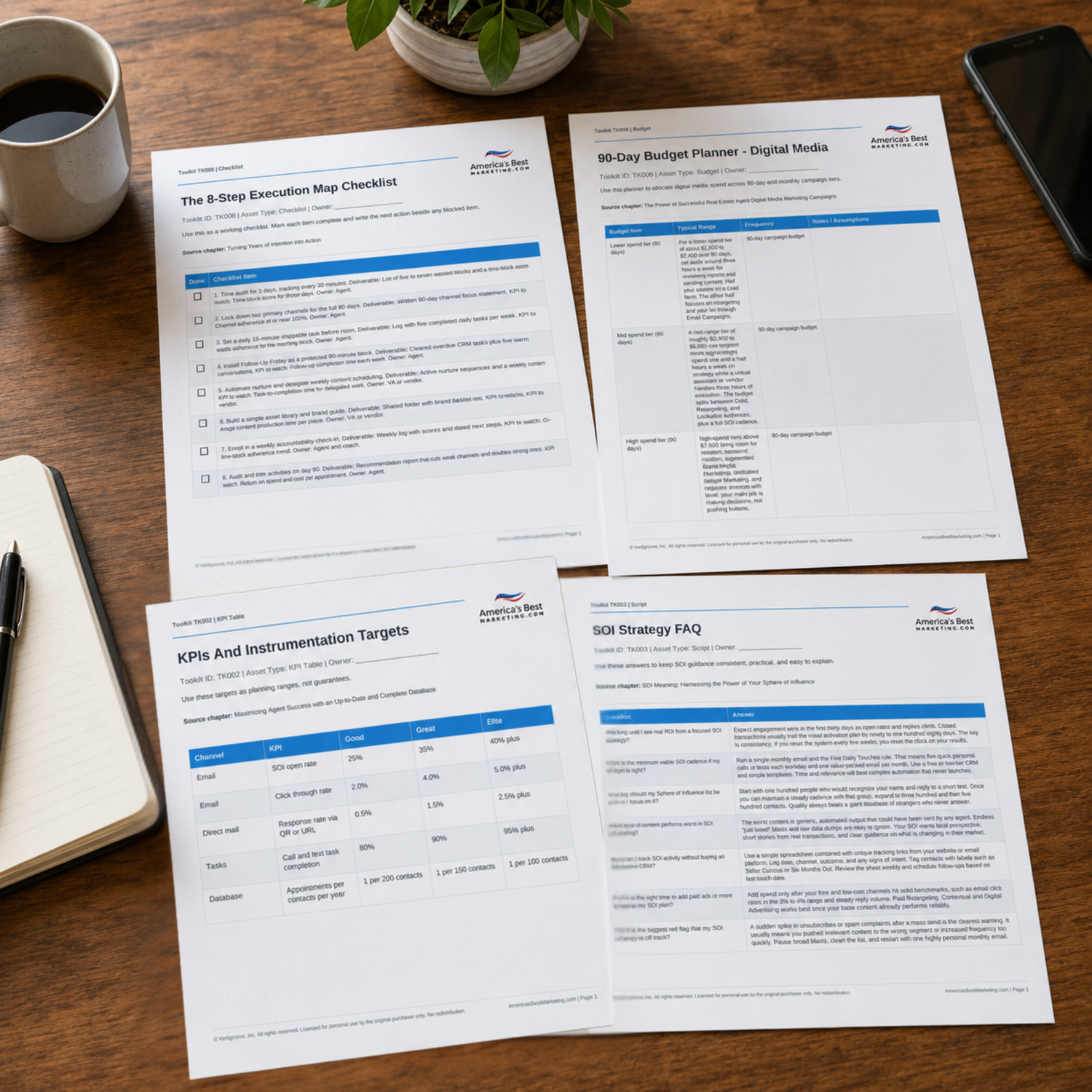
Download The Family-Friendly Content Toolkit
Use the companion Toolkit to organize the activity-guide concept, landing page, lead-capture path, follow-up cadence, seasonal refresh plan, and KPI checks that turn local family research into measurable real estate conversations.
Download the Toolkit ZIPRecommended reads
Recommended Reads for Real Estate Agents
These articles help agents connect follow-up discipline, database habits, client communication, and marketing execution into a repeatable system.

Testimonial Content That Books Appointments (Real Estate Agent Templates)
Publish content that answers local questions, supports lead capture, and gives future conversations a reason to start.
Read article
Best Real Estate Content Marketing Ideas
Turn local knowledge into searchable content buyers, sellers, and relocation prospects can actually use.
Read article
Real Estate Blogging Made Simple: How Agents Can Attract Leads and Boost Their Online Presence
Make real estate blogging easier to plan, publish, and measure as part of a weekly marketing rhythm.
Read article
Agent Spotlight Templates Real Estate Agents Can Publish Fast
Build authority with content topics that are easier to plan, promote, and connect to follow-up.
Read articleFamily-Friendly Content Questions Agents Should Be Ready To Answer
How do I talk about schools without violating Fair Housing rules?
Stick to objective information and official sources. Share district boundaries, enrollment steps, programs, and calendars. Avoid opinions, rankings, and language about who the area is for. Use a standard disclaimer that you are not an educational advisor and readers should verify details directly with the school district.
What is the best way to capture a lead from a free local guide?
Gate the printable PDF behind a short form, then deliver the download on a thank-you page and by email. Add a tracked link on every social post so you know what drove the submission. Keep the form simple, then use a short email sequence to offer a relocation call and a relevant neighborhood search link.
How long does it take to see measurable ROI from lifestyle content?
Expect early signals within a few weeks if you publish consistently and tag every link. Watch downloads, return visits, and replies to the follow-up email. The deeper payoff arrives when guide readers later become listing viewers and request showings. Keep the guide current with a seasonal refresh so it stays shareable.
How big should my target audience be for community ads?
Start tight. Build one audience for guide visitors and one for listing visitors, then cap frequency to avoid fatigue. If the audience is too small, expand by adding adjacent zip codes or interest layers tied to the guide topic such as youth sports or local events. Track cost per download, not clicks.
Do I need a separate landing page for every guide section?
No. Build one flagship guide landing page and let weekly posts act as feeders into that page. If a section becomes a clear top performer, you can spin it into its own page later. The critical requirement is one conversion page with a form, a PDF preview, and a follow-up sequence that triggers fast.
How do I keep a seasonal guide from becoming stale?
Pick a refresh rhythm and stick to it. Set a quarterly link audit, then a seasonal update for dates and registration windows. Display an update note on the page and in the PDF so readers trust it. If you cannot refresh it, remove that section and keep the guide smaller but accurate.
Should I link lifestyle content to listings or keep it separate?
Connect them with a clean bridge. Keep the guide focused on resources, then include one internal link to a relevant neighborhood search or listing collection on your site. That bridge should be objective, such as homes near a park corridor or homes with yard size filters. It turns curiosity into browsing without forcing a pitch.
Next step
Build the System Behind the Guide
Continue from one useful article into the larger ABM ecosystem: the book series for strategic depth and the full marketing program for done-for-you execution.

View the Book Series
Explore the America’s Best Real Estate Agent Marketing System books for a deeper strategic framework around visibility, referrals, listings, lead generation, and growth.
View the Book Series
See Full Marketing Program
See how AmericasBestMarketing.com runs real estate blog writing, social media, listing marketing, email, direct mail, and retargeting as one managed system.
See Full Marketing Program