Community Events Calendar Content: How Real Estate Agents Publish It to Generate Leads
Community Events Calendar Content
How real estate agents publish it to generate leads
A local-content operating system for agents who want weekly event guides, relocation intent, email list growth, and neighborhood demand signals working from one durable website hub.

A consistent calendar makes you useful before a buyer or seller ever needs an agent.
How a community events calendar becomes a lead engine
Community events calendar content turns local helpfulness into measurable demand. A real estate agent publishes one reliable calendar hub, updates it on a fixed weekly cadence, distributes the guide through social media and email, then uses signups, repeat visits, neighborhood clicks, and retargeting audiences to identify buyers, sellers, and relocation prospects before they are ready for a transaction conversation.
- A calendar works best as a permanent website hub, not a disposable social post.
- The highest-value reader is often a relocation prospect quietly studying neighborhoods, venues, schools, commutes, and weekend routines.
- The conversion path should feel like another local service: Weekend Guide signup, relocation resource, or neighborhood mapping call.
- Weekly cadence matters more than production complexity because consistency is what trains readers, search engines, and AI systems.
- Neighborhood click patterns can guide your next content page, email topic, retargeting audience, and listing-conversation angle.
Why This Pays Off
Publishing a community events calendar is a local authority play that compounds. You provide useful information before the relationship has any sales pressure, you earn repeat visits, and you capture relocation intent before people have picked an agent. The business outcome is simple: become the reliable local source for what to do, where to go, and which neighborhoods feel active.
Treat the calendar as top-of-funnel infrastructure. It should live on your website, update on a fixed weekly cadence, route readers into one clean signup path, and connect to your email, social media, search, and retargeting system. Pair the calendar hub with the page basics in Proven SEO Strategies for Real Estate Websites to Increase Leads so the asset can build search equity instead of vanishing into a social feed.
Useful event coverage helps residents and relocation prospects make weekend decisions. That makes your brand helpful without forcing a listing or buyer consultation too early.
Neighborhood names, venue names, event types, and recurring dates give search engines and AI systems specific local context to extract, associate, and return.
A Weekend Guide signup and relocation download turn anonymous traffic into a list you can nurture with practical neighborhood follow-up.
The Hyper-Local Advantage
Neighborhood utility is the core advantage. Your content saves time for someone who lives in your market or plans to move there. A calendar does that better than most market updates because it answers an immediate question: what should we do this weekend?
Top-of-mind awareness follows when the same person sees your name in the same context over and over: local, helpful, and consistent. A weekly guide plus a monthly roundup beats a random burst of posts every time because the reader learns when to expect value.
The relocation magnet forms when the calendar, a map, and a short lifestyle explanation help families, remote workers, retirees, and out-of-area buyers understand daily routines before they understand listings. People study routines before they schedule showings.
Most agents treat calendars as information posts. The higher-leverage move is to treat them as intent sensors. Track which neighborhoods and event types earn clicks from out-of-area visitors, then use that signal to prioritize follow-up content and ad audiences. A repeat click pattern is a quiet way of saying: this is where we plan to land.
The Five Mistakes That Keep Event Content From Producing Leads
- Inconsistency: You publish one monthly guide, then disappear until it feels urgent again.
- Over-promotion: You bury event content under sales pitches, so people stop clicking.
- Weak distribution: You build the asset but never push it through Email Marketing for Real Estate Agents and a weekly posting routine.
- Local keyword neglect: Your titles ignore neighborhood names, venue names, and recurring event phrases, so search engines have nothing clear to rank.
- No capture path: You get traffic but no list growth because the calendar has no obvious next step.
Set the expectation that your calendar is a service. That framing keeps the tone helpful and keeps your time investment under control. Your goal is to become the market’s default answer to a simple question: what is happening near me?
The 12-Week Hyper-Local Engine
This system has one job: publish useful event content on schedule, then convert attention into list growth. The fastest path is a calendar hub that lives in your site navigation and gets updated weekly, not a single post that expires.
Curation and setup
Build the hub and make the workflow repeatable.
Source stackChoose five recurring sources: city parks and recreation, chamber of commerce, venue calendars, school district pages, and one reliable local events publication.
Page fieldsStandardize event name, date, time, address, cost, age range, parking note, and one line on why it matters.
Capture pathAdd one signup block near the top: Get the Weekend Guide by email.
VerificationConfirm every event date, ticket requirement, location, and official source link before publishing.
Add a main navigation link titled Community Events, then create one landing page plus child pages for each neighborhood or zip code you want to own.
Distribution systems
Publish once, distribute everywhere, and measure what earns attention.
Thursday guidePublish the Weekend Guide every Thursday morning with five to eight events sorted by neighborhood.
Social rhythmTurn one guide into four social touches: Thursday main post, Friday reminder, Saturday morning repost, and Sunday recap.
Website routeRoute social clicks back to the hub through Social Media Management for Real Estate Agents so your website earns the search value.
Signal reviewTrack clicks by neighborhood page and event type so your next content decision is data-informed.
The Thursday pattern is the operating rhythm because it lands before weekend planning starts.
Lead capture and nurture
Convert calendar visitors without acting like a salesperson.
Relocation assetCreate a resource covering neighborhood routines, schools, commutes, weekend events, and a simple market snapshot.
Local detailAdd a short market snapshot to each neighborhood page with price range, inventory pace, and one practical local note.
RetargetingUse Retargeting & Contextual Ads for visitors who view two or more neighborhood pages, with frequency caps that keep the brand helpful.
NurtureSend two emails: deliver the resource, then share a neighborhood comparison checklist and ask one timing question.
Your best conversion path is a lifestyle-first download that helps someone compare neighborhoods.
If you have ever bought leads and wondered why the math did not work, read Top Mistakes Agents Make When Buying Real Estate Leads and the Multi-Channel Strategy That Actually Works. Your calendar becomes the organic layer that makes every other channel cheaper and easier to convert.
Budget, Time, And Campaign Setup
Monthly spend of $250 to $450 can support one weekly guide, one monthly roundup, and a light retargeting campaign for calendar visitors. Cap impressions at two to four per person per week. Plan 60 minutes on Monday for sourcing, 30 minutes on Thursday for publishing, and 15 minutes on Sunday for a recap.
Monthly spend of $650 to $1,200 can support the weekly guide, neighborhood subpages, a gated relocation resource, and two audiences: calendar visitors and guide downloaders. Cap frequency at three to five impressions per week. Use one monthly block to refresh the roundup and identify new neighborhood angles.
The spend is not the point. The system is the point. A modest budget attached to one reliable local asset usually outperforms a larger budget attached to disconnected posts, ads, and emails that do not reinforce one another.
Creative And Messaging Guide
The calendar wins when it feels like a service, not content. Package local information the way a busy person wants to consume it: short, sorted, and reliable. Write headlines that promise curation. You are not trying to sound clever. You are removing decision fatigue.
The City Weekend Five: top events for families.
Three events worth driving for this weekend.
Free and low-cost events: a simple weekend itinerary.
Why this neighborhood shows up on weekends: events that explain the vibe.
New in town weekend guide: where locals actually go.
Rain plan weekend guide: indoor events that still feel fun.
Use a soft call to action for the Weekend Guide list, a mid-level call to action for the relocation download, and a direct call to action for a neighborhood mapping call. Keep listings in their own lane. When the calendar becomes a listing pitch, trust drops.
Two Campaign Briefs Agents Can Run
Use a calendar screenshot and three event tiles to invite local families and couples into the Thursday guide. Headline idea: This weekend, solved. The call to action should invite readers to join the Weekend Guide list.
Use a neighborhood map with three highlighted areas and one event photo per area. Headline idea: Pick your neighborhood like a local. The call to action should invite out-of-area readers to download the relocation resource.
Content ROI And Cadence
This operating cadence keeps the calendar from drifting into random posting. Keep it visible in your workflow and review it monthly.
| Content type | Frequency | Distribution channel | Primary KPI |
|---|---|---|---|
| Weekly Weekend Guide | Every Thursday | Social plus email | Click-through rate |
| Monthly community download | First of month | Email newsletter | Lead conversion rate |
| Quarterly neighborhood deep dive | Every 90 days | Local search page | Organic search volume |
| Metric | Window | Target range | Why it matters |
|---|---|---|---|
| Click-through rate | 7 days | 1.5% to 3% | Confirms the guide headline and neighborhood sorting match how locals browse. |
| Opt-ins | 30 days | 10 to 35 | Shows the calendar converts attention into list growth, not only visits. |
| Return rate | 30 days | 12% to 22% | Signals top-of-mind awareness and a rising likelihood of future inquiry. |
| Out-of-area neighborhood clicks | 30 days | Tracked by page | Identifies relocation interest before the prospect asks for a showing. |
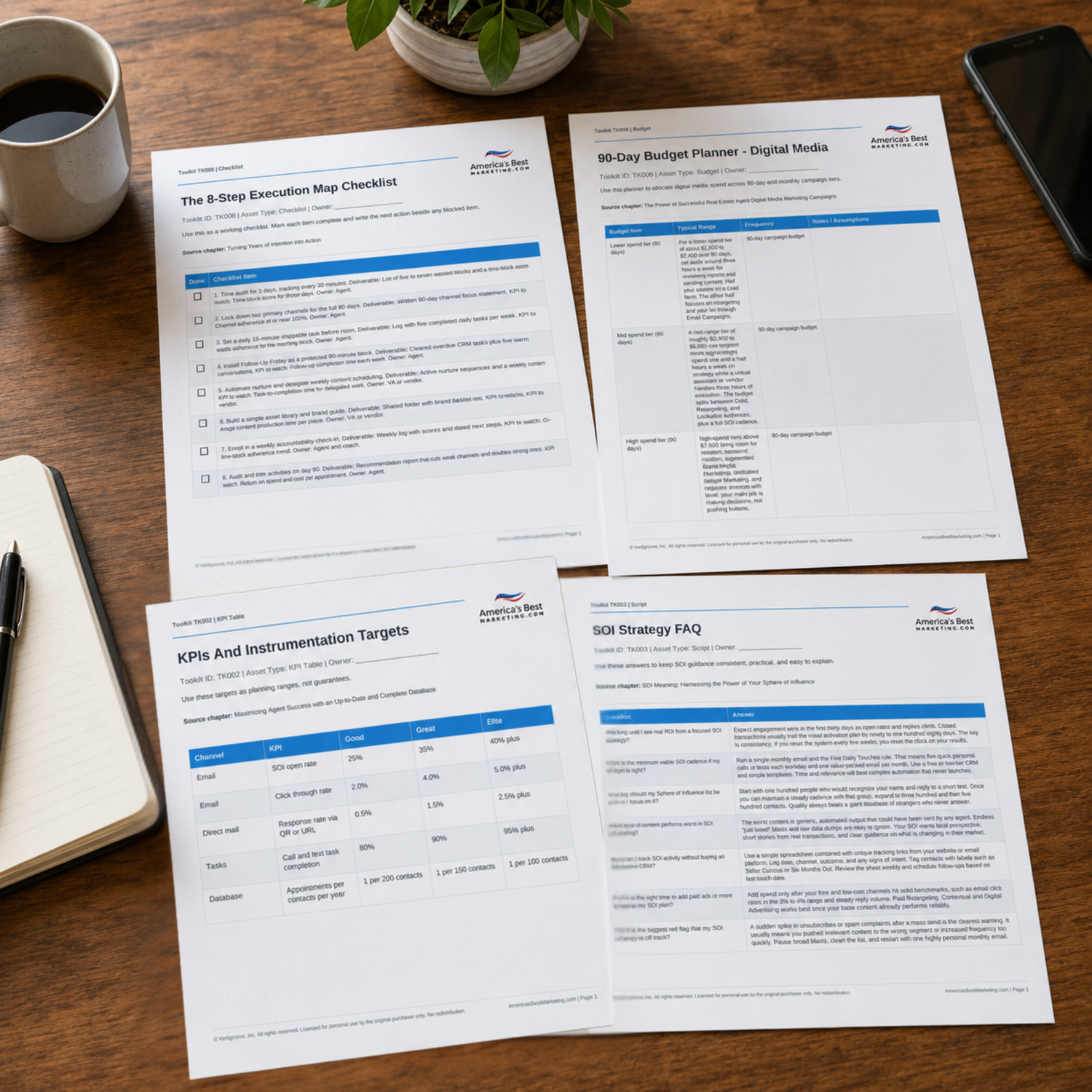
Download The Community Events Calendar Toolkit
Use the companion Toolkit to organize event sources, weekly publishing, campaign budget, performance tracking, and the community authority audit so the calendar can run consistently.
Download the Toolkit ZIPThe 10-Point Community Authority Audit
- Your calendar hub sits in the main site navigation and loads fast on mobile.
- Every event listing has a verified date, time, address, and official source link.
- You publish the weekly guide on the same day and time every week.
- Your guide sorts events by neighborhood, not by whatever you found first.
- You use one soft signup path that appears near the top of the page.
- Your monthly roundup includes neighborhood names, venue names, and event types in headings.
- Your pages include one relevant next step, not a pile of unrelated offers.
- Your calendar traffic is tracked by neighborhood page, not only site-wide.
- Your retargeting uses frequency caps and excludes current clients and past leads.
- Your hub and signup forms render cleanly on your IDX Real Estate Websites with no layout breakage.
Mini Case Pattern: Hidden City Event Series
A boutique team built a weekly Hidden City event series across five neighborhoods. They published every Thursday, sent the guide through social and email, and tracked clicks by neighborhood page. They noticed out-of-area visitors repeatedly clicking the same two neighborhoods, so they produced a relocation download focused on routines and weekend life in those areas.
The team then ran retargeting to visitors who viewed two or more neighborhood pages and capped frequency to avoid overexposure. The result was a small but clean relocation lead pipeline with better conversation quality because the prospects had already shown neighborhood preference before the first call.
Build The Calendar Hub That Compounds
Community events calendar content works because it earns trust before a transaction is on the table. The long-term win is local search visibility: each neighborhood page becomes a stable URL that can rank for event and lifestyle queries year-round.
Do these two actions first. Identify five recurring local event sources and put them in one shared spreadsheet. Then update your site navigation so the calendar hub is one click away from the homepage on your IDX site. When you want tighter measurement across channels, use the multi-channel structure in How Contextual and Retargeting Digital Marketing Work for Real Estate Agents and Why They Matter More Than Ever.
Want this built as a system instead of a side project? AmericasBestMarketing.com can set up your calendar hub, weekly distribution cadence, and measurement so local content becomes a practical lead engine.
Recommended reads
Recommended Reads for Real Estate Agents
These articles help agents connect follow-up discipline, database habits, client communication, and marketing execution into a repeatable system.

Client Follow-Up Systems That Create Lifetime Value
Turn scattered contacts into a workable pipeline with scripts, tags, reminders, and response routines.
Read article
The Pros and Cons of All-Cash Offers
Use the pros and cons of all-cash offers to create a stronger bridge between client education and real conversations.
Read article
The Role of User Experience (UX) in Real Estate SEO
Build organic reach with pages and posts that are easier to find, trust, and act on.
Read article
What Every Agent Needs to Know About Their Real Estate CRM
Turn scattered contacts into a workable pipeline with scripts, tags, reminders, and response routines.
Read articleCommunity Events Calendar Questions Agents Ask
How big should my target farm be for a local calendar?
Choose a farm you can cover with real depth. Five to ten neighborhoods or zip codes is enough for most agents because a calendar wins through repeat usefulness, not through shallow coverage. If you serve multiple areas, publish separate pages so each one stays tight, searchable, and useful for local buyers, sellers, and relocation prospects.
How much time does it take to run a weekly events calendar?
Plan for 60 to 90 minutes per week after your sources are set. Use Monday to source and verify events, Thursday to publish and distribute the guide, and Sunday to recap what earned attention. The workload stays manageable when the page format, caption pattern, and email rhythm stay consistent.
Do I need permission to list public events on my website?
Basic public event facts are often safe to summarize, but use your own wording, link to the official event page, and verify source terms when an organizer publishes usage rules. Do not copy long descriptions from another site. If a promoter asks for a removal or correction, handle it quickly and replace the item with a better verified event.
What should I publish when there are not many events in town?
Use recurring anchors such as farmers markets, live music nights, museum exhibits, park walks, school sports, volunteer days, and neighborhood business events. Add one useful local note on parking, timing, nearby food, or family logistics. The value comes from curation and accuracy, not from raw event volume.
How do I turn calendar traffic into leads without sounding salesy?
Offer one obvious next step that matches the visitor’s intent: join the Weekend Guide list, download a relocation resource, or request a short neighborhood mapping call. Keep the form short and the promise specific. A calendar converts best when the next step feels like another useful local service, not a hard sales pitch.
What metrics should I watch to know if the calendar is working?
Track weekly guide click-through rate, monthly opt-ins, return visits, neighborhood page views, and repeat clicks from out-of-area visitors. Those signals show which neighborhoods, venues, and event categories are creating demand. Use the data to choose your next neighborhood page, email topic, and retargeting audience.
Should I post the calendar on social, or keep everything on my website?
Use social media for distribution and your website as the source of truth. Post the short version on social, then route readers back to the calendar hub for the full list and signup. That gives you reach on social while building search equity, email list growth, and trackable neighborhood intent on your own site.
Next step
Build the System Behind the Calendar
Continue from one useful article into the larger ABM ecosystem: the book series for strategic depth and the full marketing program for done-for-you execution.

View the Book Series
Explore the America’s Best Real Estate Agent Marketing System books for a deeper strategic framework around visibility, referrals, listings, lead generation, and growth.
View the Book Series
See Full Marketing Program
See how AmericasBestMarketing.com runs real estate blog writing, social media, listing marketing, email, direct mail, and retargeting as one managed system.
See Full Marketing Program