Real Estate Agents Stay Top-of-Mind With A Simple 90-Day Plan
Stay Top-of-Mind With a 90-Day Plan
A Repeatable System for Real Estate Agents
A practical quarterly cadence that connects useful email, social media, direct mail, retargeting, and personal follow-up before a client needs to buy, sell, or refer.

The 90-day top-of-mind system
Real estate agents stay top-of-mind by giving their sphere a steady rhythm of useful market context, home care guidance, local insight, and personal follow-up. The operating model is simple: clean the database, choose three message pillars, plan twelve weekly themes, publish across several channels, and review the conversations created at the end of the quarter.
- Top-of-mind marketing starts with relationships that already carry some trust, not cold audiences that require credibility from zero.
- One quarterly theme map can coordinate email, social media, direct mail, retargeting, and personal outreach without rebuilding the campaign every month.
- Useful content protects attention. Market interpretation, home care prompts, and local context outperform a steady stream of self-promotion.
- The system should be judged by replies, conversations, introductions, appointments, and referrals rather than reach alone.
Why Top-of-Mind Systems Beat Cold Chasing
Cold lead chasing usually starts from zero trust. Top-of-mind marketing starts with people who already have a reason to know, like, or remember you. Your sphere does not need a hard pitch every week. It needs enough useful contact to remember that you are active, informed, and available when real estate becomes relevant.
A strong system turns the database into a working business asset instead of a storage closet. It gives past clients and advocates easy reasons to reply, forward a useful message, or introduce you. It also reduces the pressure to invent a new campaign every time business slows down. The broader strategy in Best Marketing for Real Estate Agents: Strategies That Actually Work becomes more valuable when it is translated into a cadence that can run every quarter.
- Consistency builds recall. Your name appears often enough that people remember you before a competing agent or portal captures the conversation.
- Relevance protects attention. Market snapshots, home care prompts, and local updates give people a reason to open, save, and share your messages.
- Multiple channels reduce risk. Email, social media, mail, retargeting, and personal outreach reinforce one another instead of depending on one platform.
Start With a Clean Relationship Database
Your sphere includes every person who knows your name in a positive context: past clients, family, friends, neighbors, local vendors, referral partners, open house contacts, and community relationships. The first operational move is not writing content. It is making sure those relationships live in one usable list.
At minimum, your strongest relationships should have a name, email, mobile number, mailing address, relationship tag, and a few notes that explain how you know them. When the list is clean, one monthly theme can move through Email Marketing for Real Estate Agents, social posts, postcards, and personal follow-up without starting from scratch. Topic planning becomes easier when you use resources such as Best Real Estate Content Marketing Ideas to turn relationship notes into market, home care, and local prompts.
Do not wait for the database to be perfect. Start with the best relationships first, then improve the record every time someone replies, moves, attends an event, or sends a referral. Each campaign becomes a data-cleanup cycle that makes the next campaign stronger.
Top-of-mind marketing is not merely a content calendar. It is a relationship operating system. Clean data, useful themes, and timely follow-up matter more than clever one-off posts.
The 90-Day Cadence Real Estate Agents Can Repeat
Use a quarter as the operating cycle. Ninety days is long enough to create consistency and short enough to review what worked. The sequence below gives your sphere repeated exposure across the channels people actually notice while keeping production manageable.
Audit the list and choose three pillars
Merge duplicates, confirm addresses, tag past clients and referral partners, and identify the fifty relationships that deserve extra personal attention.
Choose one local market pillar, one homeownership pillar, and one community or lifestyle pillar. For a more specialized audience, use Top Real Estate Niches to Target to sharpen the topic mix.
Plan twelve themes and publish monthly
Assign one theme per week so email, social media, mail, and follow-up point in the same direction. Send one concise monthly email with a market note, practical tip, local observation, and low-pressure invitation to reply.
Turn the same themes into weekly posts through a structured Social Media Management for Real Estate Agents plan.
Add mail, retargeting, and review
Mail one useful postcard, market note, seasonal checklist, or handwritten-style message to your best relationships through a focused Direct Mail for Real Estate Agents cadence.
Use Retargeting & Contextual Ads to reinforce presence between campaigns, then review replies, clicks, calls, appointments, and referrals at day ninety.
Keep the cadence stable and improve the topics. Rebuilding the system every month creates operational drag. Repeating the system while learning from response data creates compounding value.
A Simple 12-Week Theme Map
Decide the quarter before you start writing. Month one should rebuild awareness. Month two should deepen usefulness. Month three should invite warmer conversations. That creates a natural progression without making every message sound like a sales pitch.
Reintroduce your value
Use a local market snapshot, homeowner checklist, and community note. The purpose is to remind people that you are active, practical, and easy to contact.
Teach one decision
Explain a real choice homeowners face, such as whether to repair before selling, how to read neighborhood activity, or when to request a value update.
Invite the next step
Use stronger calls to action for people considering a move, wanting a home value range, or trying to understand timing in the current market.
Keep the weekly rhythm equally simple. Week one can deliver market insight. Week two can provide a homeownership tip. Week three can feature a local lifestyle or neighborhood prompt. Week four can ask a conversation-starting question about value, timing, or a future move. A fifth week can support a personal note batch, referral partner spotlight, or quick recap of the questions you heard most often.
This map also makes delegation easier. A writer, designer, assistant, or marketing partner can turn one monthly direction into coordinated email, social media, print, and ad reminders. When you are doing the work yourself, the map prevents the Thursday afternoon scramble to invent a topic.
Messaging That Keeps You Remembered
Top-of-mind creative does not have to be complicated. It needs to sound like you, help the reader, and repeat the same positioning across channels. The strongest topics answer a question your sphere already has or give people a reason to think about their home before a transaction becomes urgent.
Make the numbers useful
Share what inventory, pricing, buyer activity, or days on market mean for a homeowner in plain English.
Protect equity
Use seasonal maintenance, upgrade decisions, insurance reminders, or assessment notices to help people manage the asset they already own.
Stay connected
Feature neighborhoods, businesses, community changes, and lifestyle details that make the content feel rooted in the market you serve.
Build every piece around one clear next step. Soft calls to action invite a reply, save, or share. Mid-level calls to action invite a street-level value check or short conversation. Direct calls to action belong where the topic naturally connects to a real decision such as selling timeline, pricing strategy, or pre-listing preparation.
Create a response rule before the campaign starts. Replies about value, timing, or selling should move to a short consultation. Maintenance and local questions can receive a helpful answer and a softer check-in. Referral mentions should trigger a personal thank-you and same-day follow-up. The cadence creates opportunities, but disciplined follow-up turns those opportunities into appointments, introductions, and future listings.
Three Message Scripts for Your Sphere
Repeatable message structures reduce production friction and keep the campaign focused. Use the scripts below as a starting point, then adapt the local detail and call to action for the audience receiving the message.
Monthly email: market and home care update
Two-minute monthly email
Subject lineYour local market snapshot and one home tip for this month.
Opening lineLead with one number or trend your sphere can understand without industry jargon.
Value lineAdd one seasonal homeownership tip that protects comfort, value, or maintenance.
CTA lineReply with your street name if you want this narrowed to your area.
Use the same monthly format so people recognize the email and know where to find the market note, home tip, and invitation to reply.
Social post: a quick story that builds trust
Question-led social post
Hook lineA client asked me this question this week.
Explain lineExplain the decision in two or three plain-language lines.
Lesson lineShare the lesson your audience can reuse without revealing private client details.
CTA lineInvite a direct message from anyone facing the same question.
Use a clean graphic, photo, or short vertical video. Save the strongest questions for future email and direct mail themes.
Personal note or postcard: gratitude and offer
Relationship-first note
Opening lineStart with a real reason you thought of the person.
Local lineAdd one local or market note that may matter to the household.
Offer lineClose with a simple offer to help if a real estate question comes up.
Send small batches every week, log each touch in the CRM, and follow up personally when someone replies.
Budget, Time, and Channel Mix
The right budget depends on how much production you want to handle yourself. A lean plan can work when the cadence is protected. A more complete plan makes sense when a partner handles writing, design, scheduling, print, ads, and review while you stay focused on conversations.
Block one planning session at the start of the quarter, one approval block each month, and one short follow-up block each week. When those blocks are not realistic, move more production to a partner instead of allowing the cadence to fail.
Judge the system by relationship movement. Track replies, direct messages, valuation requests, conversations, appointments, referral introductions, and listing opportunities that mention your content.
| Tier | Channel Focus | Monthly Spend | Best Use Case |
|---|---|---|---|
| Lean cadence | Email, weekly social media, personal notes | $450 to $800 | Solo agents who need consistency before adding heavier production. |
| Multi-channel cadence | Email, social media, direct mail, light ads | $900 to $1,800 | Agents who want stronger recall across digital and physical touchpoints. |
| Growth cadence | Content, mail, retargeting, coaching | $1,800 plus | Agents ready to connect the cadence to deeper strategy, reporting, and one-to-one marketing coaching. |
Review the numbers as a pattern rather than isolated wins or losses. One email with modest clicks may still be valuable if it triggers direct replies from past clients. One social post with limited reach may matter if the right referral partner comments. The monthly question is simple: did this touchpoint create more useful conversations with people who already have a reason to trust you?
Ethics That Keep the System Healthy
Sphere marketing touches real relationships, so the operating standard matters. Follow email unsubscribe rules, avoid misleading subject lines, use secure systems for contact data, and do not target messages in ways that exclude or prefer people based on protected classes. Keep the tone service-first. Your marketing should make people feel informed, not cornered.
- Review list quality every quarter and remove bad addresses or hard bounces.
- Document which topics create real conversations instead of measuring reach alone.
- Adjust frequency when contacts show fatigue or stop engaging.
- Keep calls to action clear, useful, and respectful.
- Use automation for the base rhythm and personal outreach for the relationships that matter most.
A Mid-Tier Cadence in Action
Picture an agent named Dana with a decent social media presence and an inconsistent referral pipeline. She moves past clients, advocates, and referral partners into one clean list. Each month she sends one market-and-home email, mails one helpful postcard to her strongest relationships, posts weekly content from the same theme, and runs light reminder ads to warm website visitors.
After the first cycle, Dana does not judge the plan by one viral post. She looks at replies, forwarded emails, direct messages, conversations, and valuation requests. Practical homeownership topics create more replies than generic market commentary, so the next quarter keeps the same cadence and improves the topics instead of starting over.
Show Up Before the Need Becomes Urgent
Real estate agents stay top-of-mind by becoming steadily useful to the people who already trust them. Clean the list, choose the themes, send the email, publish the story, mail the useful piece, add light retargeting, and review what created conversations.
Your next move is to choose the first 90-day cycle and decide which parts you will handle personally and which parts need support. A connected system can combine IDX Real Estate Websites, monthly email, social media, direct mail, digital retargeting, and personal follow-up into one clear marketing rhythm.
The goal is not more noise. The goal is to make your name the natural answer when someone in your sphere needs to buy, sell, refer, or ask a real estate question.
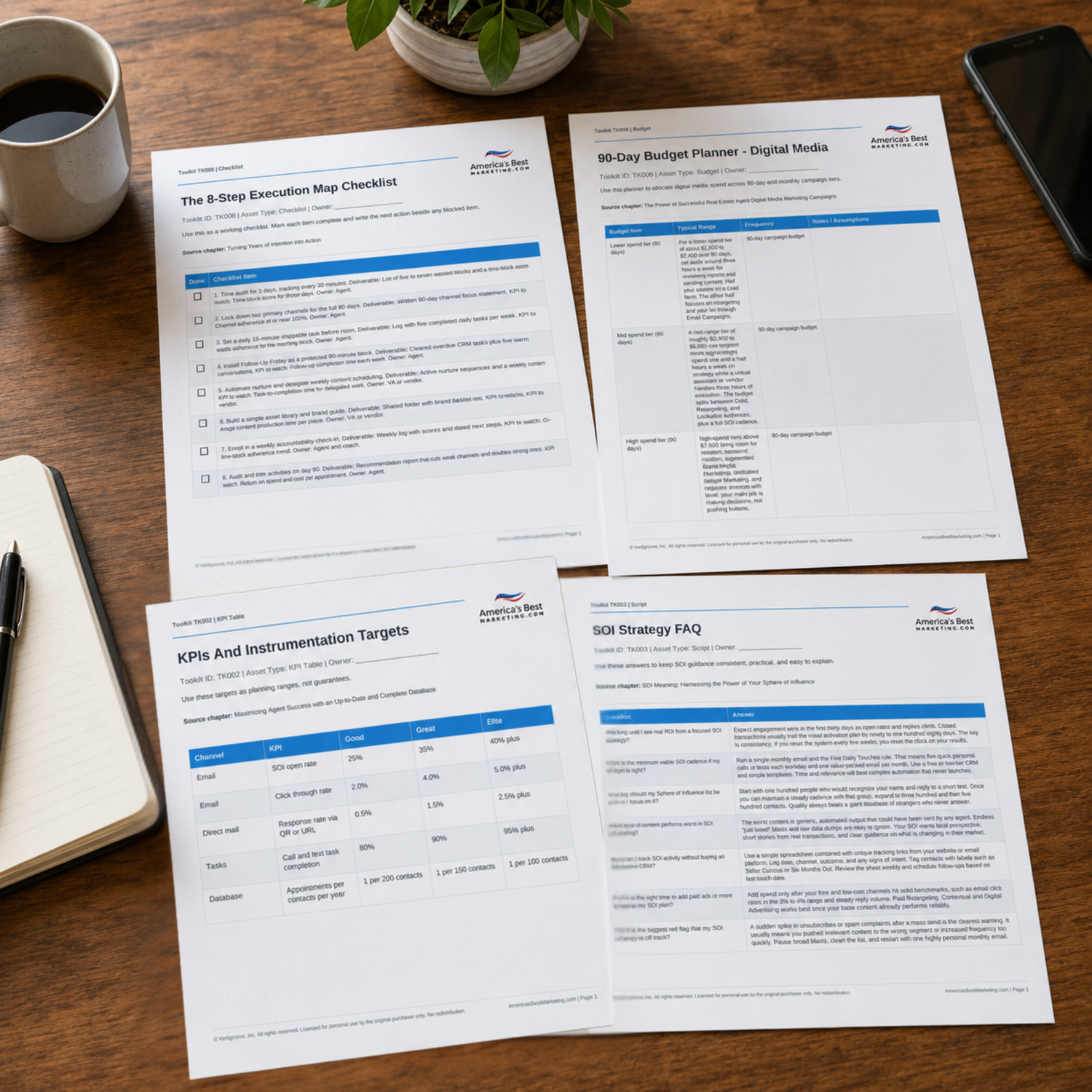
Download the 90-Day Top-of-Mind Toolkit
Use the companion Toolkit to organize the quarterly cadence, monthly spend tiers, email script, social story script, personal note script, campaign FAQ, assignments, and follow-up checkpoints.
Download the Toolkit ZIPRecommended reads
Recommended Reads for Real Estate Agents
These articles help agents connect follow-up discipline, database habits, client communication, and marketing execution into a repeatable system.

The 90-Day Real Estate Marketing Plan: Pillars, Budgets, & KPIs for Real Estate Agents
Make the 90-day real estate marketing plan more useful by tying the message, audience, and next step together.
Read article
Property Taxes Explained: Real Estate Agent Cheat Sheet + Client Email Templates
Make property taxes explained more useful by tying the message, audience, and next step together.
Read article
Live Streaming Q&As for Real Estate Agents: Topics, Scripts, and Promotion Plan
Create video content with clearer scripts, simpler formats, and a cadence agents can actually maintain.
Read article
The 90-Day Multi-Channel Plan for New Agents
Make the 90-day multi-channel plan for new agents easier to plan, publish, and measure as part of a weekly marketing rhythm.
Read articleTop-of-Mind Marketing Questions Real Estate Agents Ask
How long does it take to see measurable return from a top-of-mind campaign?
Most agents should judge the first ninety days by engagement signals such as replies, clicks, conversations, and appointment requests from people who already know them. Referral and repeat business usually needs more than one campaign cycle because trust compounds over time. The important move is to measure the first cycle, improve the next one, and keep showing up with value.
What is the minimum viable cadence if my budget is tight?
Start with one useful email each month, one social post each week, and a small batch of personal notes or texts to your strongest relationships. That gives your sphere a steady rhythm without forcing you into a large production plan. Once the habit is stable, add direct mail and light retargeting.
What content performs worst in top-of-mind marketing?
The weakest content talks only about the agent, recent wins, or generic market noise without helping the reader make a better decision. A better approach is to send short market context, home care prompts, local insight, and answers to questions your clients already ask.
How big should my sphere be before I start?
You can start with a small list if the relationships are real. Fifty high-quality contacts who know and trust you are more valuable than hundreds of names with weak data. Build the system now, then keep adding past clients, advocates, referral partners, neighbors, and local relationships as your business grows.
Should the cadence be automated or personal?
Use automation for the base rhythm: scheduled emails, planned posts, repeatable mailers, and light reminder ads. Keep personal touches for the relationships that matter most. A short text, handwritten note, or quick voice message often creates the conversation automation was designed to make possible.
What is the biggest red flag in a top-of-mind plan?
The clearest red flag is only showing up when you want a listing, referral, or appointment. That trains people to treat your marketing as pressure. Keep the majority of your touches useful, local, and relationship-centered so direct calls to action feel earned instead of abrupt.
Next step
Build the System Behind the Advice
Continue from one useful article into the larger ABM ecosystem: the book series for strategic depth and the full marketing program for done-for-you execution.

View the Book Series
Explore the America’s Best Real Estate Agent Marketing System books for a deeper strategic framework around visibility, referrals, listings, lead generation, and growth.
View the Book Series
See Full Marketing Program
See how AmericasBestMarketing.com runs real estate blog writing, social media, listing marketing, email, direct mail, and retargeting as one managed system.
See Full Marketing Program