The Ultimate Guide to Local SEO for Real Estate Agents
Local SEO for Real Estate Agents
Google Maps, Reviews, and Neighborhood Visibility
A repeatable local search system for real estate agents who want stronger Map Pack visibility, cleaner trust signals, and more conversations in the markets they actually serve.

How local SEO turns local searches into client conversations
Local SEO helps Google connect a real estate agent with buyers and sellers searching in a specific city, town, or neighborhood. The working system combines an accurate Google Business Profile, useful local website pages, consistent citations, current photos, credible reviews, and regular measurement so each search result gives people a clear reason to call, click, or request guidance.
- A focused service area usually creates stronger local relevance than a vague claim to serve an entire region.
- Google Business Profile activity works best when the website, citations, reviews, photos, and services tell the same story.
- Neighborhood pages should answer real buyer and seller questions and lead to a useful next step.
- Local SEO compounds through weekly proof, monthly measurement, and quarterly cleanup rather than one-time setup.
Why Local SEO Matters For Real Estate Agents
Local SEO is the work that helps Google understand who you are, where you serve, what services you provide, and whether local searchers can trust you. For a real estate agent, your Google Business Profile, website, reviews, citations, photos, neighborhood content, and internal links need to tell the same story.
The prize is the local search moment where a buyer or seller types a phrase such as listing agent near me, homes for sale near Oak Ridge, or best agent in a specific town. Google does not simply look for a page with the right keyword. It looks for a local entity with enough consistency and usefulness to deserve the click, call, direction request, or website visit.
If you already reviewed SEO for Real Estate: How Real Estate Agents Can Dominate Local Search and Generate More Leads, this briefing turns the local layer into a practical operating plan. The goal is not vague visibility. The goal is more profile actions, stronger trust signals, cleaner citations, and more conversations from people searching in the markets where you actually work.
Stay focused on the markets you truly serve
Google weighs how closely your profile and service area relate to the searcher and the searched location. A focused footprint usually beats a broad claim that lacks supporting local proof.
Build visible evidence that the business is active
Reviews, citations, local mentions, photos, and profile activity help Google and consumers see that your business is real, current, and trusted.
Match services and pages to real search intent
Your categories, services, website pages, and local content need to match the exact jobs buyers and sellers are trying to get done.
Local authority is built through weekly proof
Most agents treat local SEO like a one-time profile setup. The stronger model is a recurring proof cycle. Add useful photos, answer questions, request reviews, update services, and publish neighborhood content until Google sees the same local authority from every direction.
The Four-Part Local SEO Workflow
A practical local SEO system has four moving parts. Configure the profile, build supporting content, strengthen authority signals, and measure the actions that matter. Each part should be simple enough to repeat every month without turning marketing into a full-time job.
Audit and configure the Google Business Profile
Confirm primary owner access, use an accurate primary category such as real estate agency, and set the service area to places where you actually want more clients. Make the phone number, website URL, hours, and business name match the information shown on your website.
Google needs confidence before it shows a business in competitive local results. Clean profile data reduces confusion, while a focused service area makes your presence more credible to someone searching from a specific town or neighborhood.
Build local proof inside the profile
Add a clear business description, accurate services, and honest photos of you, your team, listings, recognizable local scenes, and your office when appropriate. Use profile posts to highlight one local market, listing, or client question at a time.
A profile with current photos, service details, and recent updates feels safer than a stale listing. It should answer a stranger’s first question before the click: does this agent really work here and understand this market?
Create neighborhood pages that support the profile
Choose three to ten priority neighborhoods or nearby towns. Build one useful guide for each area with housing styles, commute patterns, amenities, inventory context, and practical search behavior.
Embed active property search where appropriate through your IDX Real Estate Websites provider, then link each guide to a contact, valuation, or buyer consultation page.
Strengthen citations, reviews, and local mentions
Update major directories, portals, map listings, social profiles, and local association pages. Keep the business name, phone number, address status, website URL, and branding consistent.
Request Google reviews after strong client outcomes and reply with a specific, human response. Citations and reviews are external trust signals that tell Google the same business exists across the web and tell consumers that other people have already trusted you.
What To Put On A Real Estate Website
Your website gives local SEO its depth. A profile can earn the first impression, but the site needs to prove expertise, explain services, and move searchers toward a conversation. A strong local real estate website should include service pages, neighborhood guides, internal links, client proof, and conversion paths that match the way buyers and sellers make decisions.
For the broader on-site foundation, use SEO Strategies for Real Estate Websites to Increase Leads as the companion article. The local layer should sit on top of that foundation with pages that make market knowledge easy to crawl, scan, and trust.
- Build a page for each priority neighborhood instead of relying on one generic service area page.
- Use plain-language headings that match buyer and seller questions.
- Describe amenities, commute patterns, housing types, listing conditions, and search behavior.
- Avoid language that suggests who should or should not live in an area.
- Link Google Business Profile services to the closest matching website page.
- Give every page a next step, such as scheduling a call, requesting a valuation, or browsing available homes.
Publish one local proof point at a time
- Share a market snapshot for sellers in one neighborhood.
- Explain three things buyers should know before touring a specific area.
- Pair a new listing with one local commute, amenity, or housing detail.
- Answer a question from a first-time buyer consultation.
- Add a photo update from a local park, business district, or open house.
Make the reason and next step clear
I am grateful we were able to get you across the finish line. A short Google review helps local buyers and sellers feel confident choosing an agent they have not met yet. I will send the direct link so it is easy to share a sentence or two about your experience.
Ask soon after a strong outcome, send the direct review link, and reply after the review is posted. The process should feel personal, specific, and easy to complete.
Local SEO Hygiene Schedule
The agents who win local search treat visibility as a rhythm, not a project. This schedule keeps the important work small enough to repeat and measurable enough to manage.
| Frequency | Task | Estimated Time |
|---|---|---|
| Weekly | Reply to every new review and profile question with a specific, professional response. | 15 minutes |
| Weekly | Publish one profile post that highlights a neighborhood, listing, client question, or local market note. | 20 minutes |
| Monthly | Add two fresh photos and review the service list for accuracy. | 20 minutes |
| Monthly | Review profile insights for calls, website clicks, direction requests, searches, and views. | 30 minutes |
| Quarterly | Audit primary citations for business name, address status, phone number, URL, and category consistency. | 45 minutes |
| Quarterly | Refresh two neighborhood guides with new examples, photos, market notes, and internal links. | 40 minutes |
Where Citations Matter Most
Citations are structured mentions of your business on trusted sites. The goal is not to appear on every directory. The goal is a clean set of important profiles where the name, address status, phone number, website URL, and service focus match.
- Google Business Profile with accurate category, URL, hours, photos, services, and review link.
- Apple Maps and Bing Places so local searchers outside Google see consistent information.
- Major real estate portals with matching profile photo, bio, phone number, and website link.
- Facebook business page and LinkedIn profile with current branding and service area language.
- Local chamber, community, brokerage, and association directories where consumers may verify you.
- Review platforms or neighborhood platforms that matter in your local market.
Keep a simple spreadsheet with each profile URL, login owner, last audit date, and the exact contact details shown. When one profile drifts, local trust weakens. When every profile points in the same direction, your entity becomes easier for Google and consumers to understand.
Compliance And Trust Signals
Local SEO should make your business easier to understand, not riskier. Keep brokerage, license, and contact information aligned with the rules that apply in your market. Do not add extra keywords to the business name simply to chase rankings. Do not write neighborhood copy that stereotypes who lives in an area or implies that a place is for one type of person.
Write about amenities, commute patterns, housing styles, parks, shopping areas, schools when appropriate, inventory patterns, and transaction realities. That content is more useful for buyers and sellers, and it builds the public trust that search visibility should support.
From A Broad Market Claim To Local Proof
Marcus worked across a large region, but most of his best clients came from one suburb and two nearby neighborhoods. His profile, website, and directory listings did not show that focus. They made him look like one more general agent trying to cover every market.
He tightened the service area, updated the profile description, added photos from the suburb, and built three neighborhood guides on his site. He also created a simple review request process for clients who bought or sold in those areas. Over the next quarter, profile activity improved because the signals were finally focused.
The lesson is operational: local SEO compounds when every asset points toward the same market position. The profile names the place, the website proves the expertise, citations confirm the entity, reviews reduce perceived risk, and follow-up turns visibility into a conversation.
Connect Local Search To The Rest Of The Marketing System
Local search should not operate as a silo. A strong neighborhood article can become an email, social post, direct mail topic, and retargeting message. A new Google review can reinforce listing presentations, profile posts, and follow-up conversations.
Use Email Marketing for Real Estate Agents to distribute useful local content to your database, and use Digital Retargeting to stay visible after someone visits a neighborhood page. The objective is one coordinated system where local discovery leads to repeated trust.
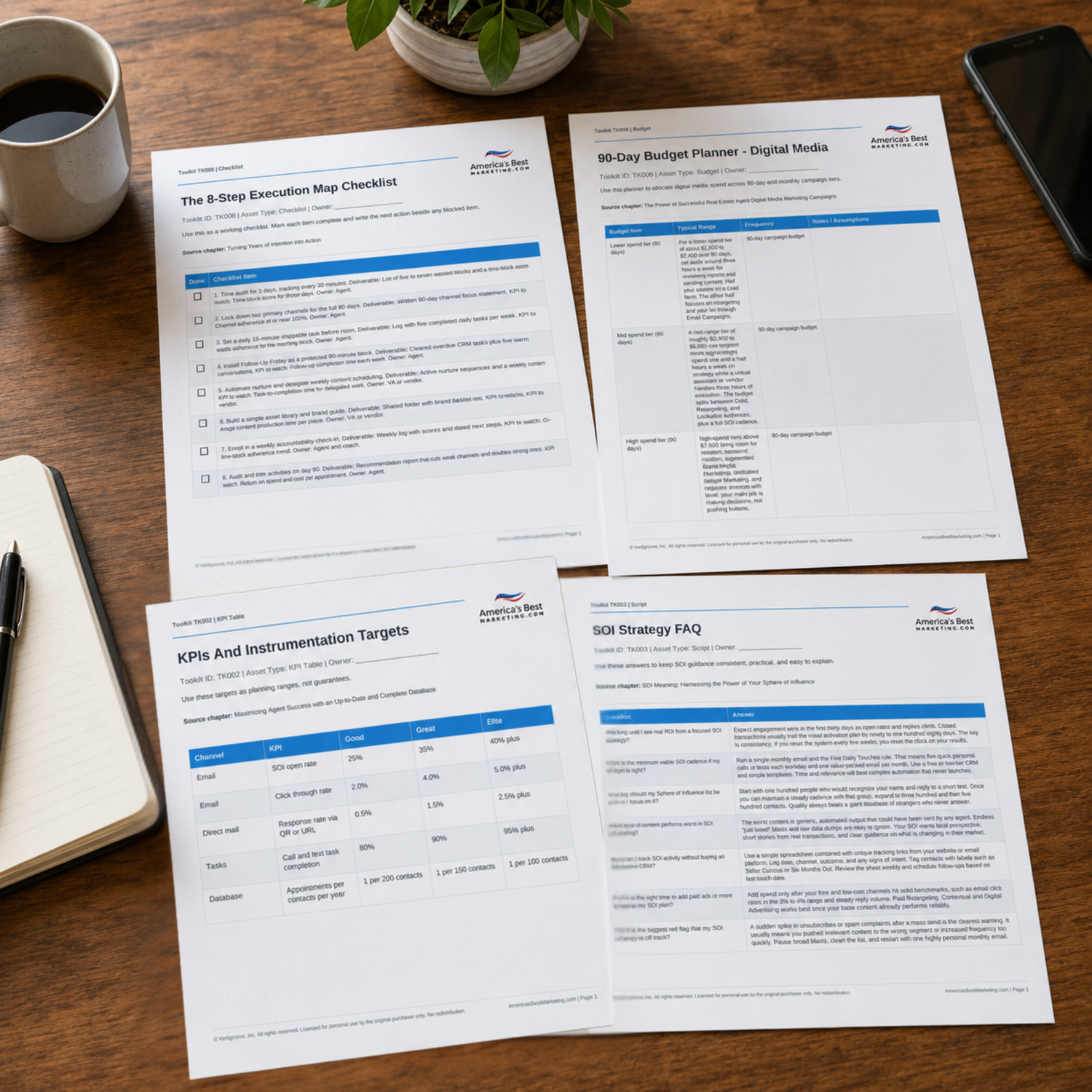
Download The Local SEO Toolkit
Use the companion Toolkit to organize the local SEO budget planner, hygiene schedule, citation and listing consistency checklist, and FAQ script that support the monthly workflow in this briefing.
Download the Toolkit ZIPRecommended reads
Recommended Reads for Real Estate Agents
These articles help agents turn client questions, local guidance, marketing channels, and follow-up into a more useful content system.

Local SEO for Real Estate Agents: How to Dominate Search in Your Neighborhood
Make local search work harder with content that answers real questions and leads to a next step.
Read article
Outdoor Lifestyle Neighborhood Guides: Searchable Relocation Content Real Estate Agents Can Publish
Turn search visibility into a clearer publishing system for neighborhoods, services, and client decisions.
Read article
SEO for Real Estate: How Agents Can Dominate Local Search and Generate More Leads
Build a cleaner system for SEO for real estate, with better timing, clearer messaging, and a next step people can act on.
Read article
Google Business Profile for Real Estate Agents: Advanced Optimization for Local Rankings
Use google business profile to strengthen visibility, follow-up, and client conversations without adding more random tasks.
Read articleLocal SEO Questions Real Estate Agents Should Be Ready To Answer
How long does local SEO take for a real estate agent to work?
Most agents should think in quarters, not days. Cleanup work can improve profile confidence quickly, but stronger Map Pack visibility usually depends on steady reviews, accurate citations, useful neighborhood content, and consistent profile activity over two to three months or more.
What should a real estate agent fix first on a Google Business Profile?
Start with ownership access, the right primary category, accurate contact details, service areas, hours, photos, and a clear business description. Then connect the profile to matching neighborhood pages on your website so Google sees the same local focus in more than one place.
Should real estate agents hide their home address on Google?
Many agents choose a service area profile when they do not meet clients at a public office. The right choice depends on brokerage rules, license requirements, safety, and how clients are served. Whatever you choose, keep the profile, website, and directories consistent.
Do Google Business Profile posts help real estate rankings?
Posts are useful freshness and engagement signals, but they should not be treated as the whole strategy. They work best when they reinforce the same neighborhoods, services, photos, reviews, and website pages that already support your local search footprint.
How should real estate agents ask clients for Google reviews?
Ask soon after a strong client outcome and make the request specific. Tell the client that a short Google review helps local buyers and sellers feel confident choosing an agent they have not met yet, then send the direct review link so the task is easy.
How many neighborhoods should a real estate agent target for local SEO?
A focused list of three to ten neighborhoods or nearby towns is usually stronger than a huge service area. Choose places where you actually work, where you want more clients, and where your website can support the profile with useful local pages.
Next step
Build the System Behind Local Visibility
Continue from one useful article into the larger America’s Best Marketing ecosystem: the book series for strategic depth and the full marketing program for done-for-you execution.

View the Book Series
Explore the America’s Best Real Estate Agent Marketing System books for a deeper strategic framework around visibility, referrals, listings, lead generation, and growth.
View the Book Series
See Full Marketing Program
See how AmericasBestMarketing.com runs real estate blog writing, social media, listing marketing, email, direct mail, and retargeting as one managed system.
See Full Marketing Program