Local SEO for Real Estate Agents: How to Dominate Search in Your Neighborhood
Local SEO for Real Estate Agents
How to Own Search in Your Neighborhood
A practical local search operating system for agents who want stronger Google Business Profile visibility, better city and neighborhood pages, cleaner reviews, and measurable buyer and seller conversations.

The Local SEO System That Wins Nearby Search
Build one connected local visibility system instead of chasing isolated SEO tricks. Keep your name, address, and phone data consistent, fully optimize your Google Business Profile, publish useful city and neighborhood pages, connect those pages to IDX searches and service paths, request reviews after strong client experiences, and review Search Console and profile activity every month.
- Local SEO works when relevance, proximity, and prominence reinforce one another across your website, Google Business Profile, reviews, and local links.
- One strong city hub supported by three priority neighborhood pages usually creates more authority than a long list of shallow market pages.
- Search intent should determine the destination page, whether the visitor needs a city overview, neighborhood comparison, valuation path, IDX search, or proof about the agent.
- The KPI that matters is not impressions alone. Track which local queries, pages, calls, forms, listing alerts, and consultations produce real buyer and seller opportunities.
What Local SEO for Real Estate Agents Really Means
Local SEO for Real Estate Agents is the process of making an agent visible and credible for searches tied to a specific city, neighborhood, property type, or local real estate decision. The searcher usually has a location in mind and a reason to act, which makes local intent more commercially valuable than broad informational traffic.
A buyer may search for homes near a downtown district. A seller may search for the best listing agent in a suburb. A relocating client may compare neighborhoods, commute patterns, schools, price bands, property types, and lifestyle tradeoffs. Those searches need local answers, not generic national advice.
Most agents leave this visibility on autopilot. Their profile is incomplete, their address information is inconsistent across the web, their city page is thin, their neighborhood content does not prove local expertise, and their reviews arrive randomly. Google then has to decide which business looks more relevant, more prominent, and easier to trust.
- Relevance: Your pages match the search with neighborhood guidance, pricing context, seller advice, buyer next steps, and local proof.
- Proximity: Your profile, service area, office information, and local content help search engines understand where you operate.
- Prominence: Reviews, local links, branded searches, and consistent engagement show that your business is recognized and trusted in the market.
Build one strong city hub first, then support it with a focused cluster of priority neighborhood pages. Depth beats a long list of weak pages because strong local pages are easier to maintain, internally link, update, and measure.
The Mistakes That Keep Agents Out of Local Search
Local search usually fails because the system is incomplete. The website says one thing, the Google Business Profile says another, reviews are sporadic, and the agent has no clear way to measure whether local visibility is turning into calls, form fills, listing alerts, or consultations.
Make NAP consistency nonnegotiable
Keep your name, address, and phone number consistent across your website, Google profile, social profiles, brokerage page, and major directories.
Keep the Google profile alive
Add photos, services, listing updates, market notes, questions, answers, and useful posts instead of treating the profile as a one-time setup task.
Go beyond schools and parks
Add price context, property types, commute considerations, inventory patterns, buyer tradeoffs, and seller considerations to neighborhood content.
Connect the local content cluster
Link city pages, neighborhood guides, IDX searches, educational articles, and service pages so each asset strengthens the others.
Protect the next action
Make it easy for a mobile visitor to call, view listings, request a valuation, save a search, or book a consultation without hunting for the next step.
Turn client wins into visible proof
Build a closing follow-up process so positive client experiences become consistent reviews rather than occasional testimonials.
The 90-Day Local SEO Plan
This sequence does not require every advanced SEO tool on day one. It requires clean data, focused pages, steady review requests, useful Google Business Profile activity, and monthly measurement.
- Audit your NAP data. Collect every major place your business appears online and make your name, address, phone number, and primary website link match exactly.
- Optimize your Google Business Profile. Confirm the right category, hours, service areas, appointment links, services, photos, and a plain-language description of your city and core neighborhoods.
- Strengthen your city page. Explain the local market, who you serve, how buyers and sellers should think about timing, and where each visitor should go next.
- Choose three priority neighborhoods. Focus on areas where you want more listing or buyer conversations instead of publishing fifteen weak pages.
- Publish one deep neighborhood guide. Include property types, price ranges, market observations, common tradeoffs, seller considerations, and links into relevant searches through your IDX Real Estate Websites stack.
- Build a review follow-up rhythm. Send a direct review request after successful closings and reinforce the process through Email Marketing.
- Connect related pages. Link city pages to neighborhood pages, neighborhood pages to filtered IDX searches, and educational articles back to the most relevant service or market page.
- Post to Google Business Profile twice per month. Use listing stories, sold updates, market notes, open house details, and neighborhood observations that link to the matching page.
- Earn local links cleanly. Use chambers, community organizations, sponsorships, business groups, and useful local resources instead of link buying or review trading.
- Review Search Console monthly. Filter queries by city, neighborhood, agent, listing, valuation, and property-type terms, then improve titles, copy, links, and calls to action.
Match Search Intent to the Right Page
Not every local search should land on the same page. A seller looking for a valuation needs a different experience than a buyer comparing neighborhoods or a past client searching your name. Strong Local SEO routes each searcher to the asset that matches the decision in front of them.
| Search intent | Best page type | Primary conversion path | What the page must prove |
|---|---|---|---|
| City-level agent search | Main city hub page | Strategy call, valuation, or listing search | You serve the market, understand the local real estate picture, and have a clear process for buyers and sellers. |
| Neighborhood comparison | Neighborhood guide | Saved search, showing request, or consultation | You understand property types, pricing tradeoffs, commute patterns, lifestyle context, and common buyer questions. |
| Seller valuation | Seller landing page or valuation page | Home-value request or listing appointment | You can explain demand, preparation, pricing strategy, marketing exposure, and what happens after the first conversation. |
| Buyer inventory search | IDX filtered search page | Listing alert, showing request, or buyer consultation | The search is easy to use, current, locally relevant, and connected to helpful guidance. |
| Branded search | About, reviews, and service pages | Call, email, or appointment | The visitor sees credibility, specialization, reviews, useful links, and a low-friction next step. |
Write for Local Intent Without Keyword Stuffing
Local SEO is not about repeating your city name until the page sounds artificial. Place local terms in the positions that matter, then write useful copy that proves you understand the market and the decision the searcher is trying to make.
- Title tag: Use the city, service intent, and agent or brand name.
- Visible page heading: Make the promise clear, whether the page covers homes for sale, seller guidance, relocation context, or neighborhood advice.
- Meta description: Explain the local outcome, not just the topic.
- Internal links: Use descriptive anchors that connect the city hub, neighborhood pages, IDX pages, and deeper education such as The Ultimate Guide to Local SEO for Real Estate Agents.
- Google Business Profile posts: Name the neighborhood and link to the most relevant page instead of sending every click to the home page.
The city hub opening
Message architecture
OpeningName the city, the audience you serve, and the real estate decision the page helps solve.
ProofAdd market context, buyer and seller pathways, neighborhood links, filtered IDX searches, and local proof points.
Next stepClose with one direct action, such as viewing listings, requesting a valuation, or booking a consultation.
Use the city name naturally in the title, heading, intro, image context, internal links, and FAQ, then update the page quarterly so the market signals stay current.
The neighborhood guide structure
Message architecture
ContextExplain property types, price bands, market speed, lifestyle tradeoffs, commute considerations, and what buyers or sellers should know.
ConnectionsLink back to the city hub, sideways to related neighborhoods, and forward to listings, valuation requests, or a consultation.
Quality gateKeep the page useful enough to deserve a search visit instead of publishing a thin geographic placeholder.
The strongest neighborhood page answers a decision question and gives the visitor a clear path into the next stage of the real estate process.
The Google Business Profile update
Message architecture
Local hookStart with the neighborhood and why the update matters now.
Useful detailAdd one market fact, listing note, open house detail, seller observation, or buyer consideration.
ActionLink to the page that matches the post and close with one clear next step.
Rotate through priority neighborhoods so the profile stays active and reinforces the same local cluster the website is trying to rank for.
Budget Tiers for Lasting Local SEO Impact
Local SEO is not free. You invest time, budget, or both. The advantage is durability. Paid campaigns stop when spend stops, but strong local pages, clean data, reviews, and profile activity can keep compounding.
| Tier | Main focus | Monthly spend | Impact on Local SEO |
|---|---|---|---|
| Foundation tier | DIY cleanup and citations | $0 to $150 | Creates cleaner NAP data, a more complete Google Business Profile, and basic neighborhood coverage. |
| Growth tier | Content and technical support | $200 to $500 | Builds deeper city and neighborhood content that can earn mid-intent local search impressions over time. |
| Dominator tier | Content, links, reviews, and measurement | $600 to $1,200 | Supports a durable local authority program with regular publishing, local links, profile updates, and performance reviews. |
How to Know Whether Local SEO Is Working
Do not manage Local SEO by guessing. Use a monthly scorecard that connects visibility to action. The goal is not to celebrate impressions. The goal is to understand which pages, queries, and profile actions are producing buyer and seller opportunities.
| KPI | Where to check | Review cadence | Decision it should drive |
|---|---|---|---|
| Indexed local pages | Google Search Console | Monthly | Decide which pages need internal links, content expansion, or technical review. |
| City and neighborhood impressions | Search Console query filters | Monthly | Find the markets where Google already sees relevance and where deeper content is needed. |
| Map-pack activity | Google Business Profile insights | Monthly | Decide whether the profile needs fresh posts, photos, reviews, services, or category cleanup. |
| Calls and form fills | Analytics, CRM, and call tracking | Monthly | Separate traffic growth from actual appointment creation. |
| Conversion rate | Analytics and landing page reports | Monthly | Improve calls to action, page flow, proof points, and contact options. |
For a broader view of website improvements that support local visibility, review SEO Strategies for Real Estate Websites to Increase Leads. Local performance depends on both market-specific content and a technically sound website.
Ethical Local SEO Practices Protect the Brand
Local SEO for real estate agents must respect search platform rules and fair housing guidance. Shortcuts can weaken trust, trigger platform problems, and create unnecessary brand risk.
- Be careful with claims. Do not claim top-producer, number-one, or market-leading status unless the statement is current and verifiable.
- Avoid steering language. Neighborhood copy should describe market facts and lifestyle context without implying who should or should not live in an area.
- Do not keyword-stuff the business name. Your Google Business Profile name should match your real-world business identity.
- Earn links and reviews cleanly. Avoid link buying, review trading, and review pressure. Build visibility through useful content, real relationships, and consistent service.
What a Practical Local SEO Turnaround Looks Like
Consider an agent with strong referral relationships but weak search visibility. The Google Business Profile has old photos, the city page is thin, neighborhood pages are shallow, and reviews arrive only when someone remembers to post. That agent may be excellent in the field while still looking invisible in local search.
A practical turnaround starts with clean contact data and a completed profile. Next, the agent publishes a stronger city page and a small cluster of neighborhood guides. Those pages connect to IDX searches, review requests, email follow-up, and monthly KPI tracking. The result is a durable visibility system rather than a one-time SEO fix.
Where Local SEO Fits in a Larger Marketing System
Local SEO creates more value when it does not sit alone. A visitor who finds your neighborhood page can enter a saved search, read another local article, request a valuation, join an email sequence, or later see a Digital Retargeting ad. The search click becomes one entry point into a larger relationship-building system.
For agents who want the system handled instead of adding another task to the calendar, the done-for-you path is straightforward: build the owned assets, keep visibility consistent, and make every local search visit easier to convert.
Download The Local SEO Toolkit
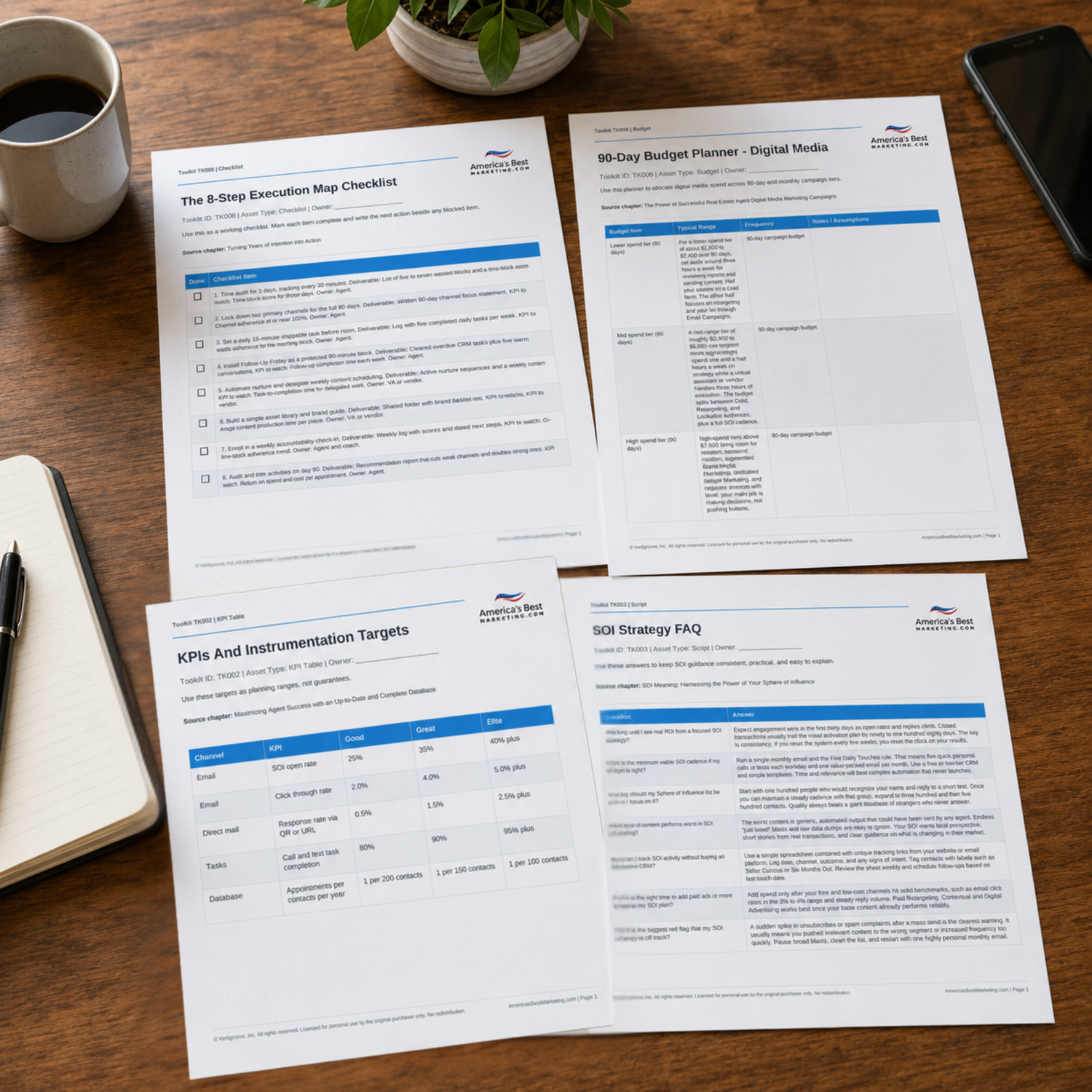
Use the companion Toolkit to turn this article into an implementation plan with local SEO budget blocks, KPI tracking, FAQ resources, script frameworks, and practical execution support.
Download the Toolkit ZIPRecommended reads
Recommended Reads for Real Estate Agents
These articles help agents turn client questions, local guidance, marketing channels, and follow-up into a more useful content system.

The Ultimate Guide to Local SEO for Real Estate Agents
Turn search visibility into a clearer publishing system for neighborhoods, services, and client decisions.
Read article
Outdoor Lifestyle Neighborhood Guides: Searchable Relocation Content Real Estate Agents Can Publish
Turn search visibility into a clearer publishing system for neighborhoods, services, and client decisions.
Read article
SEO for Real Estate: How Agents Can Dominate Local Search and Generate More Leads
Build a cleaner system for SEO for real estate, with better timing, clearer messaging, and a next step people can act on.
Read article
Local Restaurant Guides That Generate Leads: A Real Estate Agents-Friendly Where to Eat Framework
Publish content that answers local questions, supports lead capture, and gives future conversations a reason to start.
Read articleLocal SEO Questions Real Estate Agents Should Be Ready to Answer
How long does it take to see measurable ROI from Local SEO for Real Estate Agents?
Expect early wins such as cleaner branded search results and stronger Google Business Profile visibility within three to six months. Meaningful lead flow from city and neighborhood keywords usually takes nine to twelve months of steady work, especially in competitive markets where other agents already publish strong content.
What is the minimum viable cadence if my budget is tight?
Run one useful Google Business Profile update each month and one new or improved neighborhood article each quarter. That keeps your profile alive and steadily deepens your site. Consistency matters more than volume, so protect those few execution slots instead of chasing a complex plan you will not maintain.
How narrow should my farm be for local SEO content?
Start with one primary city hub and three core neighborhoods where you want to win more listing conversations. A giant list of fifteen areas usually leads to weak pages that never rank. Depth on a small cluster beats shallow coverage across an entire metro.
What content performs worst for real estate local SEO?
Generic advice such as top five tips for buyers rarely moves the needle for Local SEO. That content can nurture your list, but it does not target searchers in your city. Market reports, school-zone breakdowns, cost-of-living stories, and neighborhood comparison pages usually perform better because they match local intent.
How do I track rankings without expensive tools?
Use Google Search Console, Google Business Profile Insights, and a simple spreadsheet. Filter queries by your city and neighborhood names, then review impressions, clicks, and average position each month. Combine that with a manual map-pack check for your top phrases and you will have enough signal to guide decisions.
When should I scale my Local SEO spend?
Scale only after your main city page and at least one neighborhood guide show progress for target phrases. At that point, more content, technical cleanup, and local link building can produce faster gains. Until then, focus on fundamentals instead of adding budget to an unclear system.
What is the major red flag to avoid in Local SEO?
Buying links or trading reviews is the brightest red flag. Search platforms and regulators treat that behavior as manipulation. It can lead to profile suspensions, ranking drops, and brand damage. Earn attention through useful content, real community involvement, and a clean review process instead.
Next step
Build the System Behind Local Search
Continue from local visibility into the larger America’s Best Marketing ecosystem: the book series for strategic depth and the full marketing program for done-for-you execution.

View the Book Series
Explore the America’s Best Real Estate Agent Marketing System books for a deeper strategic framework around visibility, referrals, listings, lead generation, and growth.
View the Book Series
See Full Marketing Program
See how AmericasBestMarketing.com runs real estate blog writing, social media, listing marketing, email, direct mail, and retargeting as one managed system.
See Full Marketing Program