Real Estate Tech Trends for Agents in 2026: What to Adopt and What to Skip
Real Estate Tech Trends for Agents in 2026
What to adopt, what to skip, and why
A practical operating brief for agents who want automation, CRM discipline, SEO infrastructure, and follow-up systems that turn attention into booked conversations.

Real estate tech trends for agents in 2026
The real estate tech trends worth adopting in 2026 are the tools that improve response speed, database hygiene, lead routing, appointment setting, local search visibility, and repeatable follow-up. Skip tools that create novelty without measurable pipeline movement. The practical filter is simple: if a tool does not reduce friction or increase booked conversations within 30 to 90 days, it should not earn budget or attention.
- Adopt tech that improves throughput: first response, lead routing, appointment set rate, and database reactivation.
- Skip tools that cannot connect cleanly to your CRM, cannot be measured by source, or make clients feel processed.
- The cleanest stack is one CRM, one intake path, one booking mechanism, and one follow-up engine.
- Every 2026 tech decision should be judged against one business outcome: more qualified conversations with less operational drag.
Operational Efficiency Is The Only Trend That Counts
Most tech chatter is about features. Agents should care about throughput. How fast you respond, how clean your database is, and how reliably you turn interest into appointments matter more than the newest dashboard or AI slogan.
Real estate tech in 2026 is a sorting event. Generative AI hype will keep spinning, but the winners will run simple automation that captures, routes, and follows up without dropping the ball. The profitable outcome is not glamour. It is lower cost per lead, higher appointment set rate, and better retention through consistent follow-up.
Use one standard for every tool you consider. What does it cost, how do you measure it, and what specific outcome does it produce in your weekly pipeline.
Tech should buy back time and tighten follow-up, not add another login to the guilt pile. Start with Use AI to Cut 10+ Hours/Week: The Agent’s Revenue-First Tech Stack Guide, then use this adoption filter to decide what earns a spot in your stack.
Conversion Tech Versus Marketing Tech
Conversion tech is anything that touches lead speed, lead routing, and appointment setting. Think forms, chat, call tracking, text follow-up, CRM tasks, and calendar booking. If it does not change response time or booking rate, it is not conversion tech.
Marketing tech is anything that creates attention. Think content schedulers, design tools, posting tools, and analytics dashboards. Marketing tech can be useful, but it does not close the loop by itself.
Before you add anything, get your funnel logic straight. If your lead path is fuzzy, your tech will be fuzzy too. A clean reference is Real Estate Marketing Funnels: What They Are and How to Build One, then you can map every tool to one step in that funnel.
Paying for tools you rarely log into is not leverage. If a platform is not tied to a daily action or a weekly report, it becomes a silent margin leak.
Automation should support the human relationship. When follow-up sounds robotic, people feel processed instead of helped, and response quality drops.
Tech is a multiplier, not a savior. If manual follow-up is messy, automation just scales the mess faster. Track the one metric that tells the truth: lead-to-appointment ratio by source every week.
The Adopt List: Automation That Produces Booked Conversations
Adopt does not mean buy everything. Adopt means you install it, wire it, and measure it like a utility. Keep your stack simple: one CRM, one primary lead router, one appointment mechanism, and one follow-up engine. Anything else must prove it reduces time or increases booking rate.
AI-driven predictive analytics for likely-to-sell triggers
Use it for prioritization, not prophecy
CostPlan for $150 to $600 per month depending on data depth and contact volume.
MeasurementTrack outreach-to-appointment rate by segment, plus reply rate on targeted messages.
OutcomeMore conversations with fewer dials because you call the right people first.
Use it in a tight loop. Pull a weekly list, run a simple call and text sprint, then tag outcomes in the CRM. Pair it with Email Marketing for Real Estate Agents so warm prospects get consistent touch points after the first conversation.
Autonomous lead nurture that actually books appointments
Use it only when the handoff is real
CostPlan for $200 to $900 per month if it includes booking, routing, and text follow-up.
MeasurementTrack chat start rate, handoff rate, and appointment set rate from chat leads.
OutcomeFewer missed leads after hours and faster booking from high-intent visitors.
The key is tone and guardrails. Use short, human language. Offer a real next step fast. Never trap people in a long Q and A. If the tool cannot book or schedule a call, it is a form wearing a costume.
Hyper-local SEO systems built as data hubs
Use search infrastructure to create owned demand
CostPlan for $300 to $1,500 per month depending on content volume and tracking.
MeasurementTrack search impressions, click-through rate, and lead capture rate from hub pages.
OutcomeHigher quality inbound leads because the content matches local intent.
Hyper-local works best when the site infrastructure is built for search and lead capture. That is why IDX Real Estate Websites matter. Your content should not just rank. It should turn visitors into contact records you can follow up with.
The Skip List: Expensive Distractions That Drain Margin
Skipping is not being anti-tech. Skipping is protecting margin and attention. If you are a solo agent or a boutique team, your best advantage is speed and trust. The items below usually do the opposite.
- Metaverse and virtual land plays: Your audience is transacting in the physical world, under time pressure, with lenders, inspectors, and real constraints. If you cannot attribute booked calls to it, you are guessing.
- Generic AI video avatars: Trust is the currency of this business. Avatars often trigger the uncanny valley effect, and the audience reads it as a shortcut. Use your real face and voice.
- Anything that cannot integrate cleanly: If a tool cannot send clean data to your CRM and trigger the next step, it will become another dead end. The sticker price is rarely the issue. The cost of dropped leads is.
If you want immersive experiences, use simple virtual tours that support listings. Keep it about clarity, not novelty. If you want AI leverage, use it to draft, sort, remind, summarize, and route. Do not use it to replace the human trust layer.
The 90-Day Tech Audit: Clean, Connect, And Automate
This is the process that prevents tool sprawl. You are not buying a stack. You are building a repeatable operating system. The goal is simple: every lead gets captured, every lead gets a next step, and every lead gets follow-up that sounds human.
Audit every tool, login, and monthly charge. Cancel anything you have not used in 30 days. Export your database, dedupe contacts, standardize phone and email fields, then create source, intent, timeframe, and status tags.
Map every lead source into one intake path. Connect site leads to the CRM, test with dummy leads, build routing rules for buyer versus seller and hot versus nurture, then install source tracking.
Build one trigger flow for new leads, one nurture flow for older leads, and one quarterly reactivation path for past clients. Lock the weekly report around response speed, appointment ratio, and pipeline by source.
If your site and CRM do not talk cleanly, everything downstream suffers. Use Proven SEO Strategies for Real Estate Websites to Increase Leads as a gut check that traffic and capture are working together.
Messaging That Makes Tech Pay Off
Tools do not convert. Messaging converts. Tech just makes sure your message arrives fast and consistently. If your follow-up sounds generic, no automation will rescue it.
The time-savings angle
Headline angle
Hook lineThe 3 tools saving top producers 10 hours a week.
Middle lineUse the saved time for calls, showings, listing prep, and relationship work.
CTA lineDownload the tech audit checklist and run it this weekend.
The follow-up discipline angle
Headline angle
Hook lineMy follow-up rule that stops leads from going cold.
Middle lineEvery new inquiry receives a fast human touch, a next step, and a nurture path.
CTA lineRequest a tech stack review and get a prioritized fix list.
The booked-call angle
Headline angle
Hook lineHow I turn website clicks into booked calls in one day.
Middle lineRoute visitors back into a specific next step, not a generic homepage.
CTA lineSchedule a 1:1 working session and rebuild follow-up end to end.
Use ad spend to amplify the follow-up machine, not replace it. If you need the service layer, Retargeting, Contextual & Digital Advertising should be tied to one conversion page and one follow-up flow.
Budget Tiers And KPI Benchmarks You Can Track Weekly
Budgets should match a measurable operating goal. If you are spending more, it should be because you can prove you are booking more conversations and protecting your time.
Spend $450 to $900 per month across CRM, lead capture, and one nurture flow. Review tasks daily, clean tags weekly, and report weekly. Split effort 70 percent nurture and 30 percent hot leads.
Spend $1,200 to $2,500 per month including predictive data and retargeting. Enforce a daily response standard, review pipeline weekly, and tune the stack monthly. Split effort 60 percent nurture and 40 percent active.
| Tier | Monthly spend | Core focus | Measurement standard |
|---|---|---|---|
| Low tier | $450 to $900 | Capture plus nurture | Response speed and appointment set rate improve within 30 days. |
| Mid tier | $1,200 to $2,500 | Data plus retargeting | Lead-to-appointment ratio rises by source over eight weeks. |
| High tier | $3,500 to $7,500 | Team scale systems | Routing compliance stays above target with weekly QA reviews. |
| KPI | What it tracks | Target range | How to use it |
|---|---|---|---|
| First reply | Speed to first contact. | 5 to 15 min | Set alerts and tasks so every lead gets a same-day human touch. |
| Set rate | Appointments per lead. | 8% to 18% | Review by source weekly and cut spend on sources that stall. |
| Nurture clicks | Engagement with follow-up. | 1.5% to 3% | Rotate one value topic weekly and remove dead segments every month. |
Sarah Cuts Portal Spend And Adds Listing Opportunities
Sarah works a mid-sized market and was spending heavily on portal leads. Her issue was not lead volume. Her issue was follow-up drift and weak prioritization. She cut portal spend by 40 percent and reallocated $1,200 per month into predictive data plus retargeting that pushed warm visitors back into a booking step.
She also tightened routing. Every incoming lead got a two-hour first response standard, then a seven-day sequence that mixed text, email, and a personal call. Within six months she attributed four additional listing opportunities to better prioritization and consistent follow-up, not to a new gadget.
If you want this outcome without becoming your own IT department, start with one operating decision. Pick one CRM workflow and enforce it for 12 weeks. If you want a second set of eyes, this is what 1:1 Marketing Coaching is built to do: tighten the stack, remove waste, and make follow-up consistent.
How This Becomes A Managed Marketing System
A tech stack is not just a back-office decision. It shapes how fast prospects hear from you, how often your database sees you, and whether your local search traffic turns into a real contact record. The marketing system has to make the operational system visible.
Use the same adoption logic inside Real Estate Blog Writing Services, Social Media Marketing, Listing Marketing, Email Campaigns, and Direct Mail. Each channel should push a prospect toward one clean next step and one follow-up path.
If you want a lean tech stack that protects margin and improves follow-up, request a stack review from AmericasBestMarketing.com and build a 90-day adoption plan you can actually stick to.
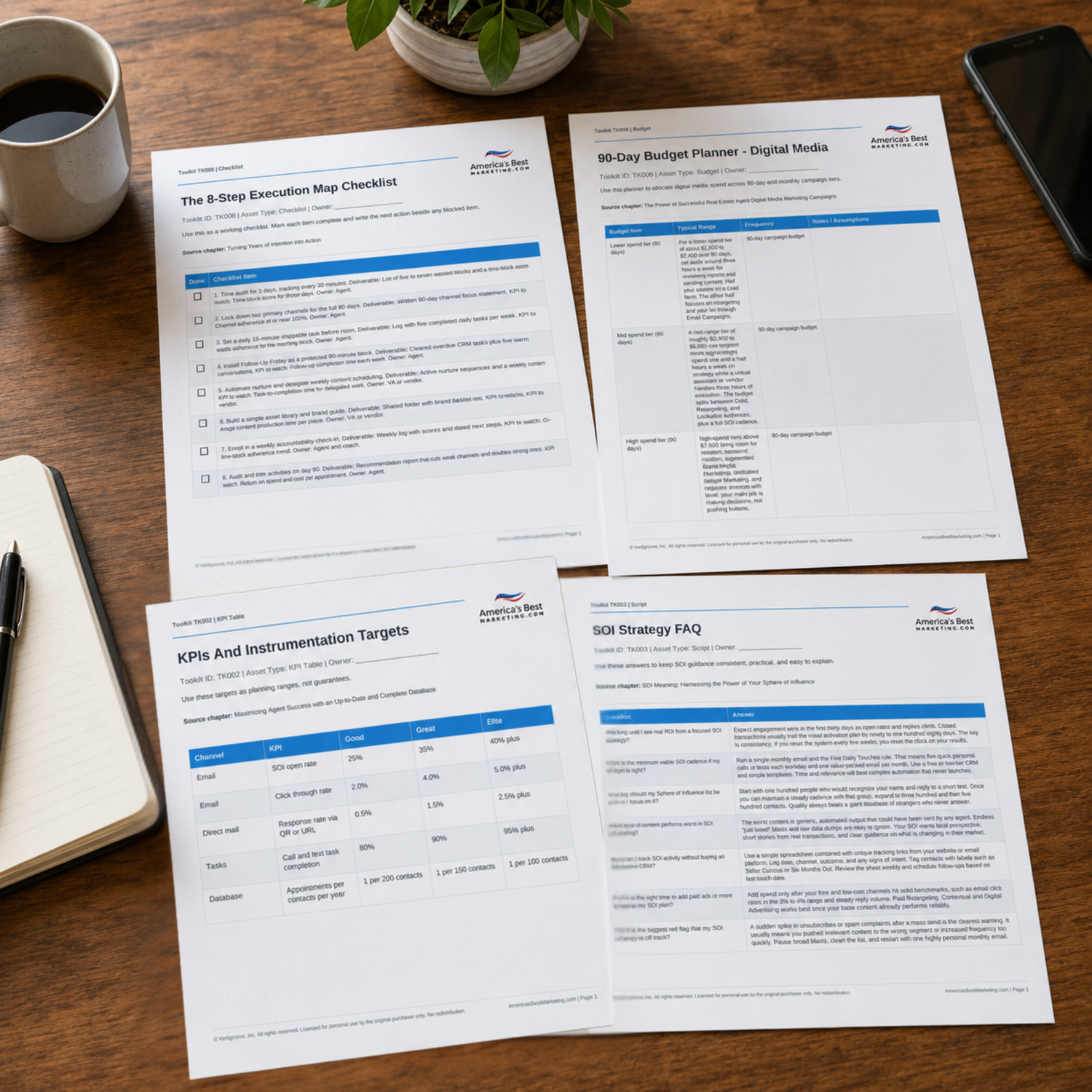
Download The 90-Day Tech Audit Toolkit
Use the companion Toolkit to clean your tech stack, tighten CRM fields, map lead routing, compare budget tiers, track KPIs, and measure whether automation is producing booked conversations.
Download the Toolkit ZIPRecommended reads
Recommended Reads for Real Estate Agents
These articles help agents connect follow-up discipline, database habits, client communication, and marketing execution into a repeatable system.

Use AI to Cut 10+ Hours/Week: The Agent’s Revenue-First Tech Stack Guide
Adopt AI where it reduces friction, not where it weakens trust or adds noise.
Read article
High-End Buyer/Seller Tech Stack: Tools and Systems Luxury Agents Use
Create more leverage from high-end buyer/seller tech stack with a clear path from attention to follow-up.
Read article
Best Website Builders for Real Estate Agents: Costs, SEO Tradeoffs, and Setup Tips
Bring more structure to website builder decisions so every touchpoint supports visibility and trust.
Read article
AI Chatbots for Real Estate Agents: Best Use Cases, Setup Checklist, and Compliance Guardrails
Adopt AI where it reduces friction, not where it weakens trust or adds noise.
Read articleReal Estate Tech Questions Agents Should Be Ready To Answer
Will AI replace my job as an agent soon
No. Clients do not hire a tool, they hire judgment and advocacy. AI will replace sloppy admin work first: sorting leads, drafting drafts, and reminding you to follow up. The agents who win will use automation to respond faster, stay consistent, and spend more time on real conversations. Your advantage is trust, local knowledge, and negotiation, not typing speed.
What is the minimum tech budget for a solo agent
Set a floor that covers three things: a CRM you actually use, a clean lead capture path, and a basic nurture sequence. A practical minimum is the cost of a CRM plus light automation, then a small amount for tracking. If your budget is tight, spend first on response speed and follow-up consistency. Fancy analytics can wait until your process is steady.
How do I avoid the subscription trap
Run a monthly stack review like a bill audit. If a tool is not tied to a daily action or a weekly report, cancel it. Demand simple proof: can you show the last five leads it influenced and what happened next. Keep one owner for each tool. If nobody owns it, it becomes a silent monthly charge that never improves pipeline.
What is the most important metric to track
Track lead-to-appointment ratio by source every week. It forces honesty. Leads are not success, conversations are. Pair it with first response time so you can see if slow follow-up is the cause. When the ratio drops, do not buy a new tool. Tighten routing, improve the first message, and fix the handoff between lead capture and next step.
How much automation is too much
Too much is when your messages sound like a bot and your client feels processed. The safe approach is this: automate reminders, routing, and the first few touches, then require a human check-in early. Use templates, but personalize one line based on what the lead did. If people reply with confusion or irritation, your sequence is too aggressive or too generic.
Do I need chat on my website
Chat is useful if it can do a real job: answer common questions, route the lead, and offer appointment times. If it only collects details and sends an email, it is just another form. Install it when you are ready to enforce response standards and measure appointment set rate from chat leads. If you are not measuring that, you are guessing.
What should I do first if my CRM is messy
Stop adding tools and clean the base. Dedupe contacts, standardize fields, and apply a simple tagging system for source and intent. Then rebuild one follow-up sequence for new leads and one for older leads. Set a weekly habit: review new leads, review tasks, and review a short report. Once the CRM is clean, automation becomes reliable instead of chaotic.
Next step
Build the System Behind the Advice
Continue from one useful article into the larger ABM ecosystem: the book series for strategic depth and the full marketing program for done-for-you execution.

View the Book Series
Explore the America’s Best Real Estate Agent Marketing System books for a deeper strategic framework around visibility, referrals, listings, lead generation, and growth.
View the Book Series
See Full Marketing Program
See how AmericasBestMarketing.com runs real estate blog writing, social media, listing marketing, email, direct mail, and retargeting as one managed system.
See Full Marketing Program