Building Your Personal Brand with Video Content
Building Your Personal Brand With Video Content
A repeatable video workflow for real estate agents
Turn agent voice, short clips, email, retargeting, and website content into stronger trust before the first conversation.

Video-based personal branding for real estate agents
A video-based personal brand is a repeatable system for showing how an agent thinks, communicates, and solves client problems before a prospect books a call. The job is not to post random clips. The job is to turn local questions, pricing judgment, negotiation insight, neighborhood knowledge, and client education into short videos that can be distributed through social, email, retargeting, and the agent’s website.
- Build three to five content pillars around recurring client questions so your videos stay useful and consistent.
- Batch four weeks of material in one four-hour session to reduce friction and protect your publishing cadence.
- Repurpose each recording into short clips, email touches, and website content so attention has a place to convert.
- Track watch behavior, saves, replies, and appointments so video performance ties back to real business development.
Why Video Builds Trust Before The First Call
Video is the fastest way to close the trust gap because prospects can hear your judgment, not just read your claims. A prospect who repeatedly sees you explain pricing, preparation, timing, and negotiation begins to understand your operating style before they ever sit across from you.
Most personal brands fail because agents treat video like a one-off performance. You want a trust engine: consistent exposure, consistent usefulness, and consistent routing to the next step. Pair that cadence with Social Media Marketing so each clip reaches the same prospect more than once.
- The Frequency Illusion makes an agent feel familiar when prospects see useful video repeatedly across several channels.
- Parasocial trust forms when viewers hear your voice, see your face, and watch you explain decisions in plain language.
- The Content Repurposing Loop turns one recording into many assets so frequency does not require constant filming.
Video is not a platform for selling houses. It is a platform for selling your decision-making process. When you narrate how you solve problems, you signal competence faster than highlight reels.
How To Shoot, Repurpose, And Distribute
Start with three to five content pillars you can own in your local market. Strong pillars include neighborhood decision guides, pricing and negotiation clarity, inspection and repair triage, moving logistics, and seller preparation. The tighter the pillar, the easier it is to build a memorable video identity.
Film four weeks of content in one four-hour window. Start with one long-form piece, then capture short clips while your lighting, topic focus, and energy stay stable. Use the same client-touchpoint discipline described in Your Brand is Built on Every Interaction: Managing Client Touchpoints for Lasting Success.
Outline the shoot
Write three bullet points per video. Do not script every word. Give yourself guardrails so the delivery sounds natural and the point stays clear.
Record the anchor video
Film one five to eight minute explanation with a clean intro and outro. This becomes the source asset for clips, email, and a website page.
Capture short clips
Record six short videos, each 20 to 45 seconds. Give each clip one idea, one example, and one call to action.
Build the visual library
Capture b-roll such as neighborhood signage, map shots, laptop screen, client folder, and walking clips that can support future edits.
Post the strongest cuts natively, cross-post short clips, and then retarget video viewers with Digital Retargeting. Turn the best-performing video into a search-friendly website page with an embedded transcript so feed attention becomes durable content.
Budget And Creative Plans That Protect Cadence
These budget bands assume self-produced video and cover paid distribution plus light tools only. Outside editing, design, and production support are separate. The right budget is the one that protects consistency without turning every video into a production bottleneck.
Spend $300 to $600 per month total. Publish one long-form video per week and three shorts per week. Keep the audience split near 70 percent warm viewers and site visitors, with 30 percent local interest. The goal is repeat exposure without fatigue.
Spend $900 to $1,800 per month total. Publish one long-form video per week and five shorts per week. Use a 60 percent warm-viewer layer, a 25 percent audience-expansion layer, and a 15 percent local seller-intent layer. The goal is faster list growth and more booked consults.
Use direct-to-camera video with a net sheet or inspection report. Lead with the headline The three numbers I check before I set a price. The call to action is simple: reply with your address for a quick pricing range and prep plan.
Use a screen recording of a map route, then explain trade-offs. Lead with the headline Where I would live if I commuted to downtown. Invite viewers to comment with the neighborhood they are considering so you can send a short decision guide.
Creative Messages That Make The Brand Feel Useful
Your video brand is a promise: this is how I think, this is how I communicate, and this is what you get when we work together. Keep that promise consistent across video, website copy, email, direct mail, and retargeting so every touchpoint reinforces the same story.
If your visuals feel stale, tighten the look and typography using The Power of High-Quality Marketing Design vs. Static and Dated.
Reusable video ideas
Agent prompts
Seller lens How I price a home when the comps look messy.
Buyer lens What no one tells you about living in your city.
Negotiation lens The fastest way to lose leverage, and how to avoid it.
Listing lens My weekly checklist before a listing goes live.
Use these headlines as starting points, then attach one local example and one specific next step.
Move viewers without sounding pushy
Call-to-action taxonomy
Soft CTA Save this, follow for more, or comment a keyword for a checklist.
Mid CTA Join the weekly video newsletter through email marketing for real estate agents.
Hard CTA Book a consult when the topic signals urgency, such as pricing, repairs, net proceeds, or timing.
The strongest videos teach the decision first and invite the next step second.
The Video Repurposing Matrix
One recording can become multiple assets with one measurable job each. Use this matrix to keep every asset tied to a purpose instead of treating repurposing as random clipping.
| Original format | Repurposed asset | Distribution channel | Target KPI |
|---|---|---|---|
| Long-form video, five minutes | Three to five short clips | Short-form feeds plus story highlights | Average watch time |
| Education vlog | Transcript-based website page | SEO landing page plus internal linking | Organic impressions |
| Market update | Email teaser plus link | Weekly email touch | Click-through rate |
| Neighborhood walk | Map carousel plus captions | Short-form feeds plus saved highlights | Saves per post |
| Client scenario story | Two quote clips | Retargeting creative rotation | Cost per landing view |
The Ten-Point Camera-Ready Audit
Recording friction kills momentum. Keep the setup simple enough that you can repeat it every week without rebuilding your office, your gear, or your confidence from scratch.
- Use a small wired or wireless mic and record a five-second audio test.
- Face a window or soft lamp, then lock exposure on your face.
- Clean the camera lens before every session.
- Use a tripod or fixed mount at eye level.
- Remove clutter and keep one brand element consistent.
- Start with the payoff sentence, not context or disclaimers.
- Keep one video focused on one idea, one example, and one next step.
- Add captions before posting.
- Say the call to action out loud and place it in the first caption line.
- Log the post topic, date, channel, and next step in a simple tracker.
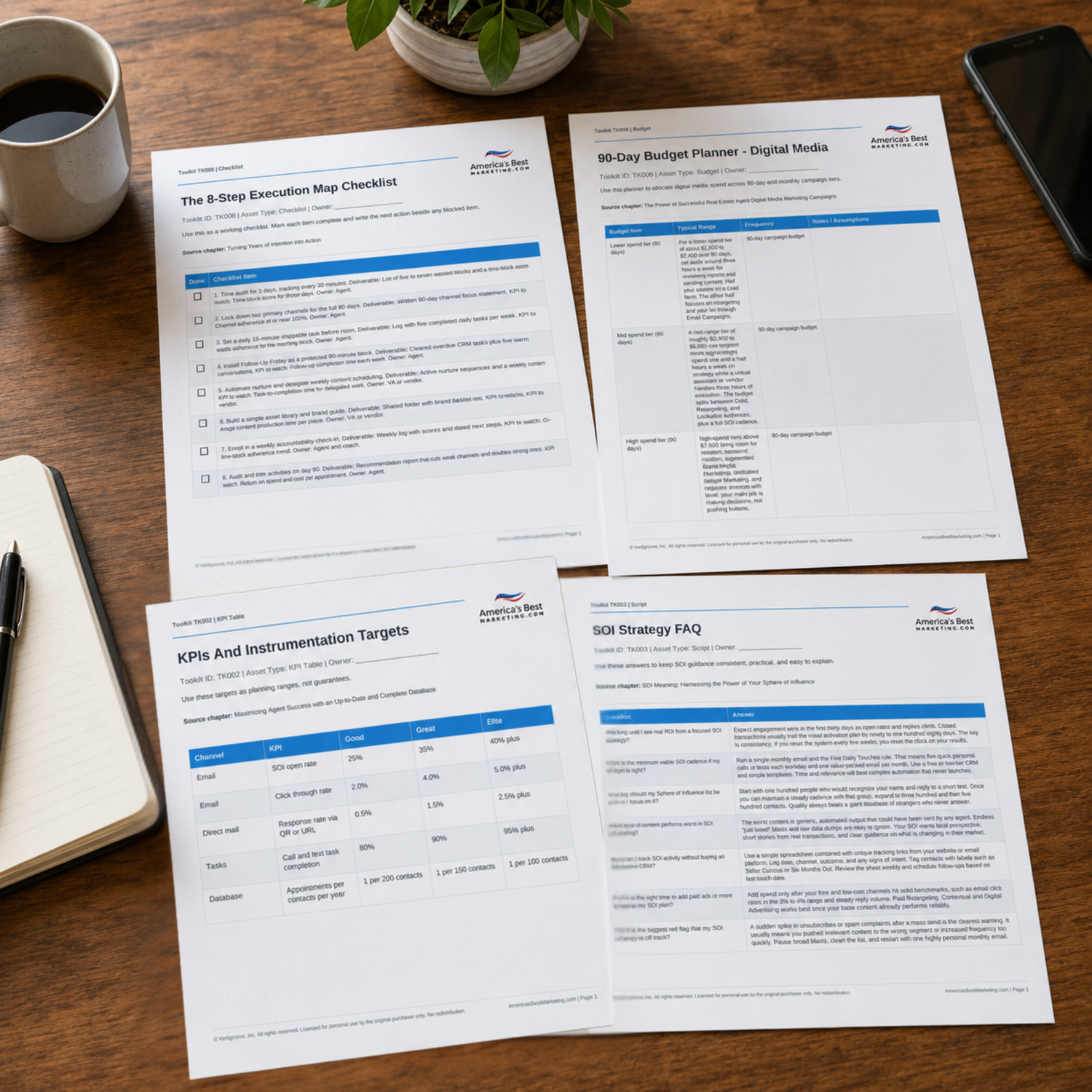
Download The Video Personal Brand Toolkit
Use the companion Toolkit to plan your video budget, run the camera-ready checklist, map a weekly repurposing rhythm, and turn common client questions into stronger on-camera structure.
Download the Toolkit ZIPFrom Camera Shy To Zip-Code Recognition
An agent started with zero video and decided to run a weekly Neighborhood Deep Dive series. They filmed four episodes in a single afternoon, cut each episode into three short clips, and posted them across their main channels. A simple retargeting layer kept the clips in front of repeat viewers.
Within 120 days, a meaningful share of inbound listing appointments cited the videos as the reason they reached out. The key move was not higher production. It was consistent publishing, repeat exposure, and a clear next step attached to each useful topic.
Turn Weekly Video Into A Managed Marketing System
A video-based personal brand compounds because trust compounds. Every week you show your judgment, you remove friction from future conversations and make the next prospect feel like they already know how you operate.
Record your first talking-head video around a common buyer mistake and the exact fix. Then map a 90-day storyboard, repurposing plan, and distribution system through America’s Best Marketing’s done-for-you real estate marketing program.
Recommended reads
Recommended Reads for Real Estate Agents
These articles help agents connect content planning, client education, local visibility, and follow-up into a more consistent marketing rhythm.

Video Testimonials: Shot List, Questions, and an Editing Workflow Real Estate Agents Can Repeat
Create video content with clearer scripts, simpler formats, and a cadence agents can actually maintain.
Read article
FHA vs Conventional Loans: Real Estate Agent Talking Points + Content Ideas That Convert
Build a cleaner system for FHA vs conventional loans, with better timing, clearer messaging, and a next step people can act on.
Read article
Real Estate Agent Video Marketing: Boost Conversions and Engage Clients with Effective Videos
Create video content with clearer scripts, simpler formats, and a cadence agents can actually maintain.
Read article
Beginner’s Guide to High Quality Real Estate Videos
Build a cleaner system for to high quality real estate videos, with better timing, clearer messaging, and a next step people can act on.
Read articleVideo Personal Brand Questions Agents Should Be Ready To Answer
How long does it take to see measurable ROI from a video personal brand?
Track signals in weeks, not days. Most agents should look first for longer watch time, more profile visits, more saves, and more direct replies. Appointments usually show up after four to eight weeks of consistent publishing. The strongest indicator is how often prospects reference a specific video during the first conversation.
What equipment is the minimum viable setup for real estate video?
Use a modern phone, a small clip-on microphone, and a simple tripod. Add one light only if your space is dark. Keep the setup in place when possible so recording does not require a rebuild every time. Repeatability matters more than studio production.
How can a real estate agent improve retention in the first seconds?
Start with the payoff line. Lead with a mistake, a decision point, or a trade-off, then explain the fix. Keep the first sentence under ten words and move the context later. Add captions and cut pauses so the opening feels direct.
How do I track leads from video without advanced tools?
Use one dedicated landing page, one keyword, and one simple log. Ask viewers to reply with a keyword such as GUIDE, then track those messages by date, topic, and next step. Add one intake question to every lead conversation: which video did you watch.
Should I post the same real estate video on every platform?
Post the same idea everywhere, but adapt the edit for each platform. Keep short-form clips vertical, publish longer explanations where longer viewing makes sense, and change the caption to match the audience.
What should my call to action be in most real estate videos?
Use a soft call to action most of the time: save this, follow for more, or comment a keyword for a checklist. Use a weekly mid-level call to action that moves viewers onto email. Reserve hard appointment calls for high-intent topics such as pricing, repairs, net proceeds, or timing.
How do I avoid sounding salesy on camera?
Teach the decision, not the pitch. Explain what you look for, why it matters, and what you would do next. Use one real-world example without naming anyone, then offer a useful next step such as a checklist, a pricing range, or a short decision guide.
Next step
Build the System Behind the Advice
Continue from one useful article into the larger ABM ecosystem: the book series for strategic depth and the full marketing program for done-for-you execution.

View the Book Series
Explore the America’s Best Real Estate Agent Marketing System books for a deeper strategic framework around visibility, referrals, listings, lead generation, and growth.
View the Book Series
See Full Marketing Program
See how AmericasBestMarketing.com runs real estate blog writing, social media, listing marketing, email, direct mail, and retargeting as one managed system.
See Full Marketing Program