Understanding the Unique Market of Rural Properties: The Agent’s Niche Playbook
Understanding Rural Property Markets
The Agent’s Niche Playbook
A field guide for agents marketing acreage, hobby farms, and land where access, water, septic, utilities, zoning, and buyer confidence decide the deal.

Rural property marketing starts with proof
Rural property marketing works when agents document access, water, septic, utilities, boundaries, and use restrictions before buyers have to guess. The practical asset is a Land Folder: parcel maps, known easements, utility notes, water and septic details, zoning references, open verification items, and a clear path to licensed experts when the answer requires professional confirmation.
- Build the Land Folder before launch so buyers see documented facts instead of vague acreage promises.
- Segment rural buyers by intent because lifestyle, agricultural, and hybrid buyers evaluate different risks.
- Use direct mail, saved acreage searches, owner outreach, and fast follow-up to run a rural territory with discipline.
- Be confident about the verification workflow while routing wells, septic, boundaries, soils, and subdivision questions to licensed experts.
Why This Pays Off
Understanding the unique market of rural properties requires a shift from standard subdivision sales to technical land management. Agents who master this niche can build stronger positioning in a lower-competition segment because fewer peers want the complexity. The opportunity is not just acreage. The opportunity is becoming the agent who can make rural property feel legible.
Rural deals are hard because the product is a system: land, access, utilities, legal rights, and local rules that must work together. Your job is to translate that system into plain language without making promises you cannot control. Start by building your proof stack with Understanding and Leveraging Real Estate Market Data to Win Listings and Trust, then run the farm like a territory, not a hobby.
When buyers see the path to verification early, they can make decisions faster and with less fear. When sellers see that you have a documentation process, they understand why your marketing is different from a generic listing launch.
- You reduce deal drag by answering access, water, septic, and utility questions before they become objections.
- You attract serious buyers who need facts, not only lifestyle language.
- You create a niche identity that can be repeated across content, email, social, direct mail, and listing conversations.
What Rural Property Really Means
Start by sorting listings into three buckets. Unimproved land is a parcel with no livable structure and often no active utilities. Hobby farms are small acreage properties that support a lifestyle plus light production, such as gardens, animals, or a workshop. Agricultural exemptions are tax or use classifications tied to local rules, which means buyers should confirm them with the county and a qualified tax professional.
The pioneer metaphor matters: you are not selling only a house. You are helping someone settle a piece of the world. Your process should answer one question early: can this land support the life or use case the buyer is imagining.
Autonomy, quiet, and usable space
Lifestyle buyers care about the daily experience. They ask about internet, driveway access, privacy, noise, safety, school distance, commute time, and whether the property feels manageable after the romance wears off.
Function, water, and allowable use
Agricultural buyers care about soils, water capacity, access for equipment, fencing, setbacks, production potential, and whether the county will support the use they have in mind.
Both dream and due diligence
Hybrid buyers want lifestyle and function together. That raises the bar for documentation because they need the emotional story and the technical checklist to line up before they move forward.
Most rural buyers are buying autonomy, not bedrooms. Track utility resilience as a core marketing metric: well history, power proximity, backup options, internet availability, and cell signal reliability. When you document resilience early, out-of-area buyers gain confidence and decision cycles tighten.
Failure Modes That Blow Up Rural Transactions
The fastest way to lose credibility in rural territory is to treat a 20-acre parcel like a city lot. Replace guesses with a clear checklist and documented sources.
- Ignoring easements, setbacks, and access rules until escrow.
- Failing to verify utilities, including internet options, before listing.
- Neglecting Direct Mail, which is vital in low-density rural markets.
- Using standard wide-angle photos that hide slope, brush, and boundary realities.
- Talking like an engineer instead of routing questions to licensed surveyors and environmental specialists.
Use this rule: if a question cannot be answered from documents or a qualified expert, label it as an open item and track who confirms it. Buyers trust certainty. They also trust honesty about what is unknown.
The Rural Farm Launch: Four Phases That Build a Moat
Rural specialization is a workflow you can repeat across listings, buyer leads, and owner outreach. Run these four phases, then refine based on the questions that repeat.
Technical due diligence
Build a Land Folder before you publish. Include parcel maps, access notes, known easements, septic and well details if available, and any county zoning references a buyer can confirm. If a seller does not have documents, write missing items as open questions and route the client to the right experts.
The visual narrative
Rural listings need scale and context. Pair photos with map overlays that show boundaries, access roads, and key features. Then write a short story: what the land does well, what it needs, and what the buyer can verify. Keep presentation consistent with Listing Marketing.
Targeted owner outreach
The best rural inventory is often held for years. Build a monthly owner outreach cadence based on acreage thresholds such as 10 acres and up. Use direct mail as your low-density force multiplier and invite landowners to request your acreage audit checklist.
Digital capture
Build landing pages and saved searches that emphasize acreage, water, and zoning terms, then route leads into fast follow-up. Use IDX Real Estate Websites so people can browse by acreage and property type without friction.
Creative And Messaging That Make The Land Feel Safe
Rural marketing fails when it sells dreams and hides constraints. Your messaging should do the opposite: show capability, show security, and show the next verification step. That is how you attract serious buyers and serious sellers.
Use headlines that signal specialization and imply a checklist behind them: The Land Specialist’s Guide to County Buying Rules, Five Questions to Ask Before Buying Acreage, Escape the City: Small Farms You Can Actually Use, How to Evaluate Wells, Septic, and Power Before You Offer, and What Zoning Allows Here and Who Confirms It.
Soft CTA: download the rural due diligence checklist. Mid CTA: view the land and acreage map on your IDX site. Hard CTA: book a rural property strategy call to define buyer criteria, verification steps, and next actions.
Publish the same proof-led message through Real Estate Blog Writing Services, Social Media Marketing, Email Marketing for Real Estate Agents, Direct Mail, and Digital Retargeting.
Rural Vs. Urban Sales Mechanics
Use this briefing table with clients and as a prep list for your own process. It keeps expectations grounded and reduces last-minute surprises.
| Item | Rural reality | Urban reality | What to do |
|---|---|---|---|
| Due diligence | Access, water, septic, and use rights drive value. | Inspections and disclosures drive most decisions. | Create a Land Folder and route open items to licensed experts. |
| Financing | Cash, local banks, and farm-style lenders show up often. | Conventional and government loans are common. | Ask early about land loan requirements and timelines. |
| Marketing | Owner outreach plus search-intent content wins. | Portals and neighborhood targeting carry more weight. | Run mail, publish niche content, and build saved searches by acreage. |
| Timeline | Longer evaluation cycle due to site and utility questions. | Faster cycle with standardized utilities. | Set a longer runway and schedule verification steps early. |
The 12-Point Acreage Audit
Walk the land like a pioneer and document what you see. This checklist helps you flag risk early and direct buyers to the right professionals for confirmation.
- Confirm access route and note any unclear entry points.
- Identify visible easement markers, roads, or shared paths.
- Record slope and drainage patterns near likely home sites.
- Check for standing water, creek beds, or flood indicators.
- Note soil conditions, including rock and heavy clay zones.
- Locate power lines and estimate distance to connection.
- Test cell signal strength on site and note dead zones.
- Ask for well information, then record knowns and unknowns.
- Ask for septic information, then record knowns and unknowns.
- Spot boundary clues like fencing, posts, and survey pins.
- Document nuisance risks like industrial uses or loud roads.
- Assign the top three buyer questions to expert sources for confirmation.
KPI Benchmarks For Rural Property Marketing
In rural territory, KPIs are not vanity metrics. They are proof that your operation is shipping the two things the niche rewards: certainty for buyers and consistent presence for landowners.
Definition: The time it takes to assemble a complete, shareable Land Folder for a listing. This due diligence packet makes the property feel verifiable instead of mysterious.
How to measure: Timestamp A is when you get the signed listing or listing input. Timestamp B is when the Land Folder is shareable and referenced in your listing workflow.
Definition: The number of outbound contacts you make to rural landowners in your farm within a period, typically per month. This measures territory pressure and inventory pipeline health.
How to measure: Count unique households touched per month through mail, call, text, or drop-by. If the same household receives a separate outbound drop, log it as a distinct touch.
| Metric | Purpose | Target range | Tracking note |
|---|---|---|---|
| Folder built | Reduce uncertainty and speed buyer decisions. | 48 to 72 hrs | Track time from signed listing to a shareable Land Folder with open items routed to licensed experts. |
| Owner touches | Keep inventory flow steady in a low-density market. | 150 to 450 | Count outbound contacts to unique owner households per month through mail, call, text, or drop-by. |
| Lead speed | Win the first conversation before the buyer drifts. | 5 to 15 min | Track response time on acreage inquiries during business hours and log missed follow-ups. |
Scripts: Sound Certain Without Overpromising
Rural clients want confidence. Your job is to be confident about the process, not confident about facts you cannot prove. These scripts keep you credible and keep the deal moving.
When asked about wells
Agent dialogue
Set contextHere is what we have documented from records and seller notes.
Protect trustFor flow and potability, a qualified well professional should confirm on site.
Next stepI will keep the well question on our open-items list until the right professional confirms it.
Use this script when a buyer asks for confidence before technical confirmation is complete.
When asked about septic
Agent dialogue
Set contextHere is what we know and what we do not know.
Protect trustA licensed septic specialist can confirm system type, condition, and capacity.
Next stepLet’s document the question now so it gets handled before you rely on it.
Put the script into your follow-up email as a checklist so the buyer sees process, not guesswork.
When asked about buildability
Agent dialogue
Set contextI can share zoning references and known constraints.
Protect trustA licensed surveyor and environmental engineer should confirm boundaries, soils, and site feasibility before you decide.
Next stepWe will separate what is documented from what still needs professional confirmation.
Rural buyers do not need poetry. They need a plan, a timeline, and a clear list of who confirms each risk.
Mini Case Pattern: Sarah Builds A Rural Farm
Sarah transitioned from a saturated suburban market to focusing on rural estates and hobby farms. By implementing a systematic direct mail campaign targeting owners of 10 or more acres and optimizing her SEO for Real Estate Agents for land-specific terms, she became the go-to expert in her county.
Over the next year, her pipeline shifted toward land deals with stronger average commission potential and less direct competition from other local agents. The key was repetition and clarity: the market saw the same checklist-led message over and over, which matches Repetitive Exposure in Real Estate Marketing.
She also focused on niche positioning aligned with Building a Trusted Brand. The result was not a louder marketing campaign. It was a more specific operating position.
How This Becomes Marketing
A rural property system is more than a transaction aid. It is a positioning asset. It gives you a credible reason to talk about land risk, buyer confidence, utility proof, and owner outreach without sounding generic.
Turn the Land Folder into public-facing proof. Publish buyer education posts, send acreage audit emails, mail landowners a checklist-led offer, build saved searches by acreage, and retarget visitors who view rural listing content but do not reach out.
If you want help turning this rural niche into repeatable marketing, AmericasBestMarketing.com can build the multi-channel execution that keeps your farm visible, your message consistent, and your follow-up organized.
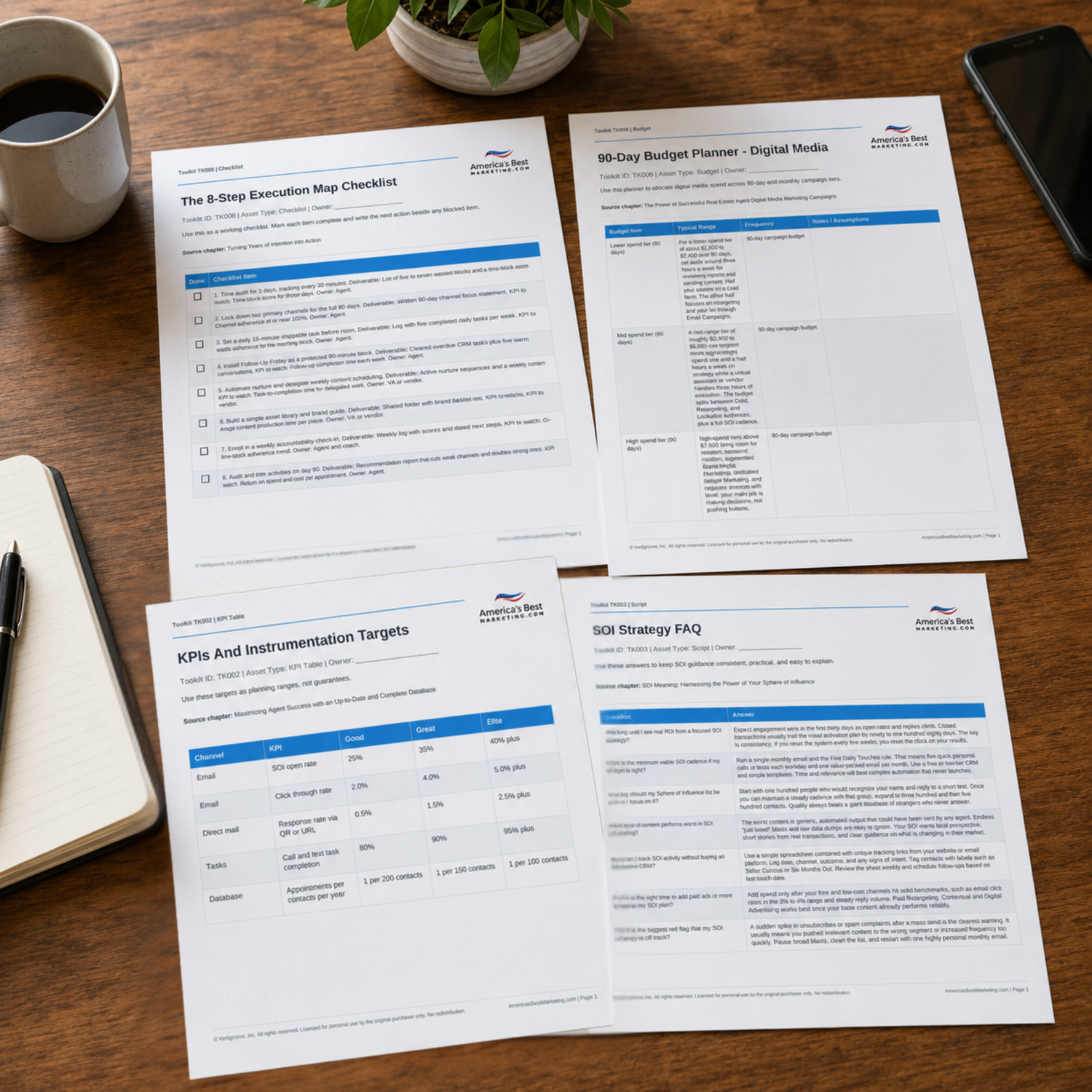
Download The Rural Property Marketing Toolkit
Use the companion Toolkit to organize the acreage audit checklist, rural farm launch plan, KPI benchmarks, client-safe scripts, and Land Folder workflow before buyer objections slow the conversation.
Download the Toolkit ZIPRecommended reads
Recommended Reads for Real Estate Agents
These articles help agents connect follow-up discipline, database habits, client communication, and marketing execution into a repeatable system.

How to Find and Evaluate Off-Market Properties
Use this alongside rural owner outreach to find inventory before it is public, evaluate seller motivation, and keep acreage prospecting from depending only on the MLS.
Read article
HOA Navigation for Real Estate Agents: Red Flags, Document Requests, and Buyer Scripts
Use this to sharpen document requests and client-safe scripts when rules, restrictions, road maintenance, or association obligations shape buyer expectations.
Read article
Tax Benefits of Investment Property: Real Estate Agent Talking Points + Investor Content Angle
Use this investor-content angle to explain tax-sensitive property conversations clearly while keeping advice routed to qualified tax professionals.
Read article
Navigating the Market for Multi-Family Homes
Use this to frame specialized property segments with stronger buyer education, follow-up triggers, and market-context conversations.
Read articleRural Property Questions Agents Should Be Ready To Answer
What is the biggest challenge in selling rural property?
The biggest challenge is uncertainty. Buyers worry about access, water, septic, and what the land can legally be used for. The fix is a Land Folder that documents what is known, what is unknown, and who confirms each item. Always advise clients to consult licensed surveyors and environmental specialists for site and water confirmation. When verification is planned early, deals move with less fear.
How do I find out if a rural property can be subdivided?
Start with county planning and zoning, then confirm with a licensed surveyor who understands minimum lot sizes, access standards, and utility constraints. Do not imply a guaranteed subdivision path. Your job is to collect zoning references, identify obvious constraints like easements, and help the buyer build a verification checklist. Subdivision depends on rules and site realities.
How big should my target farm or territory be in a rural market?
Pick a territory you can cover in a single half-day loop for showings and property walks. For many markets that means one county or a tight set of adjacent communities, not an entire region. The constraint is your ability to build local knowledge and keep consistent outreach. A smaller farm with deep competence beats a large farm with shallow answers.
What is the major red flag to avoid in rural land marketing?
The red flag is selling the dream without documenting constraints. If you cannot explain access, utilities, and use rights from sources, buyers assume the worst and disappear. Avoid vague language about buildability, wells, or zoning changes. State what is documented, state what is not, and point clients to licensed professionals for confirmation. Credibility is the product in this niche.
Next step
Build the System Behind the Advice
Continue from one useful article into the larger ABM ecosystem: the book series for strategic depth and the full marketing program for done-for-you execution.

View the Book Series
Explore the America’s Best Real Estate Agent Marketing System books for a deeper strategic framework around visibility, referrals, listings, lead generation, and growth.
View the Book Series
See Full Marketing Program
See how AmericasBestMarketing.com runs real estate blog writing, social media, listing marketing, email, direct mail, and retargeting as one managed system.
See Full Marketing Program