Client Events for Real Estate Agents: Plans, Budgets, and Follow-Up
Client Events for Real Estate Agents
Plans, Budgets, and Follow-Up That Earn Referrals
A relationship-marketing brief for agents who want every client appreciation event to create RSVPs, warm introductions, useful conversations, and measurable follow-up.

Client events work when every invitation has a follow-up plan
Client events turn warm relationships into referral opportunities when they are planned as a repeatable business-development system. The winning pattern is simple: choose one event format, invite the right people, capture RSVPs and plus-ones, tag every attendee, and follow up within 48 hours with a clear next step.
- Client appreciation events should be built around consistency, not one-time spectacle.
- RSVP forms, QR check-in, CRM tags, and plus-one capture turn the event into measurable referral marketing.
- The event itself should stay relational; the appointment conversion happens through disciplined post-event follow-up.
- Quarterly events can supply email, social, direct mail, retargeting, and listing-presentation proof when the photos and recap are reused intelligently.
Why Client Events Work for Real Estate Agents
Client events work because they create a relationship moment that advertising cannot manufacture. You are not asking people to sit through a pitch. You are inviting them to a useful, relaxed experience where they feel appreciated, reconnect with you, and remember that you are still active in the market.
The advantage is context. Your guests already know you, or they know someone who trusts you. The event gives them a low-friction reason to see you again, talk about life changes, and connect those changes to a future move. That is why even modest events can create real business opportunities when the follow-up system is disciplined.
This is also where relationship marketing connects to the larger plan. A client event should not sit apart from The Foundation and Elements of a Successful Marketing Plan. It should feed the same calendar, database, creative, and reporting structure you use for every other marketing channel.
- You reinforce trust with people who already know your work instead of only chasing cold attention.
- You create plus-one leverage when clients bring neighbors, coworkers, friends, or family members.
- You generate content proof that can support email, social, direct mail, and retargeting after the event is over.
Build The Event Around A Repeatable System
Your first job is not to invent the perfect party. Your first job is to pick one simple format you can repeat without stress. Pie Pick-Up, Coffee Drop-By, Ice Cream Social, Shred Day, Pumpkin Patch Morning, movie night, or a small neighborhood market update can all work when the invitation, tracking, and follow-up are consistent.
If you need theme ideas, start with 25 Creative Client Appreciation Event Ideas for Real Estate Agents to Build Loyalty and Referrals. Choose the event that matches your personality, market, and budget, then build a quarterly rhythm around it.
Run one repeatable event
Choose a simple format you can confidently invite people to every quarter. The value comes from consistency, not from building a different production every time.
Keep the event easy to explain in one sentence. If the invite requires a long description, the event is probably too complicated for a referral-focused cadence.
Track every step
Use RSVP forms, QR check-in, CRM tags, plus-one fields, and follow-up tasks so the event becomes measurable business development.
Every attendee should land in your database with a source tag, attendance status, and next-action note within 48 hours.
Follow up in sequence
Start with appreciation, move to a helpful next step, and then ask for a coffee meeting, valuation, listing consultation, or buyer planning call.
The strongest agents protect the relationship first and escalate only when the guest gives a real buying, selling, investing, downsizing, or relocation signal.
Most client events do not fail because the theme was weak. They fail because the agent made the event too complicated, forgot the follow-up, or did not track anything. Treat the event as a database activation campaign with a hospitality layer.
The Six-Week Client Event Cadence
This six-week cadence keeps the event operationally simple. Run it quarterly, rotate the seasonal theme, and keep the structure consistent so each cycle becomes easier.
Lock budget and venue
Set the target headcount, budget range, event theme, partner support, and vendor or venue commitment.
Watch planned spend versus actual spend so the event remains a business-development investment, not a runaway expense.
Build the invitation assets
Create the email invite, Direct Mail Marketing card, social graphic, RSVP page, and reminder copy.
Approve creative before the promotion window begins so your first invitation does not slide into last-minute scrambling.
Launch RSVP collection
Send the first invitation to segmented past clients, SOI contacts, referral sources, and warm leads.
Track RSVP conversion rate from the invite list and personally nudge your highest-value relationships.
Confirm and remind
Send a text reminder, social reminder, and personal outreach to priority clients who have not responded.
Late RSVP growth often comes from direct messages and one-to-one reminders, not from another generic broadcast.
Host and capture
Use QR sign-in, warm introductions, simple photos, and a plus-one field to document who showed up and who they brought.
Your job is to work the room with presence, not hide behind logistics that should have been handled earlier.
Send thanks and tag contacts
Send a thank-you message, tag every attendee, share a photo recap, and create follow-up tasks for warm conversations.
Watch post-event email open rate, reply rate, and appointments booked within the next 90 days.
Scripts That Make Invites And Follow-Up Easier
Your event copy does not need to be clever. It needs to be clear, specific, and easy to say yes to. Emphasize the value of attending, keep the time commitment small, and make it clear that there is no sales pitch.
The past client VIP invite
Agent dialogue
Hook lineHey [Name], I am hosting a small client appreciation night next month and your name is on my short list.
Middle lineFree [coffee / dessert / pumpkin], relaxed crowd, no sales pitch. I just want to say thanks properly this year.
CTA lineCan I save you a spot and text you the RSVP link?
Send this to your strongest past clients first. Once the first RSVPs come in, expand to the rest of your SOI and warm database.
The bring-a-neighbor ask
Agent dialogue
Hook lineQuick favor. If you have a neighbor or friend thinking about a move, bring them along to the event.
Middle lineIt is a low-key way for them to ask questions without feeling like they are on the spot.
CTA lineIf someone comes to mind, reply with their first name so I can watch for them at check-in.
Use this in a text, voice memo, social caption, or invite follow-up. The goal is to normalize plus-ones so referrals can happen naturally.
The post-event coffee follow-up
Agent dialogue
Opening lineGreat seeing you at the event. I have been thinking about what you said regarding [timeline / downsizing / investment].
Bridge lineThere are a couple of simple moves you could make in the next 90 days that would put you in a strong position.
CTA lineWant to grab a quick coffee next week so we can map it out?
Send this only to people who gave you a real signal. Timeline comments, equity questions, downsizing conversations, and referrals deserve fast, personal follow-up.
Use the same core message across your channel stack. Email Marketing for Real Estate Agents can handle the invite and recap, while Social Media Marketing and short texts keep the event visible and personal.
Budget Ranges And Time Requirements
Client events can be effective at different budget levels. The right budget depends on your list size, local costs, partner support, and how much you are willing to outsource.
Invest four hundred to seven hundred fifty dollars per event. Plan on roughly three and a half agent hours per week during the six-week cycle and limited vendor support. This range works for coffee, donuts, pie pick-up, small neighborhood drop-bys, or simple local giveaways. Invite about 150 contacts, expect 30 to 45 RSVPs, and track appointments booked within 30 days.
Invest twelve hundred to two thousand dollars per event, ideally with one vendor partner covering part of the spend. Plan on roughly two agent hours per week and three support hours per week. This range supports small catering, a food truck, direct mail invitations, outsourced RSVP tracking, and a five-touch cadence across email, direct mail, and social media.
High-budget events can exceed thirty-five hundred dollars when venue rental, staffed check-in, boosted local promotion, stronger photo capture, and structured post-event follow-up are included. That can be appropriate for top-producer databases, luxury lists, or co-sponsored community events, but only when attribution is clean.
The power moves are small but important: secure a vendor partner, ask every RSVP whether they are bringing a guest, capture clean photos, and tag every attendee in your CRM. When those basics are in place, the event becomes a repeatable referral process instead of a one-day activity.
Client Event KPI Benchmarks
Use these benchmarks as operating targets, not guarantees. They help you identify where the event system is working and where it needs adjustment.
| KPI | Good | Great | Elite | What to adjust |
|---|---|---|---|---|
| RSVP conversion rate | 15% | 20% | 25%+ | Improve subject lines, invitation clarity, timing, and event value. |
| Actual show rate | 60% | 75% | 85%+ | Add text reminders, personal confirmations, easier logistics, and calendar links. |
| New contact capture | 5% plus-ones | 10% plus-ones | 15%+ | Make the plus-one invitation explicit and easy to accept. |
| Post-event email open rate | 40%+ | 55%+ | 70%+ | Use photos, personal subject lines, and fast 48-hour follow-up. |
| Appointments booked within 90 days | 1 per 50 attendees | 1 per 35 attendees | 1 per 25 attendees | Improve CRM tagging, lead ranking, and seven-day phone follow-up. |
A Realistic Case Pattern, Not A Promise
Consider one fictional but realistic pattern. Agent Mark P committed to a mid-budget strategy and hosted four quarterly events for his 220 past clients. Across Ice Cream Social, Pie Pick-Up, Movie Night, and Market Update Coffee, he spent roughly six thousand dollars for the year, including print and outsourcing.
By using a required QR sign-in and consistent CRM tagging, Mark logged 385 total attendees and captured 41 new contacts through plus-ones. His seven-day follow-up created six qualified appointments that led to two signed listings and one buyer agreement within 180 days.
That example shows how the math can work when the system is disciplined, but your market, price point, relationships, attendance, and follow-through will drive very different results. The point is not to promise a specific outcome. The point is to build an operating rhythm that makes relationship demand visible.
Client Event Activation Checklist
Use this checklist every quarter so you spend your energy on conversations, not reinventing the wheel.
- Lock the date, seasonal theme, and venue six weeks out.
- Segment past clients, SOI top 100, warm leads, and priority referral sources.
- Confirm a lender, title partner, or local business and document who pays for what.
- Create an RSVP page connected to your IDX Real Estate Websites or CRM and generate a QR code.
- Deploy the first email and direct mail invitation three weeks out.
- Set up a QR check-in station and assign one person to help guests sign in.
- Personally greet every guest and introduce plus-ones to at least one other person.
- Send a thank-you text or email with at least one photo within 48 hours.
- Add new contacts to the CRM with the correct event tag.
- Within seven days, contact the warmest leads and book a coffee, valuation, or planning call.
How This Becomes Marketing
A well-run client event should keep working after the last guest leaves. Use photos in thank-you messages, publish a recap through Social Media Marketing, send a short story through email, and place the strongest proof into your listing presentation.
Then use Retargeting to stay visible to local homeowners who visited the event page, clicked the recap, or engaged with the photos. The advertising is not the main event. It is the reminder layer that keeps your hospitality visible longer.
If you want this entire rhythm built as one managed system, the managed real estate marketing program can connect event invitations, email, direct mail, social, retargeting, and follow-up reporting without forcing you to manage every moving part yourself.
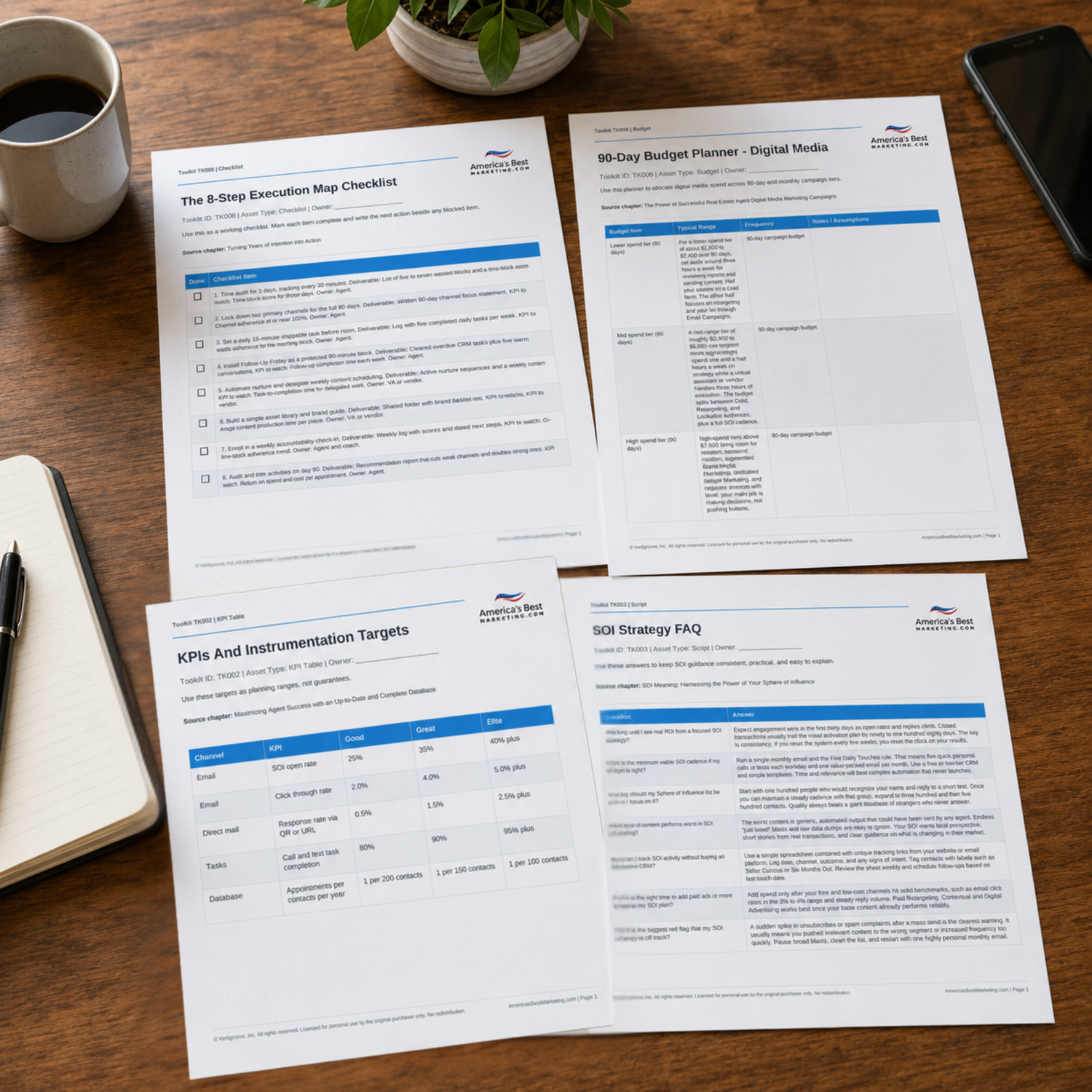
Download The Client Event Implementation Toolkit
Use the companion ZIP to plan client event budgets, benchmark RSVP and follow-up performance, organize the activation checklist, and adapt invitation scripts for quarterly relationship marketing.
Download the Toolkit ZIPRecommended reads
Recommended Reads for Real Estate Agents
These articles help agents connect relationship marketing, client education, consistent follow-up, and channel strategy into a stronger referral system.

25 Creative Client Appreciation Event Ideas for Real Estate Agents to Build Loyalty and Referrals
Turn past-client visibility into a repeatable habit that supports introductions and repeat business.
Read article
Property Taxes Explained: Real Estate Agent Cheat Sheet + Client Email Templates
Make property taxes explained more useful by tying the message, audience, and next step together.
Read article
Your Brand is Built on Every Interaction: Managing Client Touchpoints for Lasting Success
Give client touchpoints a clearer role in the marketing system instead of treating the work as a one-off idea.
Read article
How to Turn a Client into a Raving Fan
Stay remembered by past clients and sphere contacts with better touchpoints and less awkward outreach.
Read articleClient Event Questions Agents Should Be Ready To Answer
How do I capture new guest data without making check-in awkward?
Trade value for information. Place a QR code at the entrance that says something like “Scan to enter the local restaurant gift card drawing” or “Scan for your free drink ticket.” Guests expect that kind of exchange. Make sure the form collects name, email, and who invited them.
My sphere is small. Is a client event still worth it?
Yes. A small, high-trust sphere can be ideal because you can have deeper conversations with almost everyone who attends. Host a backyard barbecue, private tasting, coffee meet-up, or small dinner. Then use a focused follow-up sequence to move the warmest conversations into coffee meetings, valuation calls, or planning appointments.
Can I combine a client event with an open house or listing showcase?
You can, as long as the appreciation event does not feel like a disguised sales pitch. A simple model is to host the event at a neutral space, give a brief market update, and offer an optional tour of a nearby listing afterward for anyone who is curious.
What is the biggest time sink in client event planning?
The biggest time sink is usually managing RSVPs, vendor details, and follow-up without a system. Use one RSVP form, one checklist, one event tag, and templated follow-up messages. Outsource design and mailing when possible so your time stays focused on conversations.
How often should I host client events for referral impact?
Quarterly events are a practical rhythm for most agents. A 90-day cadence keeps you visible without overwhelming your database or your schedule. One well-run event per quarter is usually better than a burst of activity followed by silence.
What should I do if turnout is lower than expected?
Give extra attention to the people who did show up. Treat them like VIPs and secure follow-up conversations right away. After the event, send a recap email to no-shows with one strong photo, a quick market insight, and a soft ask such as “Reply if you want a two-minute market update.”
How can I repurpose event photos without sounding like I am bragging?
Frame the photos around service, community, and appreciation. Use them in your thank-you messages, then post two or three times over the next couple of weeks. Add the strongest images to your listing presentation as proof that you maintain an engaged local network.
Next step
Build the System Behind the Advice
Continue from one useful article into the larger ABM ecosystem: the book series for strategic depth and the full marketing program for done-for-you execution.

View the Book Series
Explore the America’s Best Real Estate Agent Marketing System books for a deeper strategic framework around visibility, referrals, listings, lead generation, and growth.
View the Book Series
See Full Marketing Program
See how AmericasBestMarketing.com runs real estate blog writing, social media, listing marketing, email, direct mail, and retargeting as one managed system.
See Full Marketing Program