Testimonial Content That Books Appointments for Real Estate Agents
Testimonial Content That Books Appointments
For Real Estate Agents
A testimonial content system for turning client proof into objection-aware posts, emails, scripts, and calls to action that move warm prospects toward real appointments.

How testimonial content turns proof into appointments
Testimonial content books appointments when it does more than display praise. The useful version names the prospect’s hesitation, shows the client problem your process solved, and gives the next viewer a specific action to take, such as requesting a net sheet, timeline checklist, neighborhood snapshot, or consultation.
- Generic five-star graphics create brand comfort, but objection-specific proof creates business conversations.
- The strongest testimonial content maps each quote to cost, communication, local expertise, or transaction complexity.
- Every strong review should become more than one asset across social, email, website copy, direct mail, and retargeting.
- Track testimonial performance by replies, direct messages, appointment requests, and booked consults instead of likes alone.
Why Testimonial Content Books Appointments
Most review posts read like a congratulatory sticker. Five stars, a short line about being great to work with, and no real signal that helps a nervous seller or buyer decide whether you can handle the specific issue sitting in front of them.
The better model is Objection First testimonial content. Instead of chasing more praise, you curate proof that answers the doubts prospects already have. A seller may be worried about paying a full fee. A buyer may be worried about choosing the wrong neighborhood. A past client may be wondering whether to refer you because they want their friend protected, not merely impressed.
This is where testimonial content becomes an appointment asset. It gives the next prospect language for why they should talk with you now. It also gives your broader marketing system a proof layer that supports the strategic planning discipline outlined in Charting Your Course: How Real Estate Agents Can Navigate a Strategic Growth Plan for Long-Term Success.
- You reduce perceived risk because prospects see clients with the same concern getting a clear result.
- You make your value easier to understand before the first consultation.
- You create repeatable content that can support email, social, website, retargeting, and listing-presentation follow-up.
Build The Objection First Proof Bank
Start with the last three to five closed clients. Pull every review, text, email, and handwritten note where they thanked you for something specific. Highlight any sentence that names a fear you removed, such as price, timing, communication, paperwork, inspections, local knowledge, negotiation, or the stress of buying and selling at the same time.
Then sort each line into a proof bank. Do not organize it by platform. Organize it by the business objection it answers. The goal is to make every testimonial easy to deploy when a future prospect needs reassurance around the same issue.
Protect your fee conversation
Use quotes that mention net proceeds, sale price, staging return, negotiation, or avoiding a price cut.
Pair the quote with a seller net sheet, launch checklist, or proof of buyer demand so the story connects your fee to a visible outcome.
Lower the stress barrier
Use quotes that say the client always knew what was happening, understood their options, or felt calm during a complicated moment.
Pair the quote with your update cadence, milestone checklist, or buyer and seller timeline.
Show street-level judgment
Use quotes that mention neighborhood fit, commute, schools, flood patterns, noise, older homes, resale value, or hyper-local nuance.
Pair the quote with a neighborhood snapshot, map post, local walkthrough, or short market note.
Agents often chase more reviews when what they really need is sharper proof. Three or four quotes that speak directly to cost, communication, local expertise, and complexity can outperform a wall of generic praise because they make the prospect feel seen before the first call.
What Real Estate Agents Should Collect First
Recent client emotion fades quickly. Ask for specific language while the transaction is still fresh, especially after a closing where you solved a stressful problem. If you already run a gratitude or post-closing rhythm, fold the request into the same touch pattern you use for appreciation notes and follow-up. That keeps the ask from feeling transactional.
A clean outreach note can sound like this: Thank you again for trusting me with your move. If you were telling a friend why you chose me, what is one specific thing I did that helped most? A single sentence is perfect, and I would be grateful to quote you with your permission.
If client appreciation is already part of your business development plan, connect the testimonial request to the relationship system described in Real Estate Agent Client Appreciation and Gifting Programs. The sequence matters. Appreciation first. Proof request second. Content deployment third.
Collect ten client lines, tag each by objection, and turn the top four into one post per week. Audience is past clients and warm sphere contacts. Main channels are Instagram, Facebook, LinkedIn, and one short email. Call to action is simple: reply for the checklist, net sheet, or neighborhood snapshot mentioned in the post.
Collect twenty-five client lines, sort them into four objection categories, and produce two short videos, one carousel, one email, and one website proof section each month. Audience is warm seller and buyer prospects. Call to action rotates between DM PLAN, comment NET, and request a local strategy review.
Turn Testimonials Into Appointment Content
The workflow is simple: collect the quote, match it to one objection, choose a format, and attach a next step. Do not make the viewer guess what the story means. Tell them which fear the client had, what you did, and what the next prospect can request.
The fee objection testimonial reel
Agent dialogue
Hook lineWondering if a full-service listing plan is worth the fee? This seller had the same question.
Proof lineThey wrote that the launch plan, pricing work, and negotiation kept them focused on net, not just commission.
CTA lineComment NET and I will send a sample seller net sheet for your price range.
Use a quick review screenshot, sold photo, and clean net-sheet visual. Put the money line first so the viewer connects the testimonial to financial value.
The communication cadence story post
Agent dialogue
Hook lineMost complaints about agents start with the same sentence: we never knew what was going on.
Proof lineThis client wrote that they always knew the next step before it hit their inbox.
CTA lineDM CADENCE and I will share the update checklist I use on every file.
Show your update email, pipeline board, or milestone checklist. The content should make your communication system feel built into the client experience.
The local expertise map reel
Agent dialogue
Hook lineThis buyer did not just want a city. They wanted three specific streets near coffee and a short commute.
Proof lineWe drew a tight map, walked the blocks, and sent a short video tour of each option before they flew in.
CTA lineComment MAP and I will send a neighborhood snapshot for your target streets.
Use a map screenshot, street-level clip, and local landmark. The proof should show that your market knowledge is practical, not ornamental.
Testimonial Templates By Objection
Use the same quote differently depending on the objection. The strongest testimonial post is not the one with the nicest compliment. It is the one that gives the next buyer or seller a reason to believe you can solve their specific concern.
Make value visible
Hook: We paid a full fee and still walked away with more than we expected.
CTA: Comment NET and I will send a sample seller net sheet for your address.
Make the process feel safe
Hook: We never had to chase for updates, not one time.
CTA: DM CADENCE and I will share the exact update schedule I use with every client.
Make judgment tangible
Hook: Our timeline was tight and messy, yet the move landed exactly on the date we needed.
CTA: Comment TIMING and I will send a sample calendar for a buy and sell on the same day.
For longer captions, email follow-ups, and direct message variations, adapt the structure inside Text Samples. Keep your brand voice, but make the proof specific enough that the prospect knows why the next step is worth taking.
CTA Strategy And KPI Targets
Testimonial content should point to a business action. A soft call to action fits education posts. A mid-level call to action fits proof posts. A hard call to action belongs on your strongest objection-answering assets. The next step should match the client story.
| Content tier | Weekly testimonial target | Budget target | Benchmark notes |
|---|---|---|---|
| Starter plan | One proof post | $40 monthly boost | Treat any comment or direct message using NET, PLAN, MAP, or CADENCE as a qualified response. Log every reply in your CRM. |
| Mid-range plan | Two to four proof assets | $120 monthly boost | Aim for three to six clear calls to action per week across social and email. Track how many become live conversations. |
| High commitment plan | Three to five proof assets | $200 to $300 monthly boost | Use cost per conversation and cost per appointment as the primary gauges. Move spend toward the testimonial formats that book time. |
Likes are a weak success metric for testimonial content. The point is not applause. The point is proof that moves a warm prospect into a conversation with a clear reason to book time.
Ninety Day Testimonial Content Sprint
Use this sprint to turn client proof into an operating asset instead of a one-time post. The goal is a proof library that supports your website, database, listing presentation, social channels, and paid follow-up.
- Month one: Collect twenty client quotes from reviews, emails, texts, and closing notes.
- Month one: Tag every quote by objection, including cost, communication, local expertise, complexity, timing, and confidence.
- Month two: Produce one testimonial Reel, one carousel, one email, and one website proof block from the strongest four quotes.
- Month two: Add a specific call to action to each asset, such as NET, MAP, CADENCE, PLAN, TIMING, or DOCS.
- Month three: Retarget warm website visitors with the strongest proof asset and send one testimonial email to your database.
- Month three: Review replies, direct messages, booked calls, and listing or buyer consults so the system learns from actual demand.
Once the sprint is working, connect the proof layer to Social Media Marketing, Email Campaigns, Direct Mail, and Digital Retargeting. Every channel should tell the same story: past clients trusted your process, and future clients can request the next step.
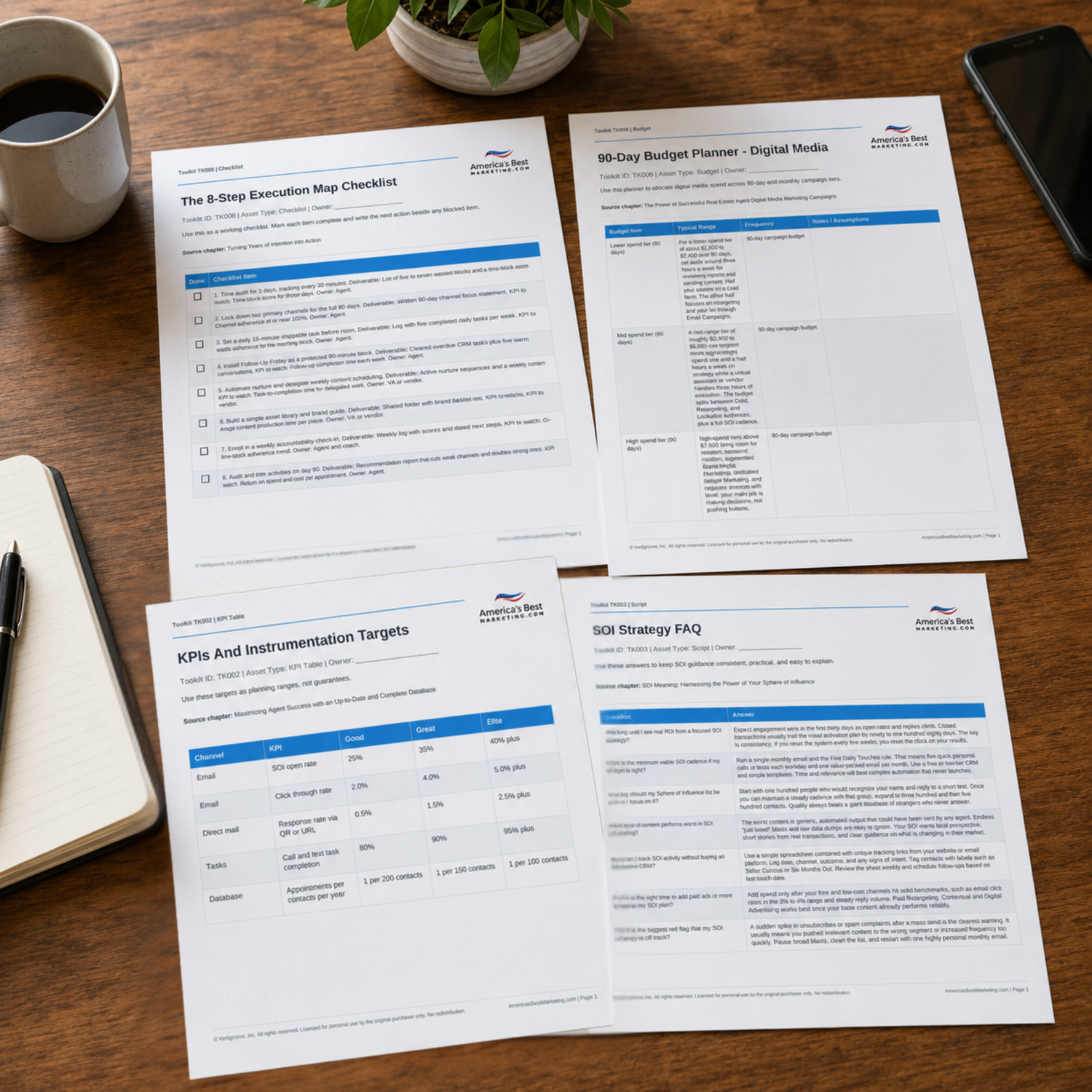
Download The Testimonial Content Toolkit
Use the companion Toolkit to plan testimonial outreach, organize objection-based proof, build weekly content assets, track KPI response, and turn client praise into clearer appointment-setting conversations.
Download the Toolkit ZIPRecommended reads
Recommended Reads for Real Estate Agents
These articles help agents connect follow-up discipline, database habits, client communication, and marketing execution into a repeatable system.

The 90-Day Real Estate Marketing Plan: Pillars, Budgets, & KPIs for Real Estate Agents
Make the 90-day real estate marketing plan more useful by tying the message, audience, and next step together.
Read article
Build a Relocation Lead Engine in Your City (Guide for Real Estate Agents)
Use relocation lead engine to strengthen visibility, follow-up, and client conversations without adding more random tasks.
Read article
Tax Benefits of Investment Property: Real Estate Agent Talking Points + Investor Content Angle
Make tax benefits of investment property more useful by tying the message, audience, and next step together.
Read article
25 Proven Real Estate Marketing Ideas for Spring
Make 25 proven real estate marketing ideas for spring more useful by tying the message, audience, and next step together.
Read articleTestimonial Content Questions Agents Should Be Ready To Answer
Should I use a client full name or only initials in testimonial content?
Full names build stronger trust when you have written permission and the client is comfortable being quoted. Use initials when privacy is sensitive, the story involves financial detail, or the client asks for a lighter public footprint.
How often should real estate agents post testimonial content?
Most agents can publish one testimonial-based asset each week without sounding boastful. Rotate proof posts with education, local insight, listing process content, and database follow-up so the feed feels useful instead of self-congratulatory.
What if a review is positive but does not answer a clear objection?
Use broad praise in Stories, website sidebars, email signatures, and about-page proof sections. Save your strongest feed posts for quotes that answer a real hesitation around cost, timing, communication, local knowledge, or deal complexity.
Can I reuse reviews from major platforms on social media?
Usually yes, but respect platform terms and client privacy. Keep the meaning accurate, avoid editing the quote into something the client did not say, and get permission before using a full name, photo, or sensitive transaction detail.
How do I turn a testimonial viewer into a booked appointment?
Match the next step to the story. A fee-related testimonial can offer a seller net sheet. A communication testimonial can offer a timeline checklist. Reply quickly with a booking link or two specific appointment windows.
Is video better than a quote graphic for testimonial content?
Short video proof often earns better reach, while carousels and quote graphics can earn more saves and shares. Use both. Lead with a focused Reel, then follow with a carousel or email that explains the full client story and next step.
Next step
Build the System Behind the Advice
Continue from one useful article into the larger ABM ecosystem: the book series for strategic depth and the full marketing program for done-for-you execution.

View the Book Series
Explore the America’s Best Real Estate Agent Marketing System books for a deeper strategic framework around visibility, referrals, listings, lead generation, and growth.
View the Book Series
See Full Marketing Program
See how AmericasBestMarketing.com runs real estate blog writing, social media, listing marketing, email, direct mail, and retargeting as one managed system.
See Full Marketing Program