Staging Storytelling: Visual Frameworks for Photos, Reels, and Open Houses
Staging Storytelling
Visual Frameworks for Photos, Reels, and Open Houses
A listing-marketing workflow for real estate agents who want one staged home to produce stronger photos, sharper short-form video, cleaner email, better open house flow, and measurable buyer intent.

Staging Storytelling turns one staged listing into a campaign
Staging Storytelling is a repeatable listing marketing workflow where an agent turns staging decisions into buyer-facing story beats. The point is not prettier content for its own sake. The point is a consistent visual narrative that earns saves, shares, listing page clicks, direct messages, showing requests, and better follow-up conversations.
- Start with one lifestyle promise before you brief the photographer, record Reels, write captions, or plan the open house.
- Capture wide anchors, micro-moments, and motion paths in one planned pass so every channel supports the same story.
- Use intent signals such as saves, shares, listing clicks, direct messages, scans, and showing requests instead of treating views as the scoreboard.
- Operationalize the workflow across listing photos, short-form video, email, open house cards, and retargeting so the listing stays visible after the first touch.
Why Staging Storytelling Pays Off
Most listing campaigns lose leverage because the staging, photography, video, email, advertising, and open house experience are treated as separate jobs. The home may look polished, yet the campaign feels fragmented. A buyer sees one story in the photos, a different tone in the Reel, a generic email in the inbox, and bland signs during the walkthrough.
Staging Storytelling fixes that operational gap. You define the lifestyle the listing should sell, capture the proof once, and repurpose the same proof across every touchpoint buyers and sellers see. That makes the campaign more coherent and makes the agent look more disciplined. It also reinforces the trust principles in Building a Trusted Brand: The Key to Attracting Target Audiences Over Paid Leads and Mass Marketing.
For sellers, the workflow gives listing marketing a visible strategy instead of a vague promise to post online. For buyers, it helps the home feel understandable before the showing. For the agent, it creates content assets that can feed social, email, open house follow-up, Listing Marketing, and Retargeting & Contextual Ads without restarting the creative process every week.
- You reduce creative waste by planning the campaign before the shoot begins.
- You create stronger seller confidence because the marketing plan has visible sequencing.
- You give buyer follow-up a specific reason to continue after the first showing, click, scan, or direct message.
How The Visual Framework Works
Start with one sentence: this listing helps the right buyer live better because it makes daily life easier, calmer, more social, more private, more flexible, or more memorable. That sentence becomes the filter for every shot, caption, email subject line, open house card, and follow-up note.
Staging sits at the intersection of interior design and digital cinematography. Design sets the room. Cinematography controls sequence, attention, pace, and proof. Strong agents use both to create a clean story instead of a random tour.
Choose the lifestyle claim
Define the benefit the home should own. Examples include calmer mornings, better hosting, easier remote work, stronger storage, lower-maintenance weekends, or a better indoor-outdoor rhythm.
This promise prevents creative drift because every asset has a single strategic job.
Capture the evidence
Document the rooms, textures, light, sightlines, storage, doorways, and movement paths that prove the promise visually.
Use both wide anchors and detail shots so the viewer understands the house and remembers the feeling.
Repurpose with discipline
Turn one capture session into listing photos, Reels, email visuals, open house room cards, follow-up prompts, and paid visibility.
The point is controlled repetition, not channel-by-channel reinvention.
Most agents think visual storytelling is about architecture. It is really about implied lifestyle. Light on a breakfast nook, a quiet work corner, the path from kitchen to patio, and the texture of a countertop all help a buyer imagine ownership before they request a showing.
The 60-Minute Visual Audit
Before you walk the home, decide where the assets will go. The short-form cut supports Social Media Marketing. The still set supports Email Marketing for Real Estate Agents. Listing page clicks should land on your IDX Real Estate Websites property page. Stronger assets can then support retargeting and open house follow-up.
- Minute 0 to 10: Choose three story beats. Example: morning routine, hosting flow, and outdoor reset.
- Minute 10 to 25: Capture five to seven wide anchors. Keep each clip steady, level, and long enough to orient the viewer.
- Minute 25 to 45: Capture ten to twelve micro-moments. Focus on texture, light, storage, views, work corners, doors opening, and details people remember.
- Minute 45 to 55: Capture human-scale motion paths. Entry to living room, kitchen to patio, hallway to primary suite, and garage to drop zone are practical sequences.
- Minute 55 to 60: Record three voice lines and one quiet room tone clip. These become your editing safety net.
One Story, Multiple Touchpoints
The mistake is trying to invent a new campaign for every channel. A better system uses the same story beats, then changes the format based on where the buyer or seller sees it.
| Channel | Asset to publish | Strategic job | Intent signal to track |
|---|---|---|---|
| Listing photos | Eight to twelve stills sequenced wide to detail. | Help buyers understand flow and finish quality before they tour. | Saves, listing clicks, showing requests. |
| Short-form video | A 12 to 18 second Reel plus one 6 to 8 second teaser. | Earn attention fast and prove the lifestyle promise with motion. | Shares, profile taps, direct messages. |
| Three-image story, one benefit headline, one property link. | Move warm contacts from passive awareness to active curiosity. | Clicks, replies, forwarded email. | |
| Open house | Three room cards plus one QR sign at the exit. | Make the in-person walkthrough feel intentional and memorable. | Scans, opt-ins, follow-up replies. |
| Retargeting | Best still, best six-second clip, and one simple CTA. | Keep the listing visible after the first visit without overexplaining. | Return visits, listing clicks, message starts. |
Hooks, Overlays, And CTAs That Keep The Story Clean
Your first two seconds and first eight words do most of the work. The hook should show the payoff, not introduce the house like a brochure. Use spoken-sounding language and pair every line with a shot that proves it.
The Lifestyle Proof Tour
Short-form sequence
Hook lineThis is the weekday morning kitchen buyers remember.
Build lineShow the path from island to patio, then cut to a coffee nook, pantry wall, or storage detail.
CTA lineComment TOUR and I will send the link.
Use this story beat when the home has a clear daily-life advantage that still photos alone may understate.
The Problem, Then The Fix
Short-form sequence
Hook lineMost homes waste this corner. This one uses it.
Build lineReveal storage, light, or layout that makes the space useful, then cut back to the full room.
CTA lineSave this before your weekend showings.
Use this beat when the listing has a small detail that changes how the home actually lives.
The Hidden Feature
Short-form sequence
Hook lineThis does not photograph well, but it changes daily life.
Build lineShow the feature in real use, then return to the room so the buyer can connect benefit and layout.
CTA lineMessage me for the showing window.
Use this beat when the asset is practical, valuable, and easy to miss during a fast scroll.
Budget And Cadence Planning
Pick the level you can execute for a full 90-day cycle. Consistency beats an ambitious launch that disappears after one listing.
| Tier | Setup | Spend | Cadence |
|---|---|---|---|
| Low tier | Phone-only capture and basic editing. | $0 to $450 | Two Reels per listing, one still set, one email, and three open house story cards. |
| Mid tier | Saved editing patterns, batching, and light paid traffic. | $600 to $1,800 | Four Reels per listing, two email touches, one retargeting audience, and weekly creative review. |
| High tier | Paid distribution layer and stronger creative rotation. | $1,800 to $5,400 | Six Reels per listing, weekly email pulse, always-on retargeting, and open house conversion tracking. |
The Visual Storytelling Mastery Checklist
Use this before every listing launch. It turns the creative process into a repeatable quality control system instead of a scramble after the photographer leaves.
- Write one lifestyle promise in plain English.
- Choose three story beats that prove the promise.
- Lock framing rules for vertical video and still photos.
- Capture five wide anchors that establish room order.
- Capture ten micro-moments that sell texture, light, storage, and use.
- Record one clean voice line for each story beat.
- Edit one 12 to 18 second Reel and one 6 to 8 second teaser.
- Export an eight-photo still set that matches the same story beats.
- Build open house room cards using the same words as your captions.
- Track saves, shares, taps, listing clicks, direct messages, and showing requests for seven days.
Mini Case Pattern: Expired Listing Reset
Here is a fictional pattern you can mirror. A boutique team took over a luxury listing that had expired and stopped leading with the house as the headline. They rebuilt the campaign around one lifestyle promise: easier hosting without wasted space.
The team used the same three story beats in photos, short-form video, email, and open house signage. In 11 days, the campaign produced stronger intent signals measured by saves, direct messages, listing page clicks, and showing requests. The lesson is not that every listing will perform the same way. The lesson is that one promise, three proof beats, and clean distribution beat scattered posting.
Close the loop by making every interaction match the promise. If the Reel says the listing lives well for hosting, the open house cards, agent talking points, follow-up email, and retargeting message should all reinforce that same story. That discipline is the practical extension of Your Brand is Built on Every Interaction: Managing Client Touchpoints for Lasting Success.
What I Would Do Next
Action one: audit one active or upcoming listing. Write the lifestyle promise, identify three proof beats, and check whether your photos, vertical video, email, open house signs, and follow-up language all point to the same story.
Action two: operationalize the workflow. If your team needs the capture plan, posting cadence, retargeting layer, and follow-up rhythm built around real capacity, America’s Best Marketing can run the marketing system for you.
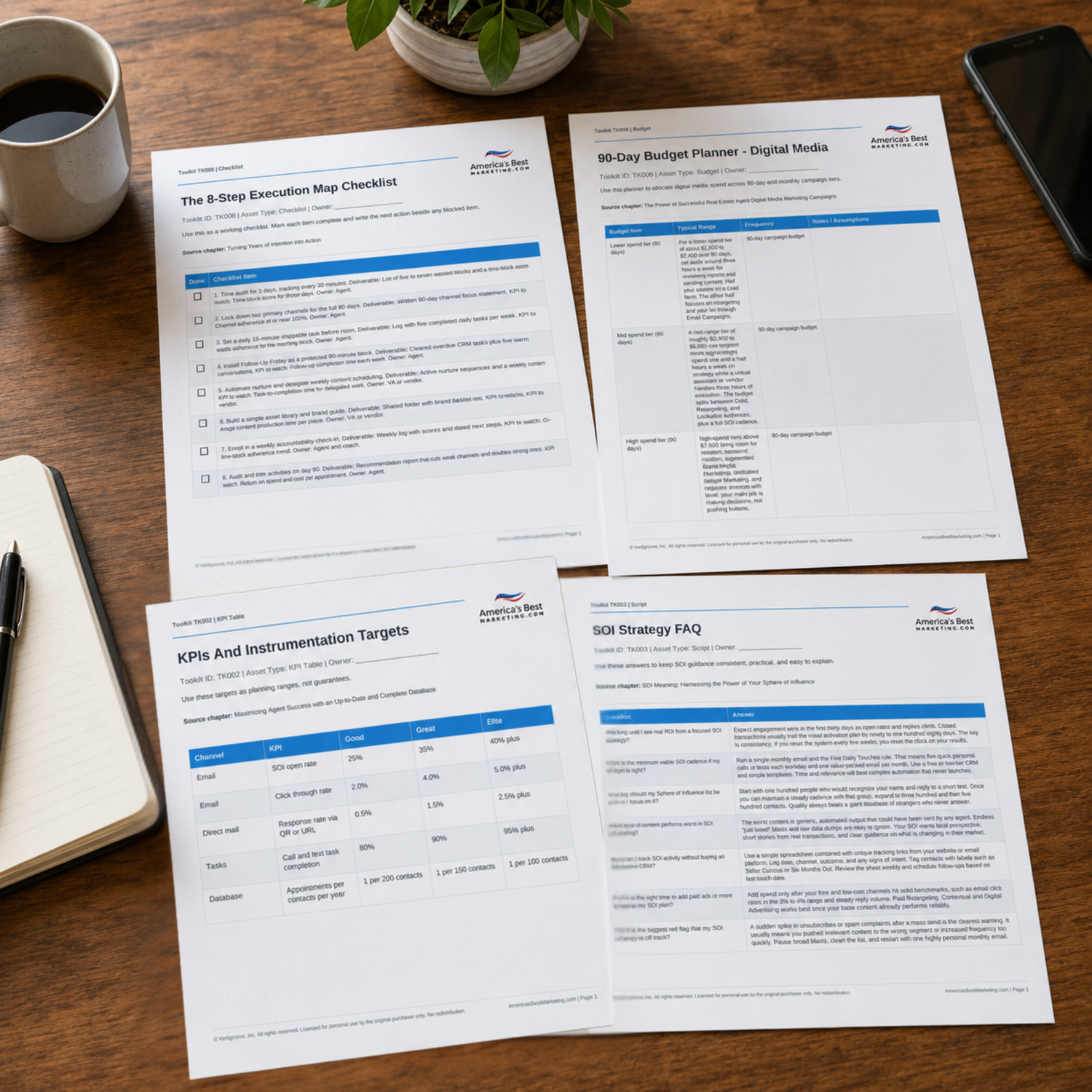
Download The Staging Storytelling Toolkit
Use the companion Toolkit to plan the listing story, organize the visual audit, choose short-form hooks, set a 90-day cadence, brief open house touchpoints, and track buyer intent signals.
Download the Toolkit ZIPRecommended reads
Recommended Reads for Real Estate Agents
These articles help agents connect listing visibility, seller education, marketing channels, and follow-up into a clearer growth system.

YouTube for Real Estate Agents: A Content Plan That Drives Listings Without Going Viral
Turn short-form and client-proof videos into a repeatable part of weekly marketing.
Read article
Outdoor Lifestyle Neighborhood Guides: Searchable Relocation Content Real Estate Agents Can Publish
Turn search visibility into a clearer publishing system for neighborhoods, services, and client decisions.
Read article
Short-Form Video Marketing for Real Estate Agents: Strategy + Calendar
Give short-form video marketing a clearer role in the marketing system instead of treating the work as a one-off idea.
Read article
Video Checklists for Real Estate Agents: Property Tours, Reels, Testimonials
Plan social content with stronger themes, better cadence, and clearer reasons for people to engage.
Read articleStaging Storytelling Questions Agents Should Be Ready To Answer
How fast should I publish after a listing is staged?
Publish the first asset the same day the listing is captured, even when it is only a short micro-moment clip. Then batch the remaining stills, Reels, email visuals, and open house prompts over the next seven days so the story stays visible without repeating the same post.
What is the minimum viable cadence for Staging Storytelling?
Start with two short-form posts, one still set, one email pulse, and three open house story cards per listing. One post should establish the room flow. The second should show micro-moments that sell lifestyle. Hold that cadence for a full 90-day cycle before adding complexity.
Which metrics show buyer intent instead of casual scrolling?
Track saves, shares, profile taps, listing page clicks, direct messages, and showing requests. Saves often signal future action. Shares often signal spouse, family, or friend validation. When those signals rise together, the listing story is working.
How do I keep captions from becoming feature lists?
Write each caption as cause and effect. Start with the lifestyle problem the room solves, then show the detail that proves it. Keep upgrade lists in the property description. For social, use one benefit, one proof detail, and one next step.
What is the safest way to show people in property content?
Use implied lifestyle instead of identifiable faces unless you have clear permission and brokerage approval. Film hands setting a table, a door opening to the patio, or a person walking through a room from behind. Keep every storyline compliant with fair housing rules and local policy.
How long does ROI usually take for this workflow?
Expect a ramp period, not an instant hit. The strongest lift usually comes after several listing cycles because the audience learns the agent’s visual style. Treat the first 30 days as setup, the next 60 days as repetition, then judge lead quality and follow-up conversations.
What content creates a compliance red flag?
Avoid visuals that misrepresent condition, hide flaws with aggressive angles, imply guaranteed value, or suggest steering toward or away from protected classes. Show what is real, frame the benefit honestly, and keep the documentation clean.
Next step
Build the System Behind the Advice
Continue from one useful article into the larger ABM ecosystem: the book series for strategic depth and the full marketing program for done-for-you execution.

View the Book Series
Explore the America’s Best Real Estate Agent Marketing System books for a deeper strategic framework around visibility, referrals, listings, lead generation, and growth.
View the Book Series
See Full Marketing Program
See how AmericasBestMarketing.com runs real estate blog writing, social media, listing marketing, email, direct mail, and retargeting as one managed system.
See Full Marketing Program