How to Turn a Client into a Raving Fan
How to Turn a Client into a Raving Fan
The 12-Month Post-Close Advocacy System
A practical follow-up system for real estate agents who want reviews, referrals, and repeat conversations after closing without turning past clients into a spam list.

Turn post-close follow-up into a referral system
A raving fan is not created by one good closing gift. A raving fan is created when the client remembers the service, keeps receiving useful support, and has a simple way to introduce the agent when someone in their world starts talking about a move.
- The fastest way to lose future referrals is to disappear after closing.
- A 12-month post-close cadence gives every client a clear path from transaction to review, referral, and repeat conversation.
- The strongest systems pair email, direct mail, selective text, social proof, and CRM tracking instead of relying on memory.
- Referral ROI starts with process signals such as reviews, replies, introductions, and event RSVPs before it shows up as closed deals.
Why Raving Fans Are Built After Closing
Turning a client into a raving fan is not about being louder, needier, or more promotional. It is about designing the post-close experience so clients keep feeling served after the commission event is over.
The business case is straightforward. A past client who remembers you, hears from you with useful context, and knows exactly how to refer you becomes a lower-cost source of future business. The agent who owns that cadence needs fewer cold starts, fewer desperate asks, and fewer expensive lead channels to stay visible.
Three forces decide whether a happy closing turns into future advocacy. The first is the referral gap, which is the time between a good transaction and the next time someone in that client’s world needs an agent. The second is post-purchase dissonance, when homeowner questions and service issues can weaken the memory of the experience. The third is peak-end rule mastery, because clients remember the sharpest emotional moment and the ending.
- The ghosting trap happens when communication stops as soon as the transaction closes.
- Inconsistent touchpoints force one holiday card to do the job of a year-round relationship system.
- Asking too early weakens the referral request before the agent creates a clean final memory.
- Ignoring social proof means reviews, testimonials, and client wins never become reusable trust signals.
- No measurement turns referrals into luck instead of a pipeline with inputs.
Start with one operating rule. If your CRM has a close date, it needs a 12-month follow-up plan. No plan means you are choosing churn by default.
The 12-Month Advocacy Playbook
This playbook is built to survive busy weeks. It uses short actions, simple scripts, and a cadence that can be delegated or automated. Run the system in three phases: the Victory Lap, the Value Phase, and the Community Phase.
The Victory Lap
Create a peak moment, lock in the memory, and collect proof while the client’s excitement is still high.
- Send a quick thank-you message on closing day.
- Capture one simple client-centered photo or story.
- Deliver one final practical win, such as a vendor intro or homeowner checklist.
- Ask for a review after the final win, not before it.
The Value Phase
Reduce dissonance and stay useful without spamming the client.
- Send a monthly equity or market update with one practical interpretation.
- Share seasonal homeowner reminders tied to local conditions.
- Offer trusted vendor recommendations when they solve a real problem.
- Ask one useful question instead of pushing a pitch.
The Community Phase
Move from useful contact to connected relationship.
- Invite clients to a small appreciation event or local partner moment.
- Prepare a home anniversary note before the one-year mark.
- Send one personal mail touch that feels specific and human.
- Make referrals easy by giving clients a short message they can forward.
Closing day social copy can stay simple: Congratulations to the Smith family on their new home. New chapter, new keys, and a smooth close thanks to a strong plan and a great team.
Route comments, direct messages, and private congratulations into your CRM. That is where the advocacy loop starts turning into measurable pipeline.
The first 30 days after closing carry unusual referral leverage because the new-home story is still fresh. Treat closing as day one of a three-year advocacy loop. The question is not whether the client liked you. The question is whether your follow-up makes you the obvious agent to mention when a move conversation starts.
The Soft-Ask Referral Script
Referral asks work best when they feel calm and easy to act on. Use the script after you have delivered a strong final service moment, not during the stressful parts of the transaction.
The post-close review ask
Client dialogue
Opening lineYou have been great to work with, and I am grateful I could be part of this move.
Value lineIf one part of the process made things easier, one sentence about that would help the next client know what to expect.
CTA lineHere is the review link. One short sentence is more than enough.
Use this after a clean closing, a useful vendor introduction, or a homeowner checklist that solves an immediate problem.
The soft referral ask
Client dialogue
Opening lineYou have been great to work with, and I care how the move settles in.
Value lineIf someone you know is thinking about a move, I will take care of them the same way.
CTA lineWant me to send you a one-sentence text you can forward when it comes up?
Log the response as a referral conversation, not as a vague note. The system is only measurable when the CRM captures the signal.
The anniversary reconnect
Client dialogue
Opening lineOne year in the house is a good moment to look at what changed around you.
Value lineI pulled a simple market snapshot so you can see the local activity without chasing headlines.
CTA lineReply with one question and I will point you to the right next step.
This message works because it is useful before it asks for anything. That keeps the relationship warm without making the client feel managed.
Budgets And Briefs That Keep The System Running
Most referral systems fail because they are vague. These two budget levels make the cadence concrete and easy to execute. Use the same calendar every month. Change the content, not the structure.
Spend $120 to $220 monthly for 100 past clients. Run one email, one handwritten note batch, and one small printed piece per quarter. Keep the audience split at 70 percent past clients and 30 percent close friends or family of clients, with no more than two touches per month across all channels.
Spend $350 to $650 monthly for 250 past clients. Run two emails per month, one segmented mailer monthly, and one quarterly client event. Keep the audience split at 60 percent past clients, 25 percent warm sphere, and 15 percent local partners, with one pure-value touch every month.
Creative Brief 1: Capture social proof within 10 days of closing. The audience is the client and the close circle that sees the win. The call to action is simple: leave one sentence about what mattered most.
Creative Brief 2: Reduce post-close uncertainty during the first six months. The audience is new homeowners with questions and small problems. The call to action is useful: reply with one question and I will point you to the right resource.
KPI Tables That Predict Referral Momentum
This cadence keeps the agent visible without overwhelming the client. Treat each KPI as a target benchmark, not a guarantee.
| Timeframe | Action Item | Primary Channel | KPI |
|---|---|---|---|
| Day 1 | Closing day celebration post and thank-you message. | Social | 3% to 6% engagement |
| Day 7 | Testimonial request after one small follow-through win. | 20% to 35% completion | |
| Month 3 | Homeowner resource note with one practical local recommendation. | Direct mail | 2 to 6 replies |
| Monthly | Market equity report with one local note and one next step. | 2% to 5% clicks | |
| Quarterly | Personal mail touch, client event invite, or partner spotlight. | Mail or event | 5% to 12% response signal |
| Metric | Target | Range | How to use |
|---|---|---|---|
| Review asks | Track monthly. | 6 to 12 | Keep each ask tied to a specific service win and a clean mobile-friendly link. |
| Email clicks | Track monthly. | 2% to 5% | Use one call to action per email and keep the first paragraph short. |
| Warm replies | Track monthly. | 3 to 9 | Count replies that start conversations, not low-intent reactions. |
| Referral mentions | Track quarterly. | 2 to 5 | Log every client who says they mentioned you, even before a formal introduction happens. |
The 10-Point Raving Fan Audit
Run this audit on your last 10 closings before you add new tactics, channels, or event spending.
- Every close date triggers a 12-month task set in your CRM.
- You have one review link that works on mobile and desktop.
- You send a day-7 testimonial request tied to a specific win.
- You publish one closing celebration post that highlights the client.
- You have a monthly equity update structure ready to reuse.
- You maintain a localized vendor list that you refresh quarterly.
- You have direct mail pieces ready for month 3 and month 9 touchpoints.
- You track replies, reviews, introductions, and referral mentions separately.
- You have a referral thank-you protocol that is consistent and compliant.
- You can name the next touchpoint for every recent client without searching your notes.
Mini Case Pattern: The Shift From Paid Leads To Advocacy
An agent running steady volume realized too many deals were coming from expensive cold-lead sources while past clients were quiet. The agent started with the most recent 100 clients and added a simple post-close system.
The system included monthly equity updates, quarterly personal touches, and review requests after a clear follow-through moment. The agent also changed the closing gift into a closing experience clients naturally mentioned on social.
The lesson is not that paid channels disappear. The lesson is that past clients should produce measurable conversations when the agent keeps serving them. A good advocacy system gives the agent a warmer pipeline and more flexibility in the marketing budget.
What I’d Do Next
Build the referral fortress by treating post-close as a pipeline stage, not an afterthought. Your job is to be useful, consistent, and easy to refer.
Start with two actions today. Audit your last 10 closings and identify who never received a review ask, equity update, personal note, or referral-friendly follow-up. Then add the 12-month cadence to your CRM so every new closing automatically creates the next relationship step.
For a done-for-you version of this system, explore email marketing for real estate agents, direct mail for real estate agents, and the full real estate marketing program from AmericasBestMarketing.com.
Download The Raving Fan Toolkit
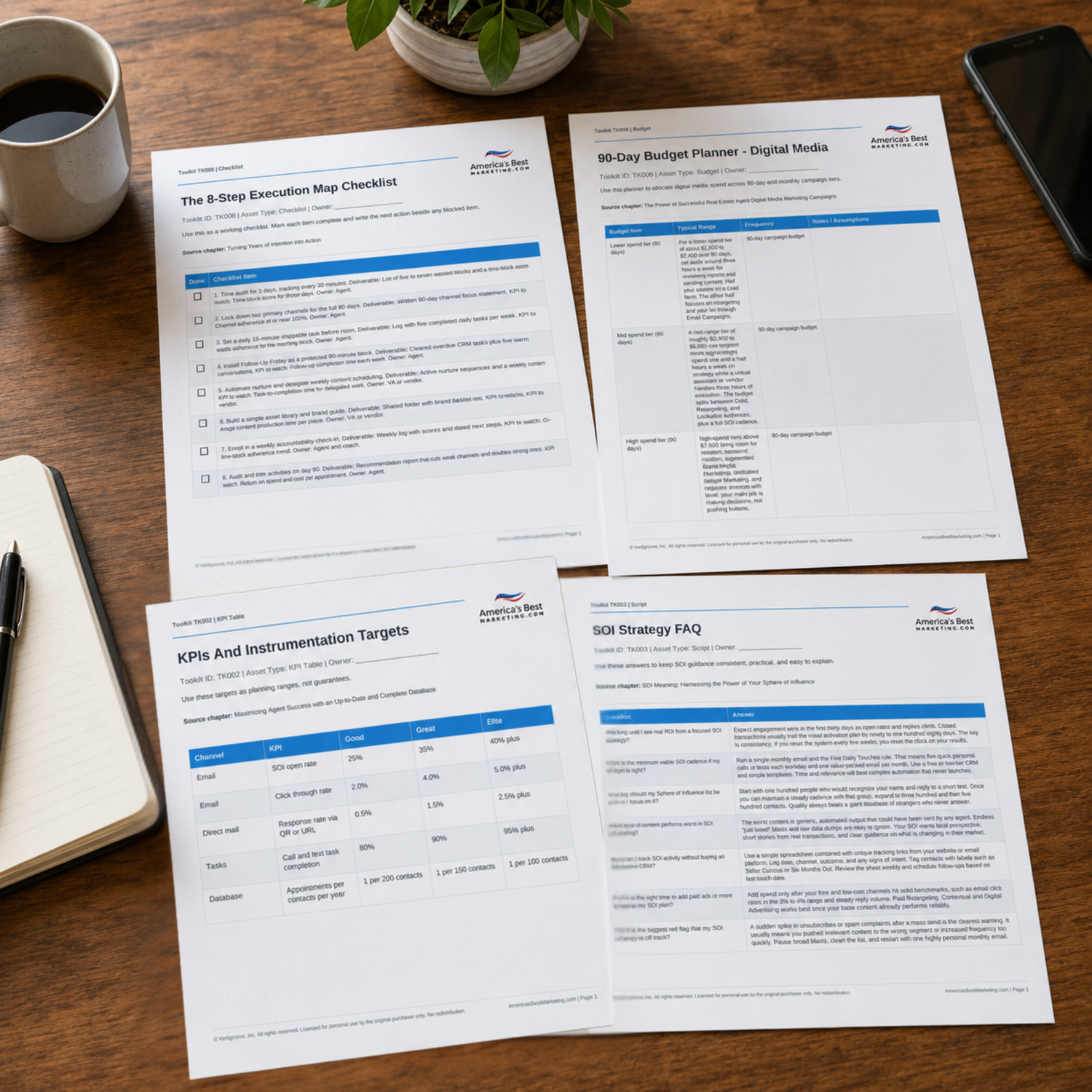
Use the companion Toolkit to turn your post-close plan into working assets, including a budget planner, audit checklist, 12-month advocacy playbook, referral KPI tracker, client FAQ prompts, and soft-ask script.
Download the Toolkit ZIPRecommended reads
Recommended Reads for Real Estate Agents
These articles help agents connect relationship marketing, client education, consistent follow-up, and channel strategy into a stronger referral system.

How to Master the Art of Follow-Up with Past Clients
Create referral momentum with relationship content, event ideas, and timely reasons to reconnect.
Read article
Pay Off a Mortgage Early: Real Estate Agent-Friendly Explainer + Content Angle for Homeowners
Make “pay off a mortgage early” more useful as an authority-content topic by tying the homeowner question to a clear audience, message, and next step.
Read article
Building a Personal Brand as a Real Estate Agent: From Your Bio to Your YouTube Channel
Make the agent’s brand easier to recognize through clearer positioning, touchpoints, and proof.
Read article
Client Events for Real Estate Agents: Plans, Budgets, and Follow-Up That Earn Referrals
Stay remembered by past clients and sphere contacts with better touchpoints and less awkward outreach.
Read articleReferral System Questions Agents Should Be Ready To Answer
How long does it take to see measurable ROI from a referral system?
Expect early signals in 30 to 90 days through replies, reviews, and introductions. Real deal flow usually shows up after 6 to 12 months of consistent post-close follow-up. Track review asks, reply rates, event RSVPs, and referral conversations first. Then connect closed referral deals back to the touchpoints that happened before the introduction.
What is the best way to ask for a referral without sounding desperate?
Ask after you deliver one clear, memorable win, not during the stressful parts of the transaction. A strong referral ask removes friction by offering a one-sentence text the client can forward. Keep the tone calm, useful, and service-first. If the client does not respond, keep serving them and ask again after another value moment.
How often should real estate agents contact past clients?
Two touches per month is a strong baseline for most databases. Pair one useful market or homeowner update with one personal or local touch so the cadence feels relevant instead of automated. Increase frequency only for clients who reply or engage. When in doubt, make the message shorter and more specific instead of sending more often.
Should post-close follow-up use email, text, or direct mail?
Use the channel based on the job it needs to do. Email scales useful updates, direct mail creates a physical reminder, and text works best for quick check-ins or simple asks. For past clients, the strongest system usually pairs monthly email with quarterly mail and selective personal texts. Every touch should have one purpose and one next step.
What should an equity update include without making risky claims?
Use ranges, neutral language, and current market context. Share a simple snapshot of recent local activity, note what changed since the last update, and offer one next step such as a short review call. Avoid guarantees about future value. The point is to give past clients a steady read on the market, not to predict the future.
How do agents get more reviews without pestering clients?
Make the ask easy, specific, and well timed. Send one link, ask for one sentence about what mattered most, and follow up once if they miss it. The bigger lever is timing. Ask after a peak service moment, such as a clean closing, a useful vendor introduction, or a homeowner checklist that solves an immediate problem.
What is a clean referral thank-you protocol?
Keep the thank-you consistent, modest, and gratitude-first. A handwritten note and a small brand-appropriate gift can work well when they follow local brokerage and compliance rules. Document the protocol so every referral source receives the same kind of acknowledgment. Ask your broker for state-specific guardrails before using incentives at scale.
Next step
Build the System Behind the Advice
Continue from one useful article into the larger ABM ecosystem: the book series for strategic depth and the full marketing program for done-for-you execution.

View the Book Series
Explore the America’s Best Real Estate Agent Marketing System books for a deeper strategic framework around visibility, referrals, listings, lead generation, and growth.
View the Book Series
See Full Marketing Program
See how AmericasBestMarketing.com runs real estate blog writing, social media, listing marketing, email, direct mail, and retargeting as one managed system.
See Full Marketing Program