Real Estate Direct Mail Tips That Actually Work: A Guide for Real Estate Agents
Real Estate Direct Mail That Actually Works
A Twelve-Month Guide for Real Estate Agents
A practical operating brief for choosing the right farm, building a recognizable mailing cadence, producing stronger creative, measuring response, and connecting print to digital follow-up.

What makes real estate direct mail work
Real estate direct mail works when the same well-defined farm receives a recognizable message every four to six weeks for at least twelve months. The strongest campaigns use one clear objective, one visible call to action, campaign-specific tracking, and fast follow-up through phone, landing pages, email, and digital retargeting.
- Protect cadence first. A smaller farm mailed consistently is more valuable than a larger list reached once or twice.
- Build every piece around one audience, one message, one image, and one measurable next step.
- Judge early campaigns by calls, scans, repeat site visits, and saved mailers before judging them only by closings.
- Connect mail to email and retargeting so warm prospects keep seeing the same brand after the postcard leaves the kitchen table.
Why Direct Mail Still Works For Real Estate Agents
Direct mail still reaches the kitchen table where many homeowners discuss whether to sell, refinance, relocate, or wait. It creates physical presence in a way that a fleeting social post cannot. When the design is recognizable and the message is relevant, the card becomes a reminder that a local agent is available before the owner is ready to make a public move.
The operating model is straightforward. Commit to a twelve month plan, reach the same homes every four to six weeks, and track every call, scan, and form fill. The payoff is stronger recognition inside the farm, a steady flow of listing conversations, and a lower-drama channel that supports the rest of the marketing system. SOI Marketing: The Power of Direct Mail Campaigns shows how physical touches can reinforce relationships that already exist.
Direct mail also bridges physical attention and digital action. A homeowner sees the piece on the counter, searches the agent’s name, visits the website, or scans a code. The mailer starts the interaction. Search, email, and retargeting continue it.
- Mailing once or twice rarely creates enough recognition to change behavior.
- Generic stock cards with tiny copy and weak headlines are easy to ignore.
- Campaigns without unique tracking cannot prove which mailer created the response.
- Mail without digital follow-up allows warm prospects to cool before the next contact.
Build A Direct Mail System Your Market Can Recognize
Start with a tight list. Choose a farm where you already have some presence, such as past clients, open house visitors, a neighborhood where you live, or a cluster around a recent sale. Clean the addresses, confirm owner names, and make sure the home values and turnover support the commission opportunities you want.
Then build a content rotation instead of sending disconnected ideas. Alternate proof pieces, education pieces, and value offers. Monthly Direct Mail for Real Estate: The 12-Month Agent Playbook provides a practical monthly framework you can tailor to recent sales, local market shifts, seasonal questions, and the conversations owners are already having.
Choose a list you can afford to keep
Build around four hundred to one thousand homes in a clear price band. Confirm owner names, remove returned mail, and exclude records that do not support the campaign objective.
Protect the mailing frequency by reducing list size before reducing cadence. Recognition is the asset you are buying.
Rotate proof, education, and offers
Use Just Sold stories for proof, market snapshots for education, and home value checks for response. Keep the visual system consistent so every piece belongs to one brand story.
Change the angle without changing the identity. The farm should recognize the agent before reading the headline.
Give every response a source
Use one campaign phone number, short landing page, or trackable code. Tag every call, scan, and form fill in the CRM.
Measure repeat visits and branded searches as well as direct replies. Quiet signals often appear before listing appointments.
Response rate is the better first gauge because it shows whether the farm notices the campaign. When response rises but appointments stall, repair the offer and follow-up before blaming the mailer.
Three High-Response Mailer Frameworks
Strong direct mail does not need more copy. It needs a sharper promise, a cleaner proof point, and a next step a homeowner can understand in seconds. Use these frameworks as repeatable production briefs rather than one-time creative experiments.
The Just Sold social proof postcard
Mailer copy
HeadlineHomes like yours are selling stronger than the headlines suggest.
Story lineName the street, the sale price band, the days on market, and one decision that helped the seller.
CTA lineCall or scan for a quick price check on your address.
Send within thirty days of closing to streets near the sale. Use the strongest listing image, keep the back focused on the story, and follow with a market update in the next cycle.
The market update value card
Mailer copy
HeadlineYour neighborhood market snapshot in one simple view.
Data lineShow total sales, median price, and average days on market for the past ninety days.
CTA lineScan or visit for a custom value range for your home.
Use one clean chart instead of a crowded data wall. Match the design to your Listing Marketing assets so the mailbox and landing page feel like one campaign.
The home value check offer
Mailer copy
HeadlineCurious what your equity looks like in this market?
Promise lineReceive a short value range with zero pressure to list.
CTA lineCall, text, or scan the code to request the estimate.
Spell out what the owner receives and pair the offer with Email Marketing for Real Estate Agents so every response gets a fast, consistent reply.
Budget And Time Plans For The Next Ninety Days
Use ninety day blocks to keep the program operational. Choose a budget, lock three mailing dates, and review the numbers after the third drop. Do not wait a full year to improve the offer, but do not quit after the first mailing because recognition has not had time to compound.
Mail four hundred to six hundred homes every six weeks. Use one oversized Just Sold or market update card with a strong front and a focused story on the back. Spend roughly three hundred to six hundred dollars per drop at about sixty to eighty cents per piece. Keep the same layout for all three drops so recognition can build.
Mail eight hundred to fifteen hundred homes every four weeks. Rotate Just Sold, market update, and value check offers inside one visual system. Use postal walk routes at roughly fifty to seventy cents per piece. Plan a quarter budget of two thousand to four thousand dollars and refresh the message by the third drop.
Lock the dates before creative production begins. Give each quarter one objective such as valuation requests or listing consultations. Use one phone number or landing page across the series so the response data stays clean.
| Campaign Tier | Plan Summary | Ninety Day Spend | What The Numbers Tell You |
|---|---|---|---|
| Starter farm | Mail five hundred homes three times | $900 to $1,200 | Expect more site visits and saved postcards than direct listing calls during the first recognition cycle. |
| Mid-level farm | Mail one thousand homes three times | $1,800 to $2,700 | Look for repeat callers, valuation requests, and a visible lift in branded search and landing page traffic. |
| High-volume farm | Mail fifteen hundred homes three times | $2,700 to $4,000 | Track cost per conversation and whether the larger audience produces several serious listing opportunities. |
What To Track From Every Mailing
Track response rate, cost per lead, appointment rate, signed listing rate, and the ripple effect across the website and social channels. Count calls, scans, and form fills from every drop. Then track how many responses become appointments and how many appointments become signed listings.
Use unique phone numbers or short landing page paths so offline response is easy to attribute. Add tracking parameters to the next links in the journey and place visitors into Digital Retargeting audiences so you can see how mail-driven traffic behaves after the first visit.
Also record qualitative signals. Note when people save a postcard, bring it to a meeting, mention it during a call, or visit the site repeatedly before reaching out. The Science of Staying Top-of-Mind: How Direct Mail Keeps Clients Coming Back explains why repeated physical touches can create staying power that a single digital impression rarely achieves.
Compliance And Data Hygiene For Your List
Every mailer must respect Fair Housing rules and basic ethics. Use inclusive language and imagery. Do not target or exclude people based on protected characteristics. Speak to homes, property decisions, and life-stage needs without implying who belongs in a neighborhood.
Data hygiene protects both reputation and budget. Remove returned mail, known moves, and people who ask to be removed. Confirm that list vendors source information legally, and keep simple notes on how each address entered the system.
- Review every headline, image, and audience filter for inclusive treatment.
- Remove undeliverable addresses after each campaign cycle.
- Document list sources and campaign dates.
- Honor removal requests quickly and consistently.
What Ninety Days Of Direct Mail Can Produce
Consider a fictional example. Alex focuses on a five hundred home farm with an average price of six hundred thousand dollars. Three mailers at eighty cents per piece create a total spend of twelve hundred dollars.
Across the three drops, fifty people scan the code or visit the landing page and twelve call or submit a form. Four become listing appointments and two become signed listings. One home sells at six hundred twenty thousand dollars and the other at five hundred eighty-five thousand dollars, creating roughly thirty-five thousand dollars in gross commission income.
Even after splits and expenses, the return is strong enough for Alex to double the farm in the next quarter. The lesson is not that every campaign will match those numbers. The lesson is that disciplined tracking makes the decision to scale or repair the campaign visible.
The High-Response Mailer Production Checklist
Use this sequence before the next print deadline so the audience, message, production, tracking, and follow-up stay aligned.
- Define a farm of four hundred to one thousand homes that match the target price range.
- Clean the list so every address has a current owner name and mailing status.
- Choose one quarterly objective such as valuation requests or listing consultations.
- Select a proven mailer format that prints affordably at the target volume.
- Write one bold headline that promises a specific benefit to the homeowner.
- Use one main image that supports the headline and keeps the design legible.
- Add one call to action with a campaign-specific phone number or landing page.
- Include a clear timing cue that gives owners a reason to respond soon.
- Schedule drops every four to six weeks before the first piece goes to print.
- Log every call, scan, form fill, appointment, and signed listing from the campaign.
No one remembers the first drop. They remember the pattern. Two months in, the campaign may still feel quiet, but the compounding effect appears in repeated site visits, saved cards, and owners who mention the mailer when they are finally ready to talk.
What I Would Do Next In Your Market
First, define the farm where you most want listings and where you already have some social proof. Second, choose one framework from this brief and send the first piece to print within the next two weeks. Third, lock the next two mailing dates before the first card lands.
Direct mail does not need to be fancy. It needs to be consistent, clearly written, and tied into the rest of the marketing stack. When list, creative, tracking, and follow-up are aligned, mail becomes a quiet engine that keeps the agent visible while digital channels continue the conversation.
When you want a partner to run the production and follow-up, use Direct Mail Marketing from AmericasBestMarketing.com so the farm, creative, campaign cadence, and response path operate inside one managed plan.
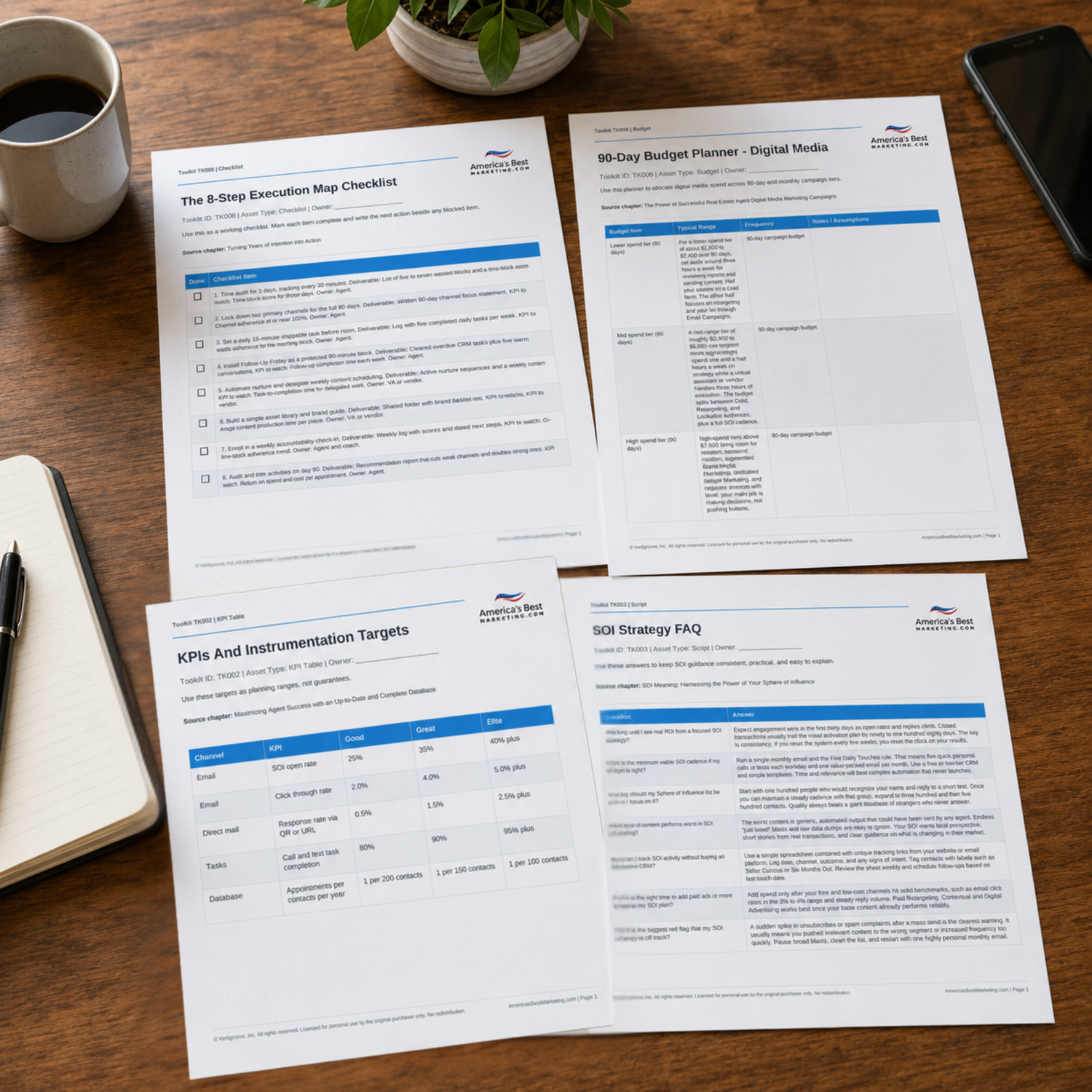
Download The Direct Mail Planning Toolkit
Use the companion Toolkit to plan the farm and budget, produce stronger mailers, rotate monthly themes, track response, and keep campaign follow-up organized across the next ninety days.
Download the Toolkit ZIPRecommended reads
Recommended Reads for Real Estate Agents
These articles help agents connect follow-up discipline, database habits, client communication, and marketing execution into a repeatable system.

Monthly Direct Mail for Real Estate: The 12-Month Agent Playbook
Turn print into a consistent relationship channel instead of a one-off postcard gamble.
Read article
Outdoor Lifestyle Neighborhood Guides: Searchable Relocation Content Real Estate Agents Can Publish
Turn search visibility into a clearer publishing system for neighborhoods, services, and client decisions.
Read article
How Contextual and Retargeting Digital Marketing Work for Real Estate Agents and Why They Matter More Than Ever
Make paid ads easier to evaluate by tying audience, creative, budget, and next step together.
Read article
SOI Marketing: The Power of Direct Mail Campaigns
Turn print into a consistent relationship channel instead of a one-off postcard gamble.
Read articleReal Estate Direct Mail Questions Agents Ask Most
Is direct mail still worth it for real estate agents?
Yes. Mail reaches owners through a quieter channel with less competition than crowded inboxes and feeds. When you commit to a clear message, a consistent cadence, and clean tracking, even modest response can create profitable listing conversations over a ninety day window and beyond.
How often should real estate agents send direct mail to a farm?
Aim for a drop every four to six weeks to the same core farm. That rhythm is frequent enough to build recognition without feeling aggressive. When the budget is tight, protect the cadence by shrinking the list instead of stretching the gap between mailings.
What is a good response rate for real estate direct mail?
Many agents treat one to three percent response as a healthy working range for a campaign that is dialed in. Count calls, scans, and form fills. Early drops may sit lower while the farm learns your name, so improve copy, offers, and follow-up instead of chasing one perfect percentage.
Should I send postcards or letters for real estate mailers?
Postcards are easier for busy owners to scan and usually cost less per piece. Letters feel more personal and can work well for higher price points or smaller lists. Many agents use postcards for broad farms and reserve letters for warm groups such as past clients or selected streets.
How big should a real estate direct mail farm be?
Most solo agents can build a workable program around four hundred to one thousand homes that match the desired price band. Choose a size you can afford to mail every four to six weeks. A smaller consistent farm is stronger than a huge list that receives one isolated mailing.
Do I need a designer to create effective real estate direct mail?
A professional designer can improve polish, but it is not required to start. Clean templates, simple type, and strong photos are enough for many farms. Prioritize clarity over clever layouts. One bold headline, one image, and one clear call to action beat a crowded card.
How can I lower direct mail costs without hurting results?
Use postal walk routes, standard card sizes, and batch printing to reduce unit cost. Remove bad addresses and non-owner records from the list. Keep creative simple and reuse proven layouts across several drops. Small savings on every piece compound across a full year of mailing.
Next step
Build the System Behind the Mailer
Continue from one direct mail campaign into the larger America’s Best Marketing ecosystem: the book series for strategic depth and the full marketing program for done-for-you execution.

View the Book Series
Explore the America’s Best Real Estate Agent Marketing System books for a deeper framework around visibility, referrals, listings, lead generation, and growth.
View the Book Series
See Full Marketing Program
See how AmericasBestMarketing.com runs blog writing, social media, listing marketing, email, direct mail, and digital retargeting as one managed system.
See Full Marketing Program