Could Poor Website Design Be Costing You Clients? How Agents Can Build High-Converting Real Estate Websites
Could Poor Website Design Be Costing You Clients?
How Agents Can Build High-Converting Real Estate Websites
A conversion briefing for real estate agents who want faster pages, clearer offers, better forms, stronger IDX flow, and a website that starts real conversations.

A high-converting website turns traffic into conversations
A real estate website converts when it loads quickly, makes the agent’s value obvious, gives buyers and sellers one clear next step, and connects every form, IDX action, and content click to timely follow-up. Poor design costs clients when visitors arrive with intent but leave because the page is slow, vague, cluttered, or disconnected from the conversation they wanted to start.
- A website should work like a 24/7 appointment-setting system, not a brochure that merely proves the agent exists.
- The highest-leverage fixes are speed, mobile readability, clear offers, short forms, visible IDX search, and credible local proof.
- Every page needs one job: buyer search, seller lead capture, neighborhood education, listing promotion, event signup, or contact request.
- Agents should measure form completion rate, bounce behavior, lead source, and cost per lead before spending more money on traffic.
Why Poor Website Design Costs Agents Real Clients
A high-converting real estate website is not just a brand asset. It is part of the sales infrastructure. It should greet visitors, explain who you help, answer common questions, build confidence, and move qualified buyers and sellers toward a specific next step.
Poor website design costs agents clients when the page loads slowly, hides the next step, buries useful information, or gives visitors too many competing choices. A visitor should know within seconds whether you serve their situation, what action to take, and why you are credible enough to contact.
If your marketing already creates attention through resources such as 27 Real Estate Marketing Ideas for Real Estate Agents This Summer, your website should be the conversion hub that turns that attention into tagged contacts, consultations, saved searches, and follow-up tasks.
- Slow mobile pages cause motivated visitors to leave before your form or IDX search loads.
- Vague headlines make buyers and sellers work too hard to understand your value.
- Weak calls to action let traffic drift away without starting a conversation.
- Generic content makes your site feel interchangeable with every other agent in the market.
The 8-Week Website Conversion Playbook
Treat your website improvement project like an eight-week operating sprint. The goal is not to redesign everything at once. The goal is to fix the highest-friction parts of the site in the right order so more visitors understand what you do, trust what they see, and take action.
Some of this work can be handled by your web provider, IDX partner, or marketing company. If your site already uses IDX Real Estate Websites, you have a stronger starting point because search experience and lead capture can be connected directly to buyer behavior.
Most agents treat their site like a digital business card when it should behave like a lead funnel. Start with form completion rate, which is the share of visitors who submit any form on the site. A small lift in that number can matter more than a large traffic increase because it turns existing attention into follow-up opportunities.
Fix speed and page focus first
Test the home page and one key landing page on a phone. Remove heavy sliders, oversized media, autoplay backgrounds, and anything that slows the first screen.
Assign one job to each major page: seller lead capture, buyer search, neighborhood education, listing promotion, or contact request.
Build stronger offers and IDX flow
Use offers such as a pricing strategy review, equity snapshot, buyer consultation, or curated home search instead of a generic contact prompt.
Make property search easy to find, easy to use, and connected to saved searches or lead alerts that support fast follow-up.
Add authority and proof
Replace thin generic content with useful local pages, neighborhood explainers, and practical resources. Support that content with Email Marketing for Real Estate Agents.
Improve your bio, add recent testimonials, show service areas, and place trust signals near key forms without crowding the page.
Weeks seven and eight connect the system. Confirm that form submissions, key buttons, and landing pages can be measured. Then connect warm traffic to Retargeting when the site is ready to convert. Review visitors, form completions, bounce behavior, and lead source performance monthly.
The content side of this playbook matters because better website conversion does not only happen on the home page. Strong local articles, event pages, neighborhood resources, and service explainers give visitors more reasons to stay and more context before they submit a form. For example, an article like 30 Summer Event Ideas for Real Estate Agents to Engage Clients, SOI, and Build Community can support relationship-building traffic, while your website conversion system turns visitors into tagged contacts and follow-up opportunities.
This is why website conversion is not only a design project. It is a routing project. Your pages should guide different visitor types toward the right destination: search, valuation, consultation, event signup, listing preparation, or follow-up. When that routing is clear, every marketing channel has a stronger place to send people.
Website Messaging Frameworks Agents Can Use
Strong website copy gives the visitor a reason to stay. Your headline should make the page instantly relevant, your supporting copy should clarify the offer, and your button should describe the next step in plain language.
Homepage hero for sellers
Page copy
Hook lineSelling in the next twelve months and want a clear plan before you decide?
Support lineGet a local pricing and preparation review based on your timing, property, and market conditions.
CTA lineRequest your seller strategy review.
Use one strong hero message instead of rotating banners. Place the form or primary button above the fold and explain what happens after submission.
Service page story for buyers and sellers
Page structure
Problem lineMany buyers and sellers are overwhelmed by unclear advice, portal estimates, and fast-changing market information.
Solution lineYour page should explain your process in a calm, specific sequence.
CTA lineInvite the visitor into one low-friction next step.
Use sections for problem, process, proof, and next step. A post about listing preparation should connect naturally to Listing Marketing, while visibility campaigns should point to Social Media Marketing.
Form follow-up confirmation
After-submit message
Confirm lineYour request was received, and the next step is simple.
Timing lineI will review your timing, property, or search criteria and follow up with a clear recommendation.
CTA lineWatch your email for the first planning note, or book a time now if your timeline is urgent.
The confirmation message should reduce uncertainty, reinforce trust, and move the visitor toward a real conversation while the intent is still fresh.
Budget, Time, and Practical Expectations
You do not need an unlimited budget to improve website conversion, but you do need a consistent operating rhythm. A lean budget can cover hosting, IDX, maintenance, and light monthly support. A larger budget can add content, retargeting, landing page testing, and stronger creative support.
For many agents, the highest return does not come from an expensive visual redesign. It comes from faster pages, clearer offers, shorter forms, better internal links, and better follow-up. Website improvements also work harder when paired with repeatable channels such as Direct Mail Marketing, email campaigns, and targeted digital ads.
Focus on speed, mobile readability, forms, IDX usability, and one strong offer for buyers and sellers. This is the right path when the site already works but needs better conversion discipline.
Add local content, retargeting, landing page testing, and stronger follow-up automation. This is the right path when the agent is already driving traffic and needs more consistent lead capture.
Use internal links deliberately. A buyer resource should move visitors toward IDX search or a consultation. A seller resource should move them toward pricing strategy or preparation help. An event or sphere article should move them toward email signup, RSVP, or a soft planning conversation.
KPIs That Show Whether the Website Is Working
A real estate website should be measured by action, not by appearance. Track a small group of numbers monthly so you can see whether visitors are moving closer to a conversation. Use the benchmarks below as planning ranges, then adjust based on your market, traffic quality, price point, and follow-up system.
| KPI | What it tracks | Target range | How to use it |
|---|---|---|---|
| Form rate | Visitors who submit a form. | 1% to 3% | Improve offers and shorten forms before increasing paid traffic. |
| Bounce rate | Visitors who leave quickly. | 35% to 55% | Review page speed, headline clarity, and mobile layout when this rises. |
| Cost per lead | Spend needed for one lead. | $40 to $120 | Compare lead cost with appointment quality before changing budget. |
Compliance, Privacy, and Data Hygiene
Your website should make it easy for visitors to understand what happens when they share their information. Keep the privacy policy visible, use clear opt-in language for newsletters and lead magnets, and avoid misleading calls to action. Forms should ask only for information you can use responsibly in follow-up.
Fair and inclusive language matters as well. Use neutral copy and imagery that welcomes every buyer and seller. Avoid assumptions about neighborhoods, families, income, or lifestyle. Strong conversion does not require pressure. It requires clarity, relevance, and trust.
Illustrative Fix: From Brochure Site To Lead Engine
Imagine an agent whose site receives steady traffic but produces few conversations. The home page has a polished photo, but the headline is vague, the form is buried, the IDX search is hard to find, and there is no seller offer. The agent does not need decorative redesign first. The agent needs a clearer path.
After improving speed, moving the seller offer above the fold, shortening the form, clarifying the IDX search path, and adding trust signals near the CTA, the same traffic becomes more valuable. That is the point of website conversion work. It does not replace marketing. It makes every campaign more accountable.
The Bottom Line: Build A Website That Starts Conversations
A high-converting real estate website is a simple system: fast pages, clear offers, useful content, strong proof, easy forms, and measurable next steps. When those pieces work together, your website supports every open house, mailer, email, listing campaign, social post, and digital ad you run.
- Test the site on mobile and remove the first item that slows the first screen.
- Write one stronger seller offer and place it where visitors can act on it immediately.
- Simplify one form so the visitor can complete it without friction.
- Confirm that visitors can find your IDX search and contact path without thinking.
- Review monthly form submissions, lead sources, bounce behavior, and lead quality before changing the traffic plan.
Your website does not need to impress other marketers. It needs to help buyers and sellers understand the next step, trust the agent behind the page, and start a conversation that can be followed up with discipline.
How This Becomes Marketing
Website conversion becomes more valuable when it is connected to the rest of the agent’s operating system. A blog article should point to the next logical step. A buyer page should connect to search or consultation. A seller page should move toward pricing strategy or preparation help. A sphere article should support email signup, RSVP, or a planning conversation.
Use your website as the destination for Social Media Marketing, Listing Marketing, Email Marketing, Direct Mail, and Digital Retargeting. Each channel should send visitors into a page that matches the promise and gives them a clean next step.
If you want help connecting website strategy, content, follow-up, and lead generation into a managed system, explore AmericasBestMarketing.com and the marketing services built to support working real estate agents.
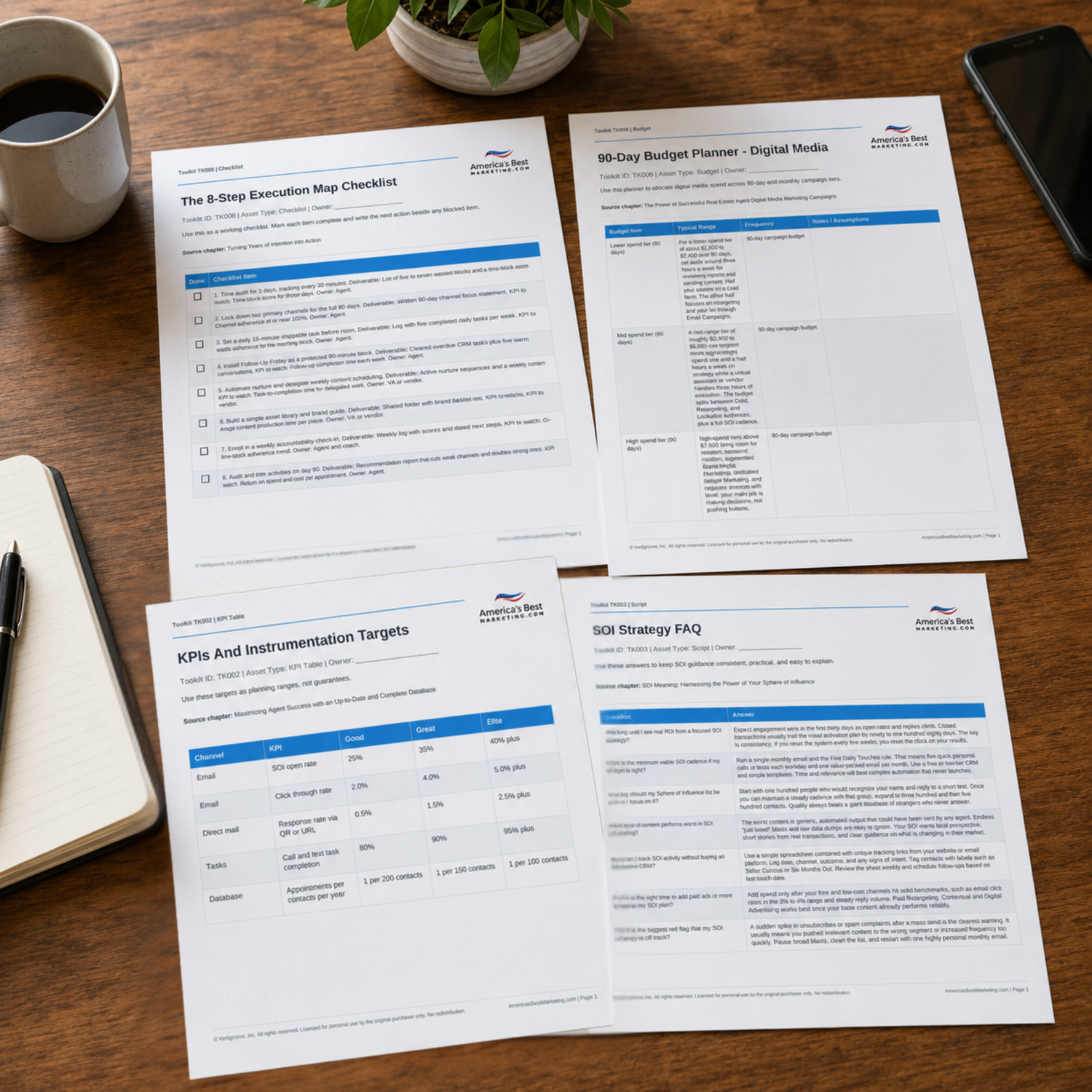
Download The Website Conversion Toolkit
Use the companion Toolkit to turn the eight-week website conversion plan into a practical working file with budget decisions, conversion actions, KPI targets, FAQs, and messaging prompts.
Download the Toolkit ZIPRecommended reads
Recommended Reads for Real Estate Agents
These articles help agents connect follow-up discipline, database habits, client communication, and marketing execution into a repeatable system.

Real Estate Agent Website Must-Haves: From Header to Footer (Checklist)
Turn website must-haves into a steady operating habit, not another item that waits for a quiet week.
Read article
High-End Buyer/Seller Tech Stack: Tools and Systems Luxury Agents Use
Create more leverage from high-end buyer/seller tech stack with a clear path from attention to follow-up.
Read article
Why Every Real Estate Agent Needs an IDX-Integrated Website
Use IDX-integrated websites to create a stronger bridge between client education and real conversations.
Read article
The Power of High-Quality Marketing Design vs. Static and Dated
Turn the power of high-quality marketing design vs. static and dated into a steady operating habit, not another item that waits for a quiet week.
Read articleWebsite Conversion Questions Agents Should Be Ready To Answer
What makes a real estate website high converting?
A high-converting real estate website loads quickly, explains who the agent helps, gives visitors a clear next step, and makes it easy to request help. The strongest sites combine useful content, simple forms, IDX search, trust signals, and follow-up systems.
How do I know if poor website design is costing me clients?
Look for warning signs such as slow mobile load time, low form submissions, high bounce behavior, confusing navigation, weak calls to action, and outdated content. If traffic is arriving but few visitors contact you, the site may have a conversion problem.
Should agents redesign the whole site or fix conversion first?
Most agents should fix conversion first unless the platform is broken or outdated. Better offers, faster pages, clearer forms, stronger headlines, and cleaner IDX navigation can improve results without a full redesign.
What website metrics should real estate agents track?
Start with monthly visitors, form completion rate, landing page bounce behavior, source of leads, and cost per lead from paid campaigns. These metrics show whether the site is moving people toward a real conversation.
How important is IDX for website conversion?
IDX matters when it helps buyers search easily and when lead routing supports fast follow-up. IDX alone will not fix weak messaging, slow pages, or unclear calls to action, but it can strengthen buyer engagement when the rest of the site is clear.
What content helps an agent website perform better?
Useful local content tends to perform better than generic real estate articles. Neighborhood pages, seller guides, buyer checklists, market updates, listing preparation resources, and practical FAQs help visitors understand your expertise and stay on the site longer.
How often should agents review their website?
Agents should review key website numbers monthly and review the full site at least quarterly. A simple monthly check of speed, forms, traffic, top pages, and lead quality is usually enough to catch problems before they cost opportunities.
Next step
Build the System Behind the Advice
Continue from one useful article into the larger ABM ecosystem: the book series for strategic depth and the full marketing program for done-for-you execution.

View the Book Series
Explore the America’s Best Real Estate Agent Marketing System books for a deeper strategic framework around visibility, referrals, listings, lead generation, and growth.
View the Book Series
See Full Marketing Program
See how AmericasBestMarketing.com runs real estate blog writing, social media, listing marketing, email, direct mail, and retargeting as one managed system.
See Full Marketing Program