A Step-by-Step Guide to Marketing Your Listings Online for Maximum Exposure
Market Your Listings Online
A Seven Day Launch Plan for Maximum Exposure
A listing marketing briefing for real estate agents who want every property launch to create buyer activity, seller confidence, and future listing proof.

How real estate agents should market listings online
Start with one strong IDX listing page, then drive every channel back to that page through email, social, retargeting, direct mail, and seller updates. A seven day listing launch works because it gives each property a clear traffic source, a clear conversion path, and a clear reporting rhythm before the listing loses momentum.
- A listing launch starts before the MLS upload with one central page, one audience plan, and one seller-facing reporting framework.
- The strongest campaigns use IDX, email, digital retargeting, social media, direct mail, and follow-up as one coordinated system.
- Short listing videos should sell the first click while the listing page carries the full gallery, map context, showing request, and lead capture.
- Seller reports should focus on visitors, ad clicks, leads, showings, and next adjustments so every launch becomes proof for the next listing appointment.
Why Listing Marketing Has To Become A System
Strong listing marketing turns a single property into two wins: a better sale process for the current client and a visible case study that helps attract the next seller. The agents who win listings consistently do not rely on one post or one portal upload. They build a repeatable launch rhythm that makes the seller feel informed and makes the market see the property from more than one angle.
The biggest mistake agents make is treating the MLS upload as the starting line. Real listing marketing starts earlier with a clear objective, a defined audience, and one central place online where all roads lead. That center should be your listing page on your IDX Real Estate Websites platform, not a rented portal page where follow-up control disappears.
When the process is built correctly, every touchpoint works harder. Social media creates attention. Email activates the database. Retargeting brings visitors back. Direct mail reinforces the launch inside the neighborhood. Seller reporting turns activity into proof. That is the difference between a listing post and a listing marketing system.
- You give sellers confidence because they can see what is happening after the sign goes in the yard.
- You capture buyer and neighbor interest on your own site instead of losing the audience to third-party platforms.
- You create a documented launch story that future sellers can understand during a listing consultation.
Build The Listing Page Before You Buy Attention
Your listing page is the campaign hub. It needs fast load speed, clean lead capture, and copy that speaks to the lifestyle of the buyer and the proof of process that future sellers care about. Square footage matters, yet the better opportunity is to explain why this address, this neighborhood, and this timing make sense.
Before you post, email, mail, or advertise, set the campaign architecture. Create one page, one set of tracking tags, and one follow-up path. Then push every channel toward the same destination so you can read the numbers without guessing.
Make one destination carry the launch
Build one landing page per listing with a full gallery, price context, neighborhood copy, showing request, and a short form that asks only for name, email, and phone.
Use at least five hundred words of local copy when the listing supports it. Include nearby amenities, commute patterns, lifestyle details, and the most useful buyer questions.
Keep every inquiry organized
Tag every new inquiry by listing name, price band, and intent. This lets your follow-up feel specific instead of generic when buyers, neighbors, or future sellers respond.
Use simple source tags for email, social, direct mail, retargeting, and QR scans so seller reports show which channels are doing the work.
Choose the streets that should remember you
Decide which streets, buildings, or neighborhoods you want to influence before the listing goes live. Your mail, social, and ad language should all reinforce that local proof.
Use the listing as a live demonstration of how you market homes in that area, not merely as an announcement that the property is available.
Many agents celebrate the moment a listing hits the MLS when the real leverage lives in the forty eight hours before launch. Use that window to build the page, confirm pixels, prepare the seller report format, and test the form before the first buyer click arrives.
The Seven Day Listing Launch Playbook
The seven day launch turns one listing into a flywheel. Days one and two build assets and segments. Days three through five push the listing across email, ads, social, and the neighborhood. Days six and seven focus on live conversations and a hard review of the numbers.
The point is discipline, not drama. Each phase has a specific owner, deadline, and deliverable so that you never fall back into a post-and-pray routine. For creative ideas that help the listing rise above the feed, study Screen Appeal Is the New Curb Appeal: How Real Estate Agents Can Create Viral Listings and then plug the strongest ideas into this framework.
Collect photography, video clips, property details, neighborhood notes, seller-approved claims, and showing logistics. Build the listing page, confirm the retargeting pixel, test the lead form, and make sure each form submission flows into the right CRM list.
Launch the MLS entry, publish the IDX page, send the just listed email, start Digital Retargeting, schedule the first Social Media Marketing wave, and approve the farm mailer with a QR code to the listing page.
Days six and seven are where the launch becomes accountable. Use a reminder email and social stories to push buyers toward showings or an open house. Then spend one focused hour inside your reporting. Review traffic by source, cost per lead, showing requests, and lead quality. Adjust spend toward what is working and summarize the movement for your seller.
The same discipline that powers this launch is what turns listing results into future seller appointments. Tie every campaign back to the strategic ideas in How to Get Listings as a New Agent: Proven Strategies to Win Seller Clients Fast so every launch feeds your next listing conversation.
Three Listing Launch Scripts That Sell The Click
Listing scripts should create curiosity fast, then move the viewer to your listing page. Keep the video short, keep the promise specific, and make the call to action easy to follow.
The quick tour under fifteen seconds
Agent dialogue
Hook lineThis is the listing buyers chase before it hits every major portal.
Middle lineLook at the light, the flow, and the room that makes this home feel bigger than the photos suggest.
CTA lineTap for price, full gallery, and showing times on my site.
Use one exterior push, three quick room cuts, one detail shot, and one final wide shot with the CTA on screen.
The problem and solution tour
Agent dialogue
Hook lineTired of homes that look great online but feel cramped in person?
Build lineThis layout gives you real breathing room, storage that fits daily life, and a yard that works for people and pets.
CTA lineTap to see the floor plan, full gallery, and tour times while this one is still available.
Start with the buyer fear, prove the solution with quick b roll, then send the viewer to the IDX page for the full detail set.
The hidden feature and local gem spotlight
Agent dialogue
Opening lineThis home has a feature most listings in this price range miss.
Reveal lineHere is the flex space that can work as an office, gym, or guest room without a remodel.
Local lineYou are also minutes from the local spots buyers ask about first.
CTA lineTap to see the map, photos, and available tour times.
Pair the interior reveal with a quick neighborhood shot so the listing feels rooted in a real lifestyle, not just a room count.
Production Plans You Can Repeat
Every listing does not need the same budget, but every listing should have the same operating logic. Match the plan to the price point, seller expectations, and competitive pressure, then report on the same metrics each time.
Budget eight hundred to one thousand two hundred dollars for a thirty day run. Goal is to fill the calendar with quality showings for entry and mid price listings. Audience is your buyer database and a two mile farm around the property. Creative is one quick tour script cut into vertical video plus one branded image. Headline is This home could be yours this season and the call to action is Tap to see price, photos, and available showing times.
Budget one thousand five hundred to three thousand dollars for higher price or highly visible listings. Goal is to maximize exposure and use the campaign as a seller-facing case study. Audience is warm buyers, retargeting audiences, and the surrounding one thousand home farm. Creative is two videos and one carousel that explain the price story. Call to action is Book a private tour or request a pricing consult.
Use Direct Mail Marketing when the neighborhood itself is part of the opportunity. A well-timed card can make nearby homeowners aware that you are actively marketing in their area, not just managing an online post. Use Email Campaigns to activate your database and give warm prospects a direct path to the listing page.
KPI Table For Listing Marketing
KPI tracking keeps emotion out of your listing conversations. You can walk into every seller update with three simple numbers: visitors to the listing page, clicks from ads, and showings booked from captured leads.
Use the benchmarks below as a dashboard, not a promise. They show typical ranges for an organized launch when the listing page is strong and the budget is focused. If your numbers fall below these ranges, adjust creative, shift spend between channels, or tighten your farm instead of guessing which lever to pull.
| Metric | What It Tracks | Target Range | Action When Off Target |
|---|---|---|---|
| Page visits | Unique visitors to the listing page. | 500 to 1,000 | Increase budget or widen targeting if the count falls short in the first week. |
| Ad clicks | Clicks from paid ads to the listing page. | 0.8% to 1.5% | Kill weak creative and shift spend toward any ad that performs above the range. |
| Showings | Confirmed showings booked from captured leads. | 10% to 20% | Improve scripts, speed to lead, and follow-up offers if the rate drops under the range. |
Ten Step Listing Optimization Checklist
Use this checklist before launch and again after the first week. The goal is to catch weak links early, when there is still time to improve traffic, lead capture, and seller confidence.
- Confirm that listing photos are bright, level, consistent, and fast to load on the listing page.
- Check that the IDX page includes neighborhood names, nearby amenities, and lifestyle hooks buyers actually search for.
- Verify that the retargeting pixel and custom audiences are growing every day the campaign runs.
- Test the lead form and confirm that new contacts drop into the correct email sequence without manual work.
- Review ad frequency and widen targeting if the same audience sees the ad too often in one week.
- Track calls, form fills, and QR scans from every direct mail piece inside the CRM.
- Score the last five leads on a simple one to three scale and note which channel sends the highest quality prospects.
- Trigger a price and copy review if unique site traffic drops under fifty visits across a full week while the home is active.
- Audit every ad and email for clear disclaimers, Fair Housing compliance, and accurate property representation.
- Prepare a weekly seller report that covers visitors, leads, showings, and the next adjustment.
Compliance And Ethical Guardrails
Trust in your listing marketing starts with accurate representation. Every photo, line of copy, and price statement needs to match the property that buyers will see when they walk through the door. Clear details build confidence and protect the seller relationship.
Fair Housing rules apply to every ad and mail piece. Target by location and property interest, not by who you think the ideal buyer is. Use inclusive language in headlines and avoid any phrase that hints at preference for a specific group. Strong marketing respects the rules and still stands out.
- Do not imply features, boundaries, school assignments, or permitted uses that have not been verified.
- Do not use audience targeting that creates exclusionary or discriminatory patterns.
- Do document seller approvals for claims, photos, pricing language, and promotion timing.
- Do keep all listing creative consistent across MLS, IDX, ads, email, social, and direct mail.
Case Study: The Launch That Won Two More Sellers
In one premium campaign, an agent invested two thousand five hundred dollars into ads, mail, and email around a single high value listing. The launch generated thousands of impressions, more than eight hundred unique visitors to the listing page, and dozens of leads.
The direct win was buyer activity. The larger win came from nearby owners who watched the process unfold. Two homeowners requested pricing consults because they could see a documented marketing plan at work in their own neighborhood.
Your results will vary, but the pattern is clear. Disciplined exposure does more than sell the current home. It shows future sellers what your marketing actually does.
Turn Every Listing Into A Seller Magnet
Listing marketing is not about posting more. It is about building a simple process that runs the same way every time and that your seller can see on paper. The seven day launch gives you that structure and makes every property a micro campaign that feeds the next one.
Run this system with your own brand and you stop sounding like every other agent in the neighborhood. Prospects remember the way you launch, not only the price you suggest. That memory is what fills the top of your pipeline with future listing consultations.
If you want this seven day listing launch run for you, not by you, AmericasBestMarketing.com can build the same structure through Listing Marketing, Social Media Marketing, Email Marketing for Real Estate Agents, direct mail, and digital retargeting so every property launch reinforces your brand.
Download The Listing Launch Toolkit
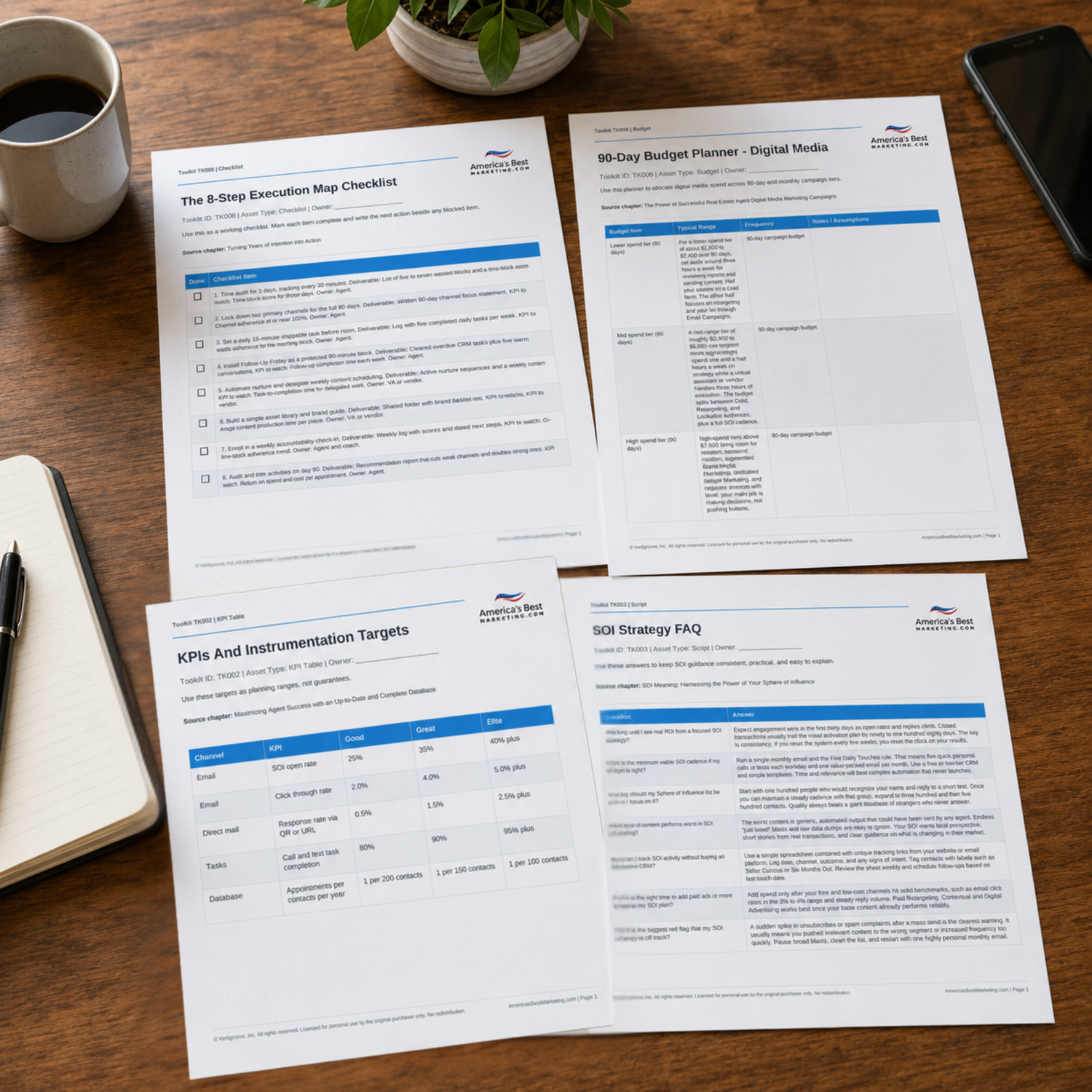
Use the TK040 implementation Toolkit to turn this listing marketing plan into working campaign assets, including the seven day launch plan, budget models, KPI benchmarks, optimization checklist, FAQ content, and three listing launch script resources.
Download the Toolkit ZIPRecommended reads
Recommended Reads for Real Estate Agents
These articles help agents connect listing visibility, seller education, marketing channels, and follow-up into a clearer growth system.

Listing Agent Marketing: A Comprehensive Guide to Securing More Listings
Make listing marketing easier to plan, publish, and measure as part of a weekly marketing rhythm.
Read article
How to Choose the Right Real Estate Agent
Make “How to choose the right real estate agent” more useful by turning the topic into a clear buyer-and-seller education resource with a defined audience, message, and next step.
Read article
Tax Benefits of Investment Property: Real Estate Agent Talking Points + Investor Content Angle
Make tax benefits of investment property more useful by tying the message, audience, and next step together.
Read article
Full-Service vs DIY Marketing: What Works
Create more leverage from full-service vs diy marketing with a clear path from attention to follow-up.
Read articleListing Marketing Questions Agents Should Be Ready To Answer
What is the minimum listing marketing plan I can run on a tight budget?
Start with a strong IDX listing page, a single just listed email to your database, and one remarketing campaign that sends traffic back to that page. Use a small test budget for the first week and measure visitors, leads, and showings. When those three numbers move in the right direction, add direct mail or an extra ad set instead of guessing.
How long should I keep my listing launch running?
The seven day launch covers the most intense period of exposure, not the full life of the listing. Keep your core campaigns live until the property is pending, but adjust cadence after the first two weeks. Shift spend away from cold traffic toward retargeting as the audience builds and refresh creative if click through rates start to slide.
How much should I spend on ads for one listing?
For most markets, an eight hundred to three thousand dollar budget over thirty days is a practical range. Lower price listings lean toward the lower end while luxury or high visibility properties justify more. The real test is cost per lead and showings booked. If leads are high quality and costs are reasonable, maintain or increase spend with confidence.
Do I need video to market my listings effectively?
Short video is no longer optional if you want full exposure. You can shoot effective clips on a modern phone with simple movement, strong light, and clear audio. Use video to create motion that stops the scroll and then send viewers to the listing page where the full gallery and details live.
How does listing marketing help me win more seller clients?
Every launch is a live case study. When you run a clear seven day plan with email, ads, and mail, you generate charts that tell a story. Show future sellers how many visitors, leads, and showings their neighbor received from your process. Sellers hire the agent with a documented system, not the one with the loudest promise.
What is the biggest mistake agents make with listing ads?
The biggest mistake is sending traffic to portals instead of your own site. When you rent traffic from a portal, you lose control of follow up and cannot see which channels really worked. Send ad clicks and QR scans to your IDX listing page so that every visitor becomes part of an audience you can nurture over time.
Can I reuse this seven day plan for different price points and property types?
Yes. The channels and sequence stay the same while the story and budget change. Entry level homes may lean on social and email, while luxury homes use heavier retargeting and direct mail. The important part is to keep the structure intact so that you can compare campaigns over time and show sellers a consistent, professional launch process.
Next step
Build the System Behind the Launch
Continue from one useful article into the larger ABM ecosystem: the book series for strategic depth and the full marketing program for done-for-you execution.

View the Book Series
Explore the America’s Best Real Estate Agent Marketing System books for a deeper strategic framework around visibility, referrals, listings, lead generation, and growth.
View the Book Series
See Full Marketing Program
See how AmericasBestMarketing.com runs real estate blog writing, social media, listing marketing, email, direct mail, and retargeting as one managed system.
See Full Marketing Program