Real Estate Agent Social Media Marketing Strategies: What Works, What Doesn’t, and What Actually Attracts Clients
Real Estate Social Media That Attracts Clients
What Works, What Doesn’t, and How to Build a Repeatable Eight-Week System
A practical social media marketing briefing for agents who want consistent local visibility, stronger audience trust, and more real conversations without chasing vanity metrics.

What actually makes real estate social media work
Effective real estate social media is a consistent visibility system, not a hunt for one viral post. Rotate useful education, listing proof, community knowledge, and personal brand content. Publish on a dependable schedule, respond while interest is fresh, and measure saves, shares, profile visits, direct messages, and link clicks so attention can become real client conversations.
- A repeatable weekly cadence builds more trust than short bursts of high-volume posting.
- Education, listings, community, and personal brand create a balanced content system.
- Short video works because it shows market expertise and personality at the same time.
- Saves, shares, profile visits, direct messages, and link clicks reveal more than likes alone.
The Non-Negotiable Rules for Effective Social Media
Real estate social media marketing is the daily habit of publishing branded, useful content so your market sees you as a steady guide, not the loudest voice. The goal is visibility that compounds until people who have followed you for months feel comfortable starting a conversation when a move becomes real.
The simplest content rotation has four pillars. Education teaches the move. Listings show what is possible. Community content proves you know the streets and local stories. Personal brand content reminds people that a real person stands behind the advice. This article extends the framework in Social Media Strategies for Real Estate Agents: Proven Tips to Attract More Clients and Sell More Homes.
- Do not fill the feed with only new listings and sold signs. That turns your presence into a repetitive sales flyer.
- Do not post once every few weeks. Followers forget your name when the cadence disappears.
- Do not rotate random fonts, colors, and visual styles. Recognition depends on consistent brand cues.
- Do not ignore short video. It is one of the clearest ways to show personality and market expertise.
- Do not leave comments and direct messages unanswered for days. Warm interest cools quickly.
The Eight-Week Social Media Launch Playbook
Treat social media like a launch, not a vague intention. Eight focused weeks can move the business from scattered posts to a system with a calendar, defined roles, repeatable assets, and basic performance tracking. Social should sit alongside email, the website, direct mail, and follow-up instead of trying to replace them. For the channel comparison, review Social Media vs Multi-Channel Marketing for Real Estate Agents.
Consolidate the platforms and define the pillars
Choose two primary platforms, clean up every profile, confirm contact details, and align the call to action with the current lead path.
Build topic banks under education, listings, community, and personal brand. Create at least five usable ideas under each pillar before design begins.
Lock the brand and build the calendar
Choose two brand colors, one heading font, one body font, and one strong headshot so every post feels connected.
Plan three to five posts per week for the next month. A partner focused on Social Media Management for Real Estate Agents can handle design and scheduling while you approve the message.
Install the response rhythm and listing templates
Block fifteen minutes each day for comments, direct messages, and warm-conversation notes. Speed and personality matter most here.
Create branded templates for just listed, just sold, pending, and open house posts. Connect the rhythm to your Listing Marketing system.
Connect retargeting and establish the baseline
Confirm the website can build audiences from social traffic before paid promotion becomes necessary. This gives future Digital Retargeting a stronger data foundation.
Review reach, engagement, profile visits, direct messages, and link clicks. Write one decision for the next month based on the pattern.
Share rate is a valuable signal because people share educational and community content when it helps them look informed or useful to their own network. A post that travels through local relationships can matter more than a post that collects passive likes.
After the first eight weeks, repeat the cycle with better data. You will know which posts earned saves and shares, which hooks pulled real comments, and which topics started direct messages from people in your market.
- Pick two primary platforms and make every profile detail match.
- Define the four content pillars with real topic lists.
- Lock colors, fonts, and one headshot across the visual system.
- Schedule at least three posts per week before the week begins.
- Respond to comments and direct messages while interest is fresh.
- Move every new listing into the social templates as soon as photography is ready.
- Verify that the website tracks visits to key lead-capture pages.
- Review analytics monthly and document one change for the next cycle.
Three Ready-to-Use Short-Form Video Scripts
Scroll-stopping content does not require special effects. It requires a clear hook, one useful idea, and a next step that feels easy. Keep the structure, then change the property, street, price range, or client question. For platform-specific tactics, review How to Use Instagram Reels and TikTok for Real Estate Leads.
The house that almost sells itself
Agent dialogue
Hook lineThis is the feature buyers text me about before they even tour this house.
CTA lineSend me the word tour and I will send you the link and full details.
Open on the exterior, cut quickly to the standout feature, show how it connects to the room, and close on your face or logo with the message prompt.
The problem-and-solution education post
Agent dialogue
Hook lineMost buyers in this price range miss the same small detail before they write an offer.
Build lineHere is the one thing I ask clients to confirm so they avoid surprise costs after closing.
CTA lineSave this for later, then message me when you want a full cost breakdown for your own search.
Use a direct-to-camera opening, a quick visual of the problem, a checklist or screen recording for the solution, and a soft invitation to continue privately.
The hidden feature and local gem reel
Agent dialogue
Hook lineFrom the street this looks like every other house on the block, but there is one surprise inside.
Build lineThis feature changes how a family actually lives in the space.
CTA lineSend me the word list and I will share a short list of hidden-gem streets like this.
Walk from the sidewalk to the front door, reveal the feature slowly, add one neighborhood clip, and end with the direct-message prompt.
Use soft calls to action when you want people to stay in scroll mode, such as save this for later or share this with a friend. Use mid-level calls when you want private conversations, such as message me the word market. Reserve hard calls for a small share of posts where the viewer is invited to request a seller consultation or strategy session.
Production Plans, Budget Levels, and KPIs
You do not need a studio schedule to win on social. You need production habits that match the calendar and the available budget. Once design and scheduling support are in place, the agent’s highest-value work is to show up on camera, approve copy, and stay present in comments and direct messages.
Reserve one hour each week to film one short tour, one education tip, and one local moment on your phone. Use simple templates, schedule three posts per week, and place most of the emphasis on education and community with one listing feature.
Reserve ninety minutes each week to record two short videos and approve carousel templates built by a marketing partner. Maintain a four-post cadence and boost only the strongest posts after saves, shares, and direct messages show what resonates.
| Tier | Agent Role | Monthly Spend | What This Supports |
|---|---|---|---|
| Low commitment | You script, film, and post every piece. | $0 to $100 | The feed stays active with simple posts and basic use of free design and scheduling tools. |
| Mid commitment | You approve copy and engage with followers. | $150 to $450 | Branded templates, regular posting across two platforms, and light boosting of the strongest posts. |
| High commitment | You focus on video and strategy calls. | $700 to $1,500 | Full content design and scheduling with frequent posting and close integration with listings. |
Measure the Signals That Predict Real Conversations
Budget is only one side of the equation. The other is instrumentation. Decide how success will be measured before the content ships so vanity metrics do not control the strategy. Four numbers matter most for agents who want listing and referral volume from social: engagement rate, profile clicks, direct-message lead count, and content share rate.
Platform analytics already show these signals. Review engagement at the post level, profile visits on a weekly view, link taps from the profile, and direct messages tied to specific posts. The goal is not one universal benchmark. The goal is a rising number of saves, shares, profile visits, and private conversations from the same local audience month after month.
Social works best when it feeds channels the business controls. Move warm attention into the website, connect it to Email Marketing for Real Estate Agents, and use consistent follow-up so the audience does not disappear when an algorithm changes.
Fair Housing, Advertising, and Lead-Data Discipline
Keep every piece of content inside Fair Housing rules. Use inclusive language and a wide mix of people in visuals. Avoid steering language about schools or who should live in a particular area. Label paid promotion clearly in line with platform and advertising requirements.
Protect lead data collected from social by using secure forms on your own website instead of random links in direct messages. The trust created by helpful content can disappear quickly when the follow-up path feels careless or the data request feels unnecessary.
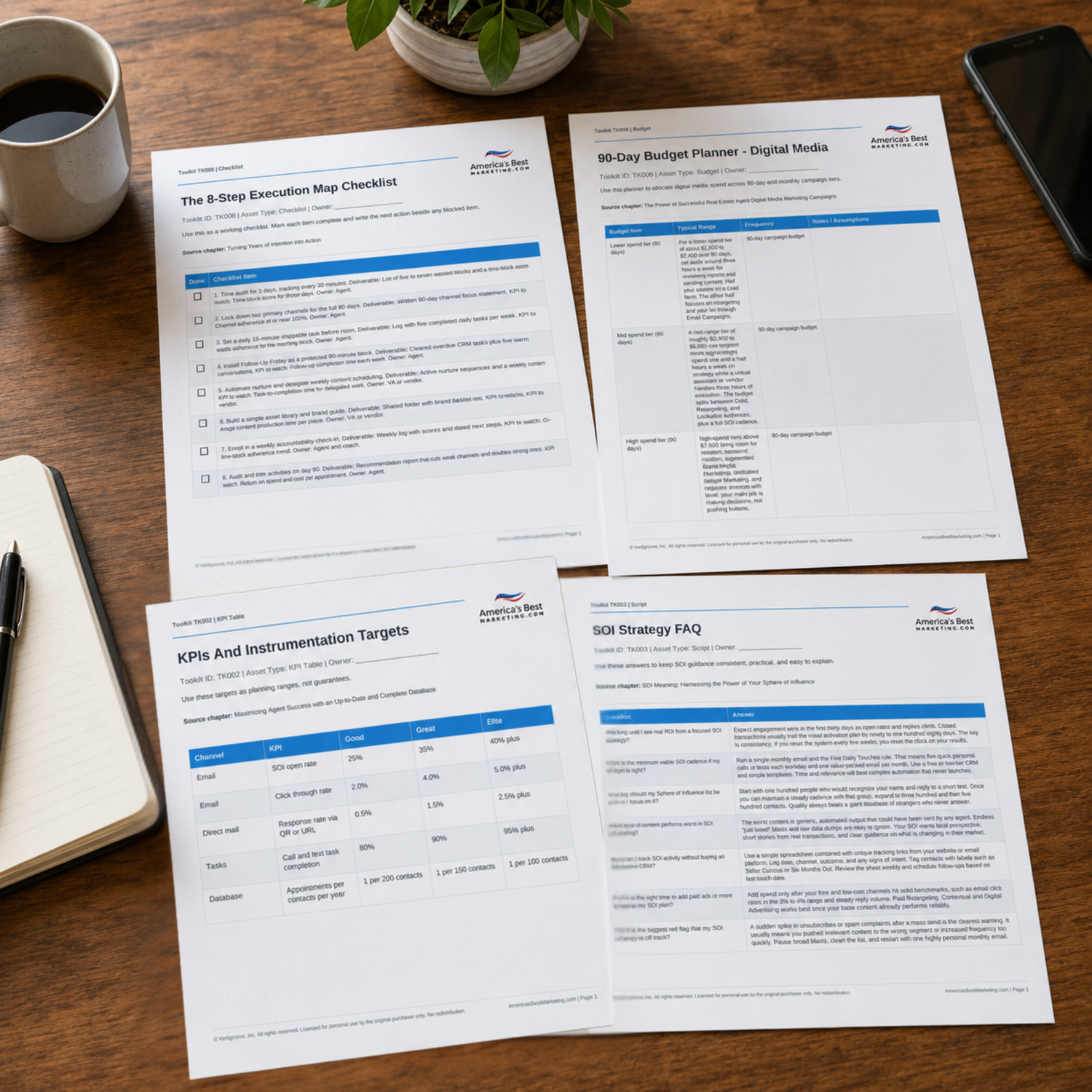
Download the Social Media Launch Toolkit
Use the companion ZIP to plan the eight-week rollout, map weekly production, track engagement and lead signals, compare budget levels, and keep three repeatable short-form video scripts ready for the next content session.
Download the Toolkit ZIPContinue the Strategy
Recommended Reads for Real Estate Agents
These articles help agents connect follow-up discipline, database habits, client communication, and marketing execution into a repeatable system.

Social Media vs Multi-Channel Marketing for Agents
Turn social media into a local visibility system instead of a stream of disconnected posts.
Read article
Hyper-Local Content Kit for Real Estate Agents: Parks, Events, Map Posts
Turn local knowledge into searchable content buyers, sellers, and relocation prospects can actually use.
Read article
Investor Content for Real Estate Agents: Build a Real Estate Investment Portfolio Series That Attracts Clients
Make investor content easier to plan, publish, and measure as part of a weekly marketing rhythm.
Read article
The Power of Successful Real Estate Agent Social Media Campaigns
Turn social media into a local visibility system instead of a stream of disconnected posts.
Read articleReal Estate Social Media Questions Agents Ask Most
How long should I expect to run a social campaign before seeing a closed transaction?
Plan on at least three to six months of consistent posting before you expect a closed deal that you can clearly trace to social. First you build awareness, then trust, then private conversations, and only then contracts. Treat social as a visibility engine that feeds your pipeline rather than a quick transaction lever.
What is the minimum viable posting cadence if my budget is extremely tight?
Aim for three quality posts each week on one main platform and one mirror post on your second platform. One post should teach, one should highlight a listing or buyer story, and one should feature a local spot or your personal brand. Consistency at this level beats short bursts of daily posting that fizzle out.
What is the biggest red flag that suggests my social media strategy is failing?
The clearest warning sign is a flat or shrinking audience combined with almost no saves, shares, or direct messages. A feed full of templated posts that never generate comments from people in your market is a second warning sign. When this happens, reset your pillars and focus on education and community content that answers real questions clients ask every week.
Should I be posting more listing photos or educational videos?
Educational video usually wins over raw listing photos because it gives followers a reason to stay long term. Use listings as proof and context instead of the entire story. A healthy mix might look like two education videos, one community feature, and one listing highlight in a typical week.
How do I track which social platform gives me the most leads without complex software?
Start with a simple tracking sheet and add a field in your intake form that asks where a client found you. Inside each platform, watch profile visits, link clicks, and direct messages. Over time you will see which platform produces real conversations and you can shift more effort toward that channel.
When should I consider running paid ads instead of focusing only on organic content?
Paid ads make the most sense once you have a clear message, a consistent organic feed, and at least one lead capture path that already works. Use a small budget to boost your highest performing posts or to send traffic to a strong seller or buyer guide. That way your ad spend amplifies what already resonates instead of trying to fix weak content.
Is Instagram or Facebook better for connecting with hyper-local sellers?
Both can work, so the better choice is usually where your past clients actually spend time. Instagram tends to reward short video and polished visuals, which suits education and lifestyle content. Facebook groups and pages can work well for neighborhood updates and long-form posts. Pick one to lead, mirror key posts to the other, and keep testing where conversations begin.
Next step
Build the System Behind the Content
Continue from one useful article into the larger ABM ecosystem: the book series for strategic depth and the full marketing program for done-for-you execution.

View the Book Series
Explore the America’s Best Real Estate Agent Marketing System books for a deeper strategic framework around visibility, referrals, listings, lead generation, and growth.
View the Book Series
See Full Marketing Program
See how AmericasBestMarketing.com runs real estate blog writing, social media, listing marketing, email, direct mail, and retargeting as one managed system.
See Full Marketing Program