Best Real Estate Marketing Ideas: 15 Innovative Strategies to Attract More Clients
Best Real Estate Marketing Ideas
15 Strategies to Attract More Clients
A practical ninety day protocol for real estate agents who want steadier lead flow, cleaner follow-up, stronger local visibility, and a marketing system they can actually repeat.

Best real estate marketing ideas, organized into a repeatable system
The best real estate marketing ideas are not isolated tactics. They work when your website, search content, email, direct mail, social media, listing promotion, retargeting, and follow-up all point toward the same next step. Start with a strong sphere, build an owned hub, capture attention with useful local offers, and measure which channels create real conversations.
- Random tactics create noise. A coordinated marketing ecosystem creates a cleaner path from attention to conversation.
- Your website, tracking, buyer guide, seller guide, database, and follow-up cadence should be in place before you increase promotion.
- The practical launch window is ninety days: setup in month one, visibility in month two, refinement in month three.
- Every campaign should do one of three jobs: drive attention, capture attention, or convert attention.
Why These Marketing Ideas Work Better As A System
Most agents do not need more marketing ideas. They need fewer disconnected moves and more operating discipline. A modern marketing ecosystem gives every channel a job. Your site becomes the hub. Search content, email, social media, direct mail, listing campaigns, and Retargeting & Contextual Ads become the spokes.
That structure matters because buyers and sellers rarely act after one exposure. They notice an article, see a social post, receive an email, scan a postcard, come back through a retargeting ad, and finally raise their hand when the offer feels useful. The system creates repetition without making the agent sound desperate.
The strongest starting point is still the sphere. People who already know your name are easier to activate than strangers. That is why a clear explanation of sphere of influence meaning for real estate agents belongs near the front of the plan. Your best marketing often starts with the people most likely to trust the next message.
Sequence is the overlooked leverage. Agents launch content before tracking, ads before offers, or email before segmentation. A better rule is simple: every strategy should either drive attention, capture attention, or convert attention. If it does none of those, cut it.
Build The Marketing Hub Before You Add More Channels
A strong campaign needs an owned destination. That is usually an IDX-enabled website, a focused landing page, a guide download, a valuation request, or a local market page. Without a hub, traffic leaks into platforms you do not control and follow-up becomes harder to measure.
Start with IDX Real Estate Websites, tracking, and a clean offer. Then support that hub with local search content and channel-specific prompts. The goal is not just to look polished. The goal is to know where attention came from, what message created the hand raise, and which follow-up should happen next.
Give every campaign one useful destination
Build pages that answer a practical question, invite a guide download, request a valuation, or route visitors into property search. A fast hub makes every other channel easier to measure.
Match the message to intent
A homeowner farm, past client list, active buyer audience, and retargeting pool should not all see the same message. Better segmentation makes the call to action feel timely.
Convert the hand raise quickly
Lead flow only matters when the next step is clear. Use tags, reminders, email sequences, and a short call script so a new inquiry does not sit in the dashboard untouched.
The 90 Day Protocol For 15 High Impact Strategies
These fifteen strategies work best when they launch in sequence. Treat the first month as setup, the second month as visibility, and the third month as refinement. That rhythm keeps the workload manageable and prevents the plan from becoming another oversized idea list.
- Build a fast IDX hub. Your website should be the place every campaign lands, with clear calls to action and useful property search tools.
- Install tracking before promotion. Use pixels, analytics, and UTM links before you spend more money so you can see what happens after the click.
- Own local search with your Google profile. Complete categories, service areas, reviews, photos, and short updates create quick local trust signals.
- Create a buyer guide that earns the hand raise. Make it practical, local, and short enough to finish so early stage buyers have a reason to identify themselves.
- Create a seller guide that frames your process. Explain pricing, preparation, timing, and expectations before the listing conversation becomes a pitch.
- Launch a tight direct mail farm. Start small and repeat to one neighborhood, price band, or service area instead of spreading budget too thin.
- Use Direct Mail for Real Estate Agents as a rhythm. One touch is forgettable. A ninety day sequence is easier to remember.
- Build a four week local content calendar. Use recurring themes such as market movement, neighborhood spotlights, buyer friction, seller timing, and client proof.
- Use local SEO to compound authority. Publish useful articles around neighborhoods, price bands, process questions, and market updates that people actually search for.
- Turn testimonials into branded proof assets. Quote cards, closing wins, short stories, and proof posts make your brand feel more credible than generic promotion.
- Segment your database before increasing email volume. Past clients, sellers, buyers, and long term nurture leads need different messages.
- Run Email Marketing for Real Estate Agents with one job per send. One email can educate, another can invite a valuation request, and another can share a market update.
- Standardize your Listing Marketing launch system. Build a repeatable checklist for copy, timing, feature callouts, open house promotion, lead routing, and follow-up.
- Retarget visitors who showed interest but did not act. Most people do not convert on the first visit, so retargeting improves the efficiency of traffic you already earned or paid for.
- Add a review and coaching rhythm. Even good strategies drift without accountability, message discipline, and a decision process for what to keep, cut, or scale.
Used this way, the list becomes an operating plan. Weeks one through four handle site, tracking, search basics, and lead magnets. Weeks five through eight add direct mail, content, testimonials, and email segmentation. Weeks nine through twelve focus on listing discipline, retargeting, and review.
Make Every Offer Easy To Understand
Most real estate marketing underperforms because the message is vague. Buyers and sellers do not need another slogan. They need a clear reason to click, reply, download, request, or call. That means local specifics, cleaner headlines, and one next step at a time.
Use headlines that sound like useful information instead of ad copy. Examples include price tiers holding firm in one neighborhood, what sellers are overlooking before listing, or what smart buyers check before touring homes in a specific area. The point is to sound informed and nearby, not loud.
Goal is to generate seller conversations from owners who are curious but not urgent. Use a market snapshot with one clear chart and one plain language takeaway. Headline: Price Tiers Holding Strong In This Neighborhood. CTA: Request a Quiet Market Valuation.
Goal is to capture buyer leads before they contact three agents at once. Use a short guide with local financing, timing, and inventory notes. Headline: What Smart Buyers Check Before Touring Homes In This Area. CTA: Download the Buyer Guide.
- Soft CTA: Download the buyer guide.
- Soft CTA: Get the local market snapshot.
- Mid CTA: Request a quiet market valuation.
- Mid CTA: Ask for the neighborhood watch list.
- Hard CTA: Schedule your listing strategy call.
- Hard CTA: Book your buyer planning call.
Budget Ranges And KPIs That Keep The System Honest
Your budget should support the sequence, not fight it. The low tier needs consistency and discipline. The mid tier adds reach and better follow-up. The higher tier lets you press harder in a tighter local market with more frequency and stronger service support.
Do not treat these ranges as promises. They are operating ranges that help you prioritize. The right budget depends on your market, production goals, audience size, existing database, creative quality, and follow-up speed.
Spend four hundred fifty to seven hundred fifty dollars per month for ninety days. Use two emails monthly, one direct mail touch monthly, one local content post weekly, and one small retargeting audience with a frequency cap of four to six impressions every seven days.
Spend twelve hundred to twenty two hundred dollars per month for ninety days. Use weekly content, always-on remarketing, two segmented emails monthly, one direct mail touch monthly, and stronger listing campaign support.
| Operating Tier | Monthly Spend Range | Primary Focus | Scoreboard To Watch |
|---|---|---|---|
| Lean system | $300 to $800 | Content creation, basic SEO, organic social growth, and lean direct mail. | Track visits, replies, guide downloads, and appointments by source. |
| Growth system | $800 to $2500 | Targeted retargeting, stronger listing support, and email segmentation. | Track cost per lead, email clicks, site capture rate, and booked conversations. |
| High commitment system | $2500+ | Hyper local reach, premium guides, stronger creative, and broader channel coverage. | Track cost per appointment, repeat response, referral activity, and campaign source quality. |
Compliance And Ethics That Protect The Brand
Fair Housing standards, CAN-SPAM rules, and transparent ad disclosures are not side issues. They protect trust and reduce cleanup later. Keep audience targeting clean, make unsubscribe links obvious, and avoid language that sounds exclusionary, misleading, or too good to be true.
Compliance also protects conversion. The fastest way to lose trust is to overpromise, target carelessly, or make an offer feel like bait-and-switch. Strong marketing should make your process easier to understand, not harder to defend.
A Practical Campaign Pattern
An agent in a competitive local market puts search and lead capture first instead of buying more random reach. They tighten site pages, publish hyper local content, add one practical guide to the homepage, and then use email, retargeting, and direct mail to keep sending people back to that owned hub.
The takeaway is not that one tactic creates a guaranteed outcome. The takeaway is that sequence improves signal. When the hub, offer, audience, follow-up, and tracking all work together, the agent can see which channel is creating real conversations and which activity should be cut, improved, or scaled.
The point is not to add fifteen disconnected ideas to an already busy week. The point is to make fifteen strategies behave like one disciplined marketing machine.
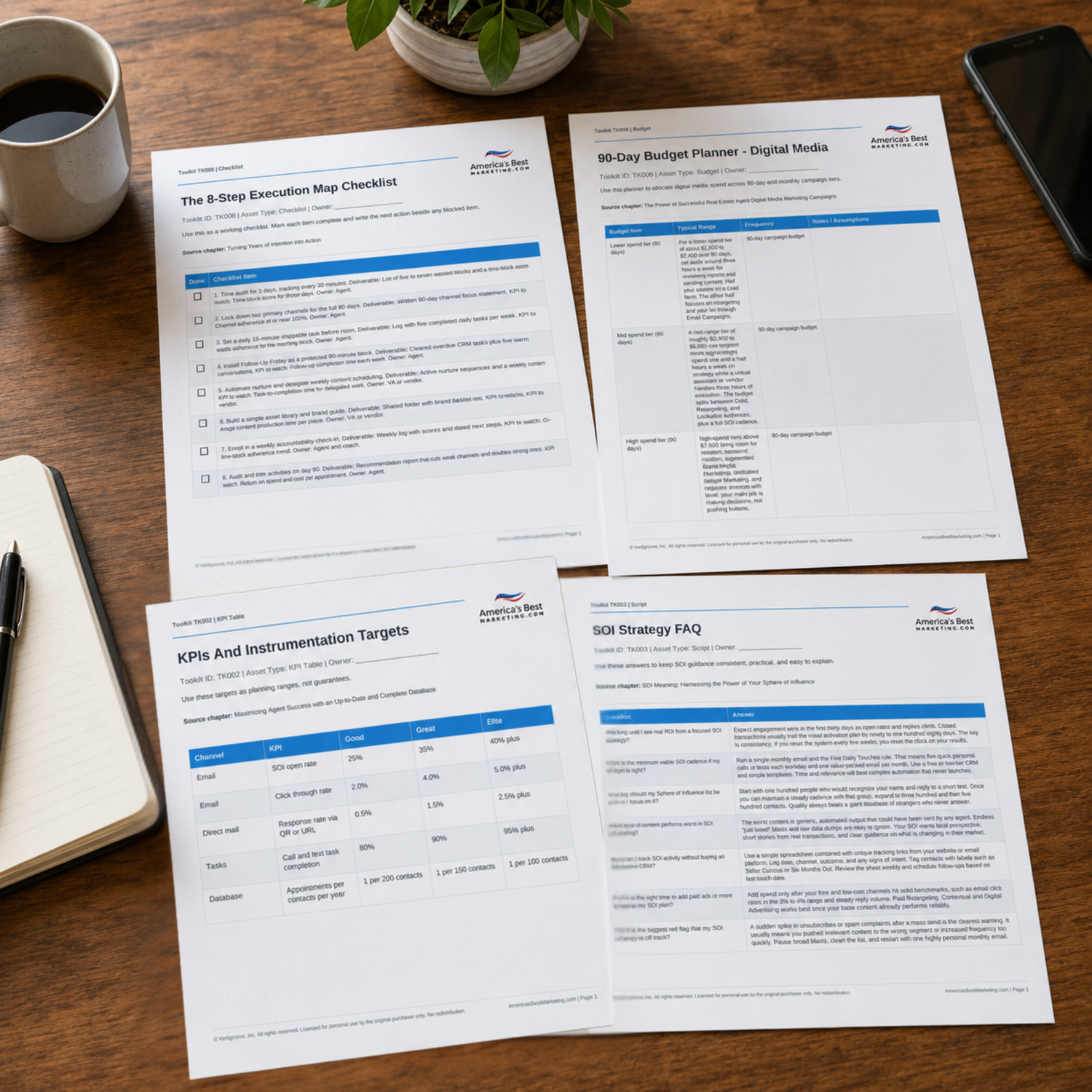
Download The 90 Day Marketing Ideas Toolkit
Use the companion Toolkit to turn the 15-strategy protocol into working campaign assets, planning prompts, tracking steps, and a repeatable ninety day execution rhythm.
Download the Toolkit ZIPRecommended reads
Recommended Reads for Real Estate Agents
These articles help agents connect follow-up discipline, database habits, client communication, and marketing execution into a repeatable system.

Best Marketing for Real Estate Agents: Strategies That Actually Work
Use marketing strategy to strengthen visibility, follow-up, and client conversations without adding more random tasks.
Read article
Property Taxes Explained: Real Estate Agent Cheat Sheet + Client Email Templates
Make property taxes explained more useful by tying the message, audience, and next step together.
Read article
Mastering Real Estate Niche Marketing Ideas: A Guide for Investors to Empty Nesters
Turn personal brand work into a system clients can notice, remember, and trust.
Read article
27 Real Estate Marketing Ideas for Real Estate Agents for Summer
Bring more structure to summer marketing ideas so every touchpoint supports visibility and trust.
Read articleReal Estate Marketing Ideas Questions Agents Ask Most
How long should I wait to see measurable ROI from implementing these strategies?
Give the full system one solid quarter before you judge it. Direct mail, retargeting, and email can show signals faster, but search content, trust building, and database nurture take longer to mature. Review the numbers every two weeks, but make structural decisions after a full ninety day cycle so you are measuring a real pattern instead of a mood swing.
What is the minimum viable marketing cadence if my budget is extremely tight?
Start with one useful local post each week and two emails each month to your sphere and nurture list. Add one small direct mail touch each month to your best farm if budget allows. That is enough to keep your name active across three channels without turning your calendar into a mess. The real key is to hold the cadence, not to make it look bigger than it is.
How big should the target audience or farm be for effective Direct Mail for Real Estate Agents?
For most solo agents, three hundred to five hundred homes is a smart starting range. It is large enough to show signal and small enough to repeat without budget regret. Keep the farm tight, stay in one message lane, and connect the mail piece to a specific online offer so the campaign feels integrated instead of isolated.
What content performs worst or offers the lowest ROI for modern agents?
The weakest content is usually self centered, generic, and disconnected from a next step. Awards with no context, vague motivational posts, and broad market commentary rarely create action. Useful local information performs better because it gives buyers and sellers a reason to remember you. If a post does not help someone decide, compare, or prepare, it is probably just noise.
How do I track my progress without investing in expensive marketing tools?
Use free website analytics, UTM links, your email dashboard, and a clean spreadsheet. Track visits, guide downloads, form fills, calls, and appointments by source. That is enough to show whether search, email, direct mail, or paid traffic is creating real movement. Fancy reporting is nice, but a simple scoreboard used every week beats a premium dashboard nobody checks.
When is the best time to start scaling up my digital advertising spend?
Scale once your message, audience, and landing pages are working together. If lead cost is steady, follow up is fast, and appointments are actually being set, then increase spend in small steps and keep watching quality. Do not scale because impressions look good. Scale when your system can handle more qualified traffic without lowering service quality.
What is the major red flag in a marketing campaign that signals I should stop immediately?
The biggest red flag is rising spend with no movement in real conversations. If clicks climb, forms stay flat, and appointments do not follow, stop and inspect the offer, audience, and landing page. A second warning sign is compliance drift, especially targeting or copy that could create risk. Pause fast, fix the weak link, then relaunch with a cleaner version.
Next step
Build the System Behind the Ideas
Continue from one useful article into the larger ABM ecosystem: the book series for strategic depth and the full marketing program for done-for-you execution.

View the Book Series
Explore the America’s Best Real Estate Agent Marketing System books for a deeper strategic framework around visibility, referrals, listings, lead generation, and growth.
View the Book Series
See Full Marketing Program
See how AmericasBestMarketing.com runs real estate blog writing, social media, listing marketing, email, direct mail, and retargeting as one managed system.
See Full Marketing Program